
Decoding Your Digital Persona: Predicting Personality Traits via Touchscreen Dynamics
The probability of predicting personality traits by the way user types on touch screen
The paper introduces a soft biometric identification framework that predicts personality traits—age-group, gender, handedness, and the number of hands used—by analyzing keystroke dynamics on touchscreen smartphones. Using multiple Machine Learning (ML) classifiers and a specialized Leave-One-User-Out Cross-Validation (LOUOCV) method, the study achieves up to 80% accuracy in certain trait predictions from a single short text input.
TL;DR
Can the way you type on your smartphone reveal your age, gender, or whether you are left-handed? This research demonstrates that "soft biometric" traits can be extracted from simple touchscreen keystrokes with high accuracy (up to 80%). By identifying these traits, the study shows that user recognition systems can become 17% more accurate without requiring any additional hardware.
Background: The Shift to Behavioral Biometrics
As smartphones replace conventional keyboards, the "how" of our digital interaction becomes as important as the "what." This paper positions itself at the intersection of Behavioral Biometrics and Soft Biometric Profiling. Unlike hard biometrics (fingerprints), soft biometrics like age or gender are not unique but provide crucial context that can narrow down an identity in digital forensics, e-commerce, and access control.
The Core Motivation: Solving the "Static Profile" Problem
The primary challenge in keystroke dynamics is the variability of human behavior. Factors like fatigue, illness, or emotion cause typing patterns to drift. Prior works often used standard cross-validation, which the authors argue leads to misleadingly high scores because samples from the same person appear in both training and testing sets. This paper tackles this by leveraging a more rigorous Leave-One-User-Out Cross-Validation (LOUOCV) approach.
Methodology: From Taps to Traits
The researchers focused on the word "Kolkata" typed seven times by 92 volunteers. They extracted five core timing features:
- PR-Time: Press to Release (Duration of a single key tap).
- PP-Time/RR-Time: The interval between consecutive presses or releases.
- RP-Time: The latency between releasing one key and pressing the next.
- Digraph Time: Total time from first key press to second key release.
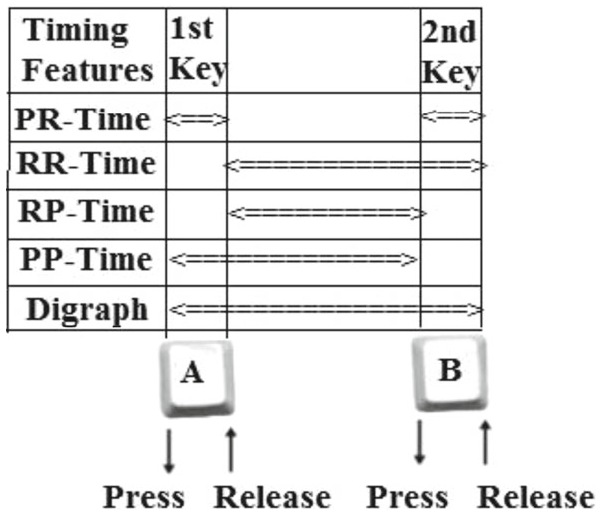 Figure 1: Illustration of the timing intervals (PP, PR, RP, RR) used to define the typing pattern.
The ML Pipeline
The authors didn't rely on a single algorithm. Instead, they used Score Fusion. For instance, they combined Naïve Bayes (NB) and rpart for age prediction, and Random Forest (RF) with C5.0 for determining how many hands the user was using.
Experimental Insights & Results
The findings suggest that our motor patterns are highly indicative of certain demographics.
| Trait | Accuracy | Top Performing ML Ensemble |
|---|---|---|
| Age-group | 80.21% | NB + rpart |
| Hands Used | 78.62% | RF + C5.0 |
| Handedness | 60.59% | NB + rpart |
| Gender | 58.26% | K-nn + rpart |
The study reveals a counter-intuitive insight: Age is easier to predict via touch patterns than gender. While gender recognition remains a "challenging issue" (hovering near 58%), age and hand usage (single vs. double-handed typing) show distinct, learnable clusters in the behavioral data.
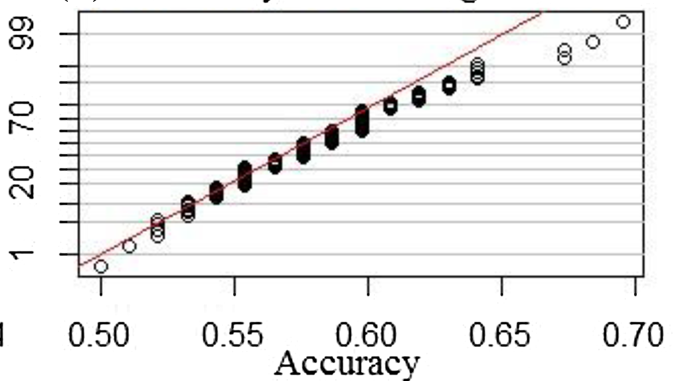 Figure 2: Probability plots showing the accuracy distribution for Age-group (a), Gender (b), Handedness (c), and Hands Used (d).
Critical Analysis: Why This Matters
The most significant takeaway is the 17% accuracy gain. By first identifying the user's "soft" profile, a biometric system can "filter" its database, making final identity verification much more robust.
Limitations & Future Outlook
- Context Sensitivity: The data was collected from stationary subjects. Real-world usage involves walking or sitting, which introduces noise.
- Sensor Potential: The study focused purely on timing. Incorporating the smartphone’s gyroscope and accelerometer (motion behavior) would likely push gender and handedness accuracy far beyond the 60% threshold.
Conclusion
This work moves us closer to "continuous authentication"—a world where your phone knows it is you (or someone like you) not just because of your face, but because of the rhythmic signature of your thumbs. It turns a mundane task like typing a password into a powerful layer of invisible security.