
AttRNN: Decoding the Digital Soul through Temporal Attention
Personality Traits Based on Users' Digital Footprints in Social Networks via Attention RNN
This paper introduces AttRNN, an Attention Recurrent Neural Network designed to predict the "Big Five" personality traits using users' digital footprints on social networks. By treating digital footprints as sequential data and applying an attention mechanism, the model achieves a state-of-the-art Pearson correlation of 0.48 for the "Openness" trait on a dataset of 19,000 Facebook users.
Executive Summary
TL;DR: Researchers from Shandong University have developed AttRNN, a deep learning framework that predicts human personality traits by analyzing the chronological sequence of Facebook "Likes." By moving beyond static classification and leveraging an Attention Mechanism, the model captures the temporal nuances of digital behavior, achieving a new performance benchmark for predicting the "Openness" trait.
Context: This work resides at the intersection of Computational Social Science and Deep Learning. It transitions personality prediction from simple regression models to sophisticated sequence modeling, proving that when you interact is as important as what you interact with.
The Problem: Why Static Models Fail
Personality is not a single data point; it is a "cross-situational and temporally stable set of individual attributes." However, our digital behavior fluctuates. Previous SOTA methods, largely based on Linear Regression, treated a user's entire history of "Likes" as a flat bag-of-words.
This approach has two fatal flaws:
- Temporal Neglect: It treats a "Like" from five years ago the same as one from five minutes ago.
- Noise Sensitivity: Not all digital footprints are equally indicative of personality; some are mere "noise" that dilutes the predictive signal.
Methodology: Putting the "Attention" in RNN
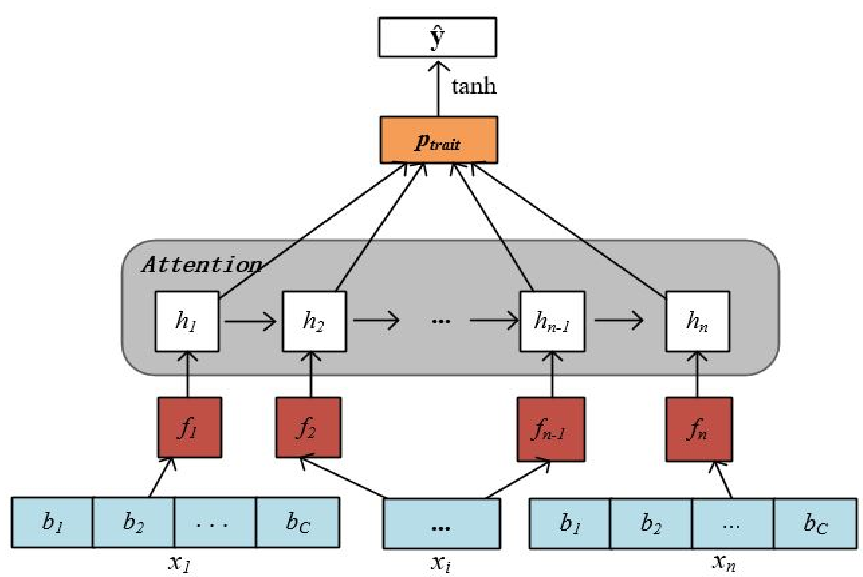
The authors' core insight is that personality traits manifest as patterns over time. Their proposed AttRNN framework consists of three stages:
- Sequential Embedding: Instead of a single vector, they partition user behavior into time intervals, creating a sequence of footprints using multiple-hot encoding.
- The Attention Layer: Instead of just using the final hidden state of the RNN, they calculate an attention weight for every time step. This allows the model to "focus" on specific behavioral clusters that strongly correlate with specific traits (e.g., Openness).
- Trait Prediction: The resulting weighted context vector is passed through a activation function to map results to the standard psychological scale ranges.
Empirical Evidence: Openness is the Key
The experiment utilized the myPersonality dataset, involving approximately 19,000 volunteers. The results, measured by the Pearson Correlation Coefficient, reveal a striking victory for temporal modeling.
| Model | Openness | Conscientiousness | Extroversion | Agreeableness | Neuroticism |
|---|---|---|---|---|---|
| Linear Regression | 0.43 | 0.29 | 0.40 | 0.30 | 0.30 |
| AttRNN (Ours) | 0.48 | 0.31 | 0.35 | 0.29 | 0.31 |
| BiGRU | 0.41 | 0.23 | 0.29 | 0.26 | 0.26 |
Key Insights from the Results:
- Openness Dominance: The model reached 0.48 in Openness. The authors argue this is because digital footprints (interests in music, movies, etc.) are direct proxies for an individual’s intellectual curiosity and aesthetic sensitivity.
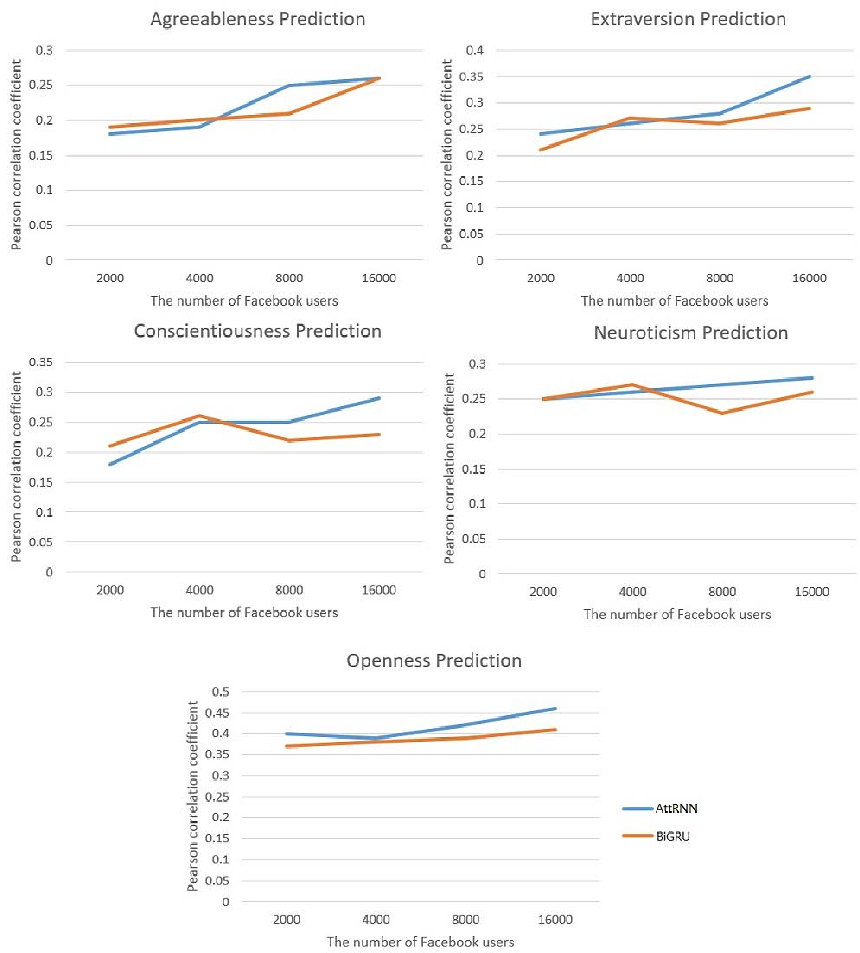
- The BiGRU Failure: Interestingly, the more complex BiGRU (Bidirectional Gated Recurrent Unit) performed poorly. The authors attribute this to the sparsity of Facebook Likes; complex models overfit when the "signal" per time step is too thin.
- Data Scaling: As shown in the figure below, AttRNN performance improves consistently as more data is introduced, suggesting it is well-suited for "Big Data" social analytics.
Critical Analysis & Future Outlook
Why it works: The attention mechanism acts as a "filter" for the chaotic nature of social media. By calculating , the model learns to ignore the random, impulsive "Likes" and focuses on the consistent behavioral patterns that reflect the true self.
Limitations: The model relies on discrete time windows. If a user is inactive for long periods, the sequential data becomes sparse, potentially leading to the same issues seen in the BiGRU model. Furthermore, it currently only uses binary "like" data, ignoring the semantic depth (the meaning of the content liked).
The Future: The authors aim to integrate Deep Semantic Features (likely using LLM-based embeddings) with their attention mechanism. This would allow the model to understand not just that you liked a post, but why the content of that post resonates with your specific psychological profile.