
Beyond the Needle: Decoding the Distinction Between Social and Physical Empathy
Relations between personality traits and empathy for social pain and physical pain
This study investigates the distinct psychological correlates of physical and social empathy by analyzing their relationships with Big Five personality traits and the Interpersonal Reactivity Index (IRI). Utilizing Cyberball simulations and painful imagery, the research identifies that while both types of empathy are related, they are driven by different personality facets, with Agreeableness uniquely predicting empathy for social exclusion.
TL;DR
Why do we cringe when someone gets an injection, but feel a different kind of "ache" when we see someone left out of a group? This study explores the divergence between empathy for physical pain and social pain. By testing 251 participants, researchers found that while physical empathy is linked to Extraversion, empathy for social exclusion is uniquely driven by Agreeableness—the desire for social harmony.
Background: The Dual Nature of Pain
Empathy is the bedrock of human cooperation, yet it isn't a single "feeling." Neuroscience shows that our brains process physical pain (like a cut) and social pain (like being snubbed) using different, though overlapping, circuits. While we've known that personality traits affect how we feel others' physical pain, this paper asks a critical question: Does your personality dictate how much you care about someone else's social exclusion?
The "Cyberball" Experiment: Testing Social Ostracism
To measure social empathy, the researchers used the Cyberball paradigm—a virtual ball-tossing game.
- Inclusion Phase: Three players toss the ball equally.
- Exclusion Phase: The "target" player is suddenly ignored by the other two.
Participants watched these scenarios and reported how painful they felt it was for the victim and how much concern they felt. Simultaneously, participants viewed high-impact photos of physical pain (e.g., a needle piercing skin) to measure physical empathy.
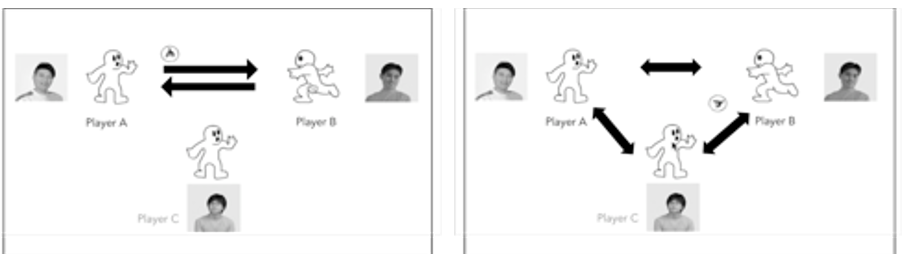 The Cyberball setup: Player C is the victim of social exclusion in the right-hand panel.
Key Methodology: Correlating the Big Five
The researchers mapped these responses against the Big Five Personality Traits (Extraversion, Agreeableness, Conscientiousness, Neuroticism, Openness) and the Interpersonal Reactivity Index (IRI). This allowed them to see which "personality profile" is most prone to which type of empathy.
Results: Why "Nice People" Feel Social Pain
The study found several striking correlations, particularly in female participants:
- Physical Pain = Extraversion & Empathic Concern: Females who were more outgoing and already possessed a "other-oriented" disposition felt more physical empathy. This suggests that physical empathy is closely tied to external attention and social engagement.
- Social Pain = Agreeableness: Only Agreeableness—the trait associated with valuing social harmony—significantly predicted social empathy. If you value a "conflict-free" group, you are more sensitive to the pain of someone being thrown out of that group.
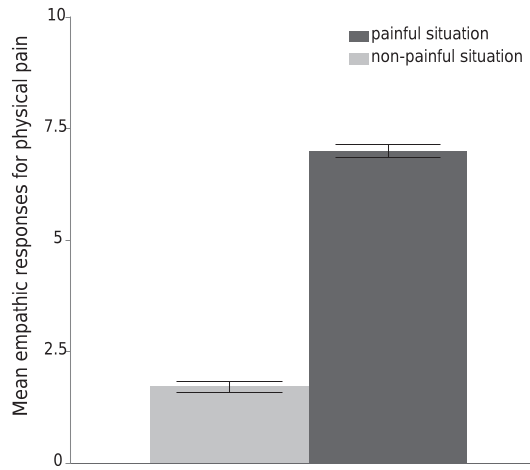 Experimental results showing a clear spike in perceived pain when observing the exclusion phase compared to inclusion.
Critical Insight: Cognitive Divergence
The correlation between social and physical empathy was only moderate (r = .24). This is a crucial finding for academic tech editors and psychologists alike: it confirms that sharing someone's emotional exclusion is not the same cognitive process as sharing their physical injury. Social empathy requires "mentalizing"—thinking about the other person's internal social state—while physical empathy is more visceral and sensory.
Limitations and Future Work
The study acknowledges a significant gender imbalance (more male participants than female), which may affect the generalizability of the trait correlations. Furthermore, the researchers suggest that an individual's own sensitivity to being excluded might be a major factor in how they empathize with others—a promising avenue for future psychological research.
Conclusion (Takeaway)
This research highlights that Agreeableness is a specific engine for social bonding. In a world increasingly mediated by digital interactions (like the Cyberball game itself), understanding that social empathy is a distinct personality-driven trait helps us better understand the roots of prosocial behavior and the devastating impact of social isolation.