
Digital Birds of a Feather: Mapping Personality Homophily in Social Networks
Identifying and validating personality traits-based homophilies for an egocentric network
This paper presents a framework for identifying and validating personality trait-based homophilies—clusters of individuals with similar psychological profiles—within Facebook egocentric networks. The authors developed an ensemble-based regression model using open vocabulary analysis of status updates to predict Big5 traits, achieving a clustering accuracy between 73% and 87% across different traits.
TL;DR
Is your friend group actually like you, or did you just happen to end up in the same Facebook comments section? This paper moves beyond surface-level "likes" to prove that our inner psychology—specifically our Big5 personality traits—forms the invisible bedrock of our social circles. By analyzing Facebook status updates through an ensemble of linguistic models, the researchers identified "homophilies" (clusters of similar people) and validated them through real-world interviews, finding that Openness and Extraversion are the strongest drivers of digital social bonding.
Beyond the Click: The Motivation
In sociology, the Homophily Principle suggests that similarity breeds connection. However, most algorithmic attempts to group people online rely on interaction frequency (who you talk to most) or interest similarity (what pages you both like).
The authors argue these are "noisy" signals. You might argue frequently with someone you dislike, or like the same brand page for entirely different reasons. The true "hidden variable" is personality. The challenge? Personality is internal. This paper asks: Can we see the soul through the status update?
Methodology: The Linguistic Ensemble
The researchers didn't just look at what people said, but how they said it. They compared two major approaches:
- Closed Vocabulary (LIWC): A dictionary-based approach checking for specific categories of words.
- Open Vocabulary (MEH): A data-driven approach analyzing every word used (1-grams) and thematic clusters (LDA Topics).
Architecture Overview
To achieve SOTA results, they built an Ensemble Model. They learned that different linguistic features are better at predicting specific traits. For instance, topical modeling is superior for detecting 'Conscientiousness,' while raw word usage (1-grams) better captures 'Openness.'
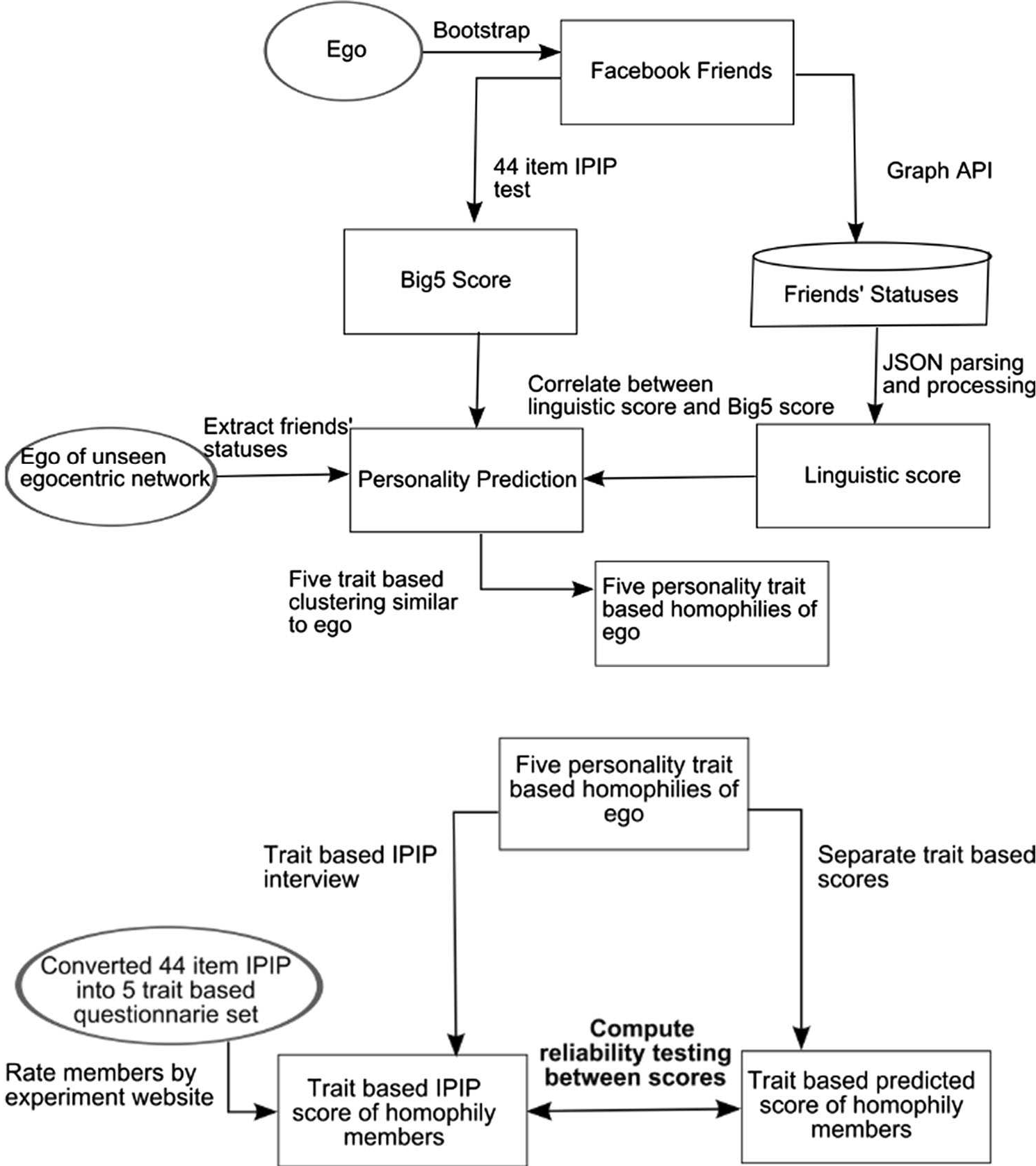 Fig 1: The two-step process—Modeling personality from Facebook data, then validating through real-world IPIP interviews.
Proving It: Real-World Validation
The most striking part of this study is the validation. Instead of just relying on a "Test Set," the authors interviewed 155 participants. They used Intraclass Correlation (ICC) and Cohen’s Kappa to see if the people the algorithm thought were similar actually felt similar in real life.
Key Findings
- Openness wins: The model was exceptionally good at identifying groups of "Open" individuals (intellectually curious, imaginative).
- The Neuroticism hurdle: Like many studies before it, predicting Neuroticism from text remains difficult, likely because people tend to self-censor negative emotions on public platforms like Facebook (the "Social Desirability Bias").
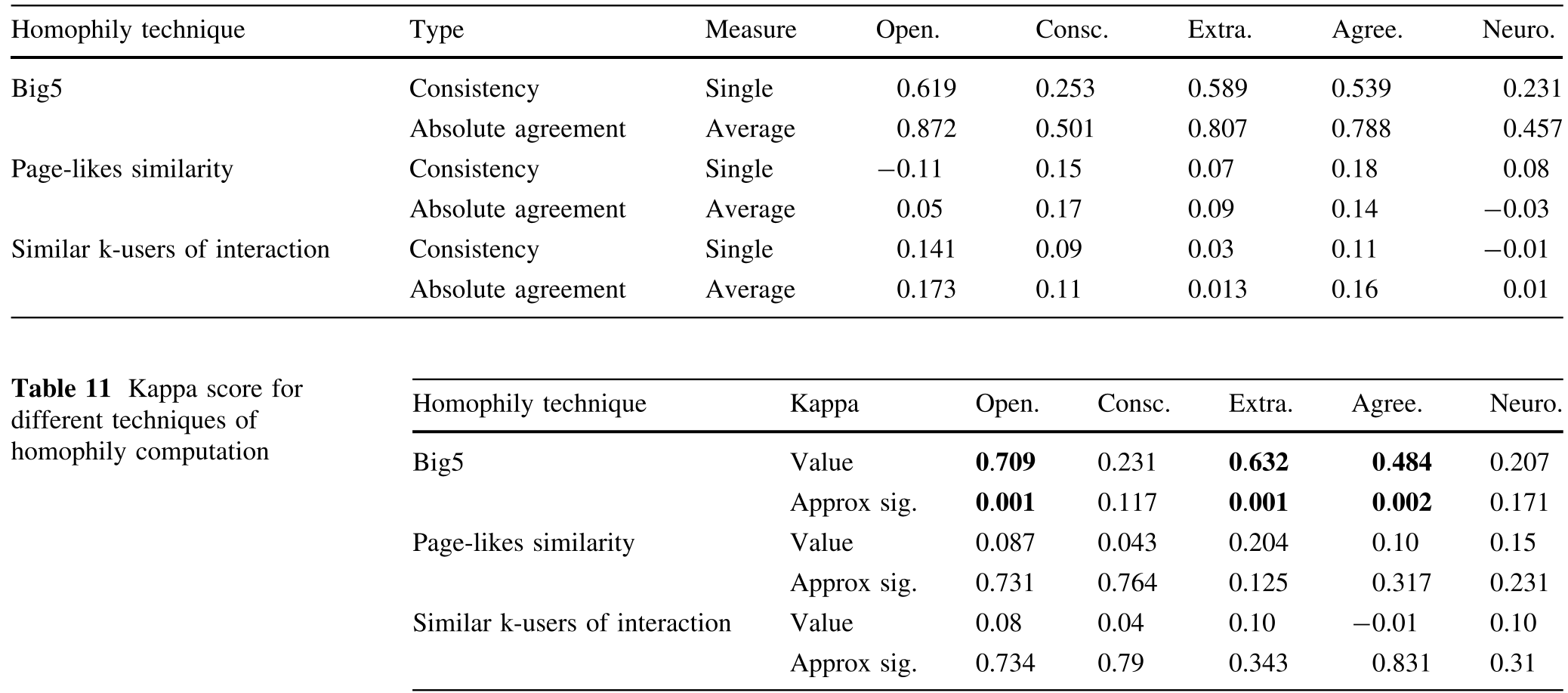 Fig 2: Statistical evidence showing that Big5-based homophily (0.709 Kappa for Openness) far exceeds baseline methods like Page-likes (0.087).
Application: The "Movie Night" Test
To prove this isn't just academic theory, the authors applied their model to Group Recommendations. They found that:
- Openness homophilies correlated strongly with preferences for Sci-Fi/Adventure.
- Extraversion homophilies naturally gravitated towards Comedy.
- Agreeableness homophilies preferred Romance/Drama.
Critical Insight & Future Outlook
This work demonstrates that our digital footprint is a high-fidelity mirror of our psyche. However, a notable limitation is the platform-specific nature of the data. Facebook's "ego-centric" network is closed; how would this transfer to anonymous platforms like Reddit or high-velocity environments like TikTok?
As AI moves toward more personalized assistants, understanding these personality-based homophilies will be crucial for creating groups that don't just "interact," but actually "resonate."
Keywords: Big5 Traits, Egocentric Networks, Homophily Validation, Ensemble Learning, Social Media Analytics.