
Beyond Questionnaires: Building the Next Generation of AEHS via Social Media Intelligence
Including Personality Traits, Inferred from Social Networks, in Building Next Generation of AEHS
The paper proposes a novel framework for Adaptive Educational Hypermedia Systems (AEHS) that integrates Big Five personality traits inferred from social networks. It introduces a system architecture based on the LAOS framework that combines personality, learning styles (Felder-Silverman), and knowledge levels to deliver multi-dimensional content adaptation.
TL;DR
Adaptive Educational Hypermedia Systems (AEHS) have long struggled with "questionnaire fatigue." This paper presents a breakthrough approach: extracting Big Five personality traits directly from social networks (Facebook, Twitter) to initialize learner models. By combining these traits with Felder-Silverman learning styles, the proposed framework automates the delivery of personalized content, collaborative tools, and tailored feedback.
Background: The Fatigue of Traditional Adaptation
Most AEHS prioritize what a student knows (knowledge level) or how they process information (learning style). However, they often overlook who the student is (personality). Historically, capturing this data required long, tedious surveys that dissuaded learners before they even began. This research positions AEHS at the intersection of social computing and pedagogical science, aiming to make student modeling friction-free.
The Core Insight: Personality as a Driver for Knowledge
The authors argue that personality traits—specifically the OCEAN model (Openness, Conscientiousness, Extraversion, Agreeableness, Neuroticism)—are the missing link in adaptation.
- The "Why": A student high in Neuroticism may prefer a surface approach and individual work due to fear of failure.
- The "How": By using social media footprints, the system can predict these traits and automatically adjust the "Semantic Density" of content or suggest collaborative "Wikis/Blogs" for those high in Extraversion.
Methodology: The LAOS-Aligned Architecture
The system architecture follows the LAOS (Layered WWW AHS Authoring Model) to ensure a clean separation between the domain, the learner, and the adaptation logic.
1. The Learner Model (UM)
Unlike traditional models, this one is built on the IMS-LIP specification, ensuring that the data is interoperable. It uses APIs to pull:
- Identification & Interests: From profile bios.
- Personality Traits: Inferred from digital behavior (e.g., navigation traces or social interaction).
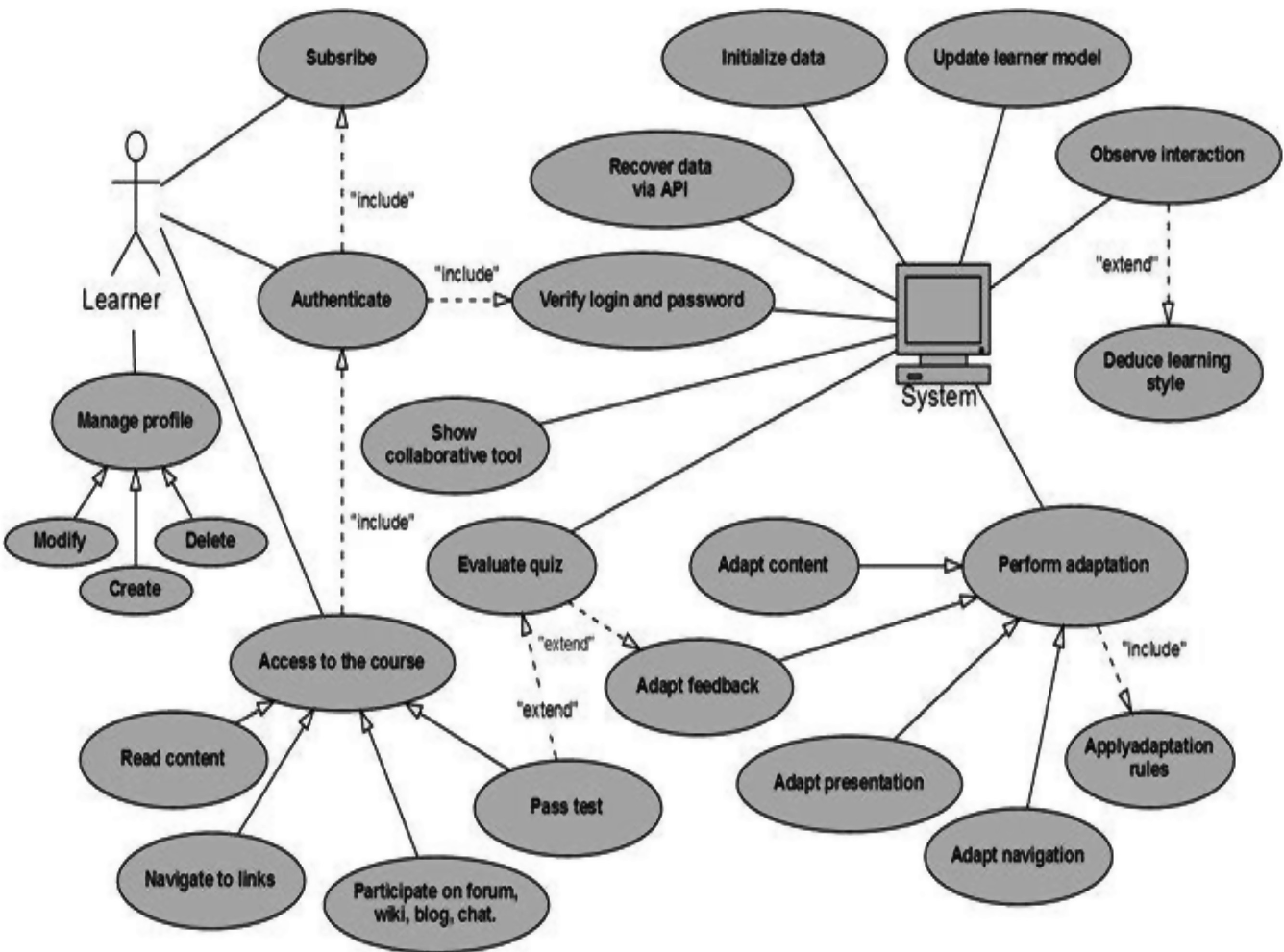 Figure 1: Use case diagram showing the interaction between the learner, social network authentication, and the adaptive system.
2. Domain & Pedagogical Mapping
The system maps learner profiles to Learning Objects (LO) tagged with IEEE-LOM and SCORM standards. The genius lies in the "Pedagogical Rules," which act as the bridge:
- Rule Example:
IF personality = Neuroticism THEN Interactivity Level = 0 AND Semantic Density = Low. - Rule Example:
IF learning style = Active THEN Resource Type = Simulation/Group Work.
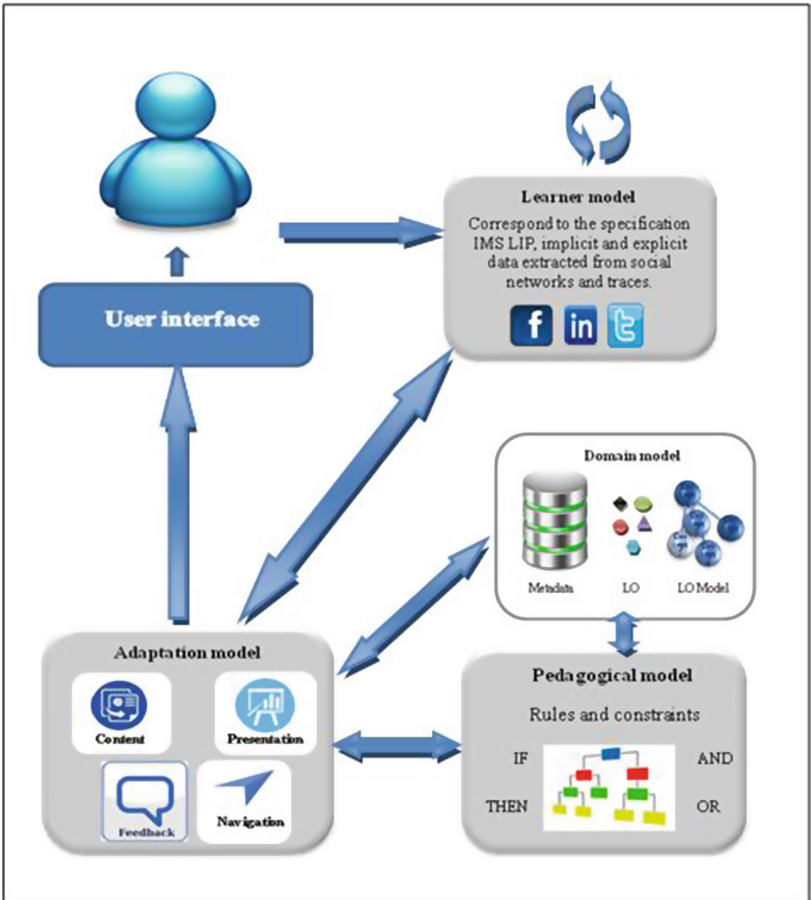 Figure 2: The multi-layered architecture separating Domain (DM), Learner (UM), and Adaptation (AM) models.
Experimental Insight: From Theory to Rule-Based Logic
The paper categorizes academic behavior based on the Big Five. For instance, learners high in Openness are identified as utilizing a Deep Approach—they connect new information to prior knowledge. Conversely, those high in Agreeableness are motivated by Extrinsic factors and collaborative settings.
| Personality Trait | Learning Approach | Motivation Type | Collaboration |
|---|---|---|---|
| Openness | Deep | Intrinsic | Collaborative |
| Neuroticism | Surface | Extrinsic | Individual |
| Extraversion | Deep | Academic Success | Collaborative |
The adaptation model uses Bayesian Networks to dynamically calculate the probability that a specific learning object suits the current state of the learner, allowing the system to adjust in real-time as the student progresses.
Critical Analysis & Conclusion
Takeaway
The integration of social media intelligence into AEHS solves the "cold start" problem of learner modeling. By aligning with IMS-LIP and LOM standards, the authors provide a blueprint for a system that is not only smart but also industrially compatible.
Limitations & Future Work
While the conceptual framework is robust, the paper notes that the implementation is still at the prototype stage. Future challenges include:
- Privacy Concerns: Learners may be hesitant to grant AEHS access to their private Facebook or Twitter data.
- Algorithm Bias: Ensuring that personality inference from social media is accurate across different cultures and languages.
- Real-world Testing: Empirical validation is needed to prove that personality-based feedback actually leads to higher grades compared to standard AEHS.
As e-learning moves toward Connectivism, systems that understand the social and psychological profile of the learner will undoubtedly outperform those that treat students as mere "data containers."