
The Liar’s Blueprint: Does Personality Determine How Easily Machines Spot Deception?
The Effect of Personality Type on Deceptive Communication Style
This paper investigates the correlation between the "Big Five" personality traits and deceptive communication styles using the DECOUR corpus of Italian court transcripts. The authors developed SVM-based deception detection models and integrated them with an unsupervised personality recognition system to analyze how specific personality profiles influence the detectability of lies in high-stakes legal environments.
TL;DR
Can your personality make you a "better" liar? This research utilizes Italian court transcripts (the DECOUR corpus) to prove that machine learning models for deception detection are significantly influenced by the speaker's personality. By clustering speakers using the Big Five trait model, the study finds that extroverted and friendly individuals are actually easier for AI to "catch," while certain other profiles successfully mask their linguistic tells.
Problem & Motivation: Beyond the Lab
Most deception detection research happens in controlled lab environments where the "stakes" are low. In a real-world courtroom, the psychological pressure is immense. The authors argue that we cannot treat all liars as a monolithic group. The core insight here is that stylometry (the study of linguistic style) is inherently tied to personality. If personality affects how we talk when telling the truth, it must logically affect the "leakage" of linguistic cues when we lie.
Methodology: The Core Architecture
The researchers combined two distinct computational linguistic tasks:
- Deception Detection: Using Support Vector Machines (SVM) trained on n-grams of lemmas and Part-of-Speech (POS) tags.
- Personality Recognition: Using an unsupervised system that maps linguistic features (punctuation, word frequency, repetition) to the Big Five traits: Extraversion, Emotional Stability, Agreeableness, Conscientiousness, and Openness.
They utilized the Information Gain algorithm to select the most discriminative linguistic features and used Multi-Dimensional Scaling (MDS) to visualize the "distance" between different personality types and their associated detection accuracies.
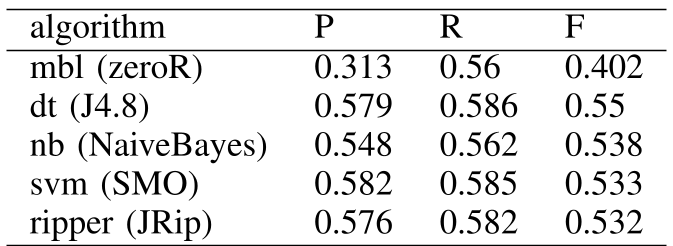 Table VII: Comparison of different algorithms using personality traits as features for deception detection.
Experiments & Results: Who is the Best Liar?
The results were striking. The models consistently outperformed the baseline (reaching ~70% accuracy). However, the real value appeared in the clustering analysis:
- The "Transparent" Liar: Speakers who were extroverted and organized (Conscientious) had highly recognizable deceptive styles. Their lies "stood out" from their truth.
- The "Opaque" Liar: Subjects classified as "uncooperative" or "secure" (stable/low neuroticism) were much harder for the models to predict. Their detection accuracy often fell near or below the baseline.
- Key Finding: A decision tree analysis (Figure below) suggested that "secure and not open-minded" people tended to lie more in this specific judicial context.
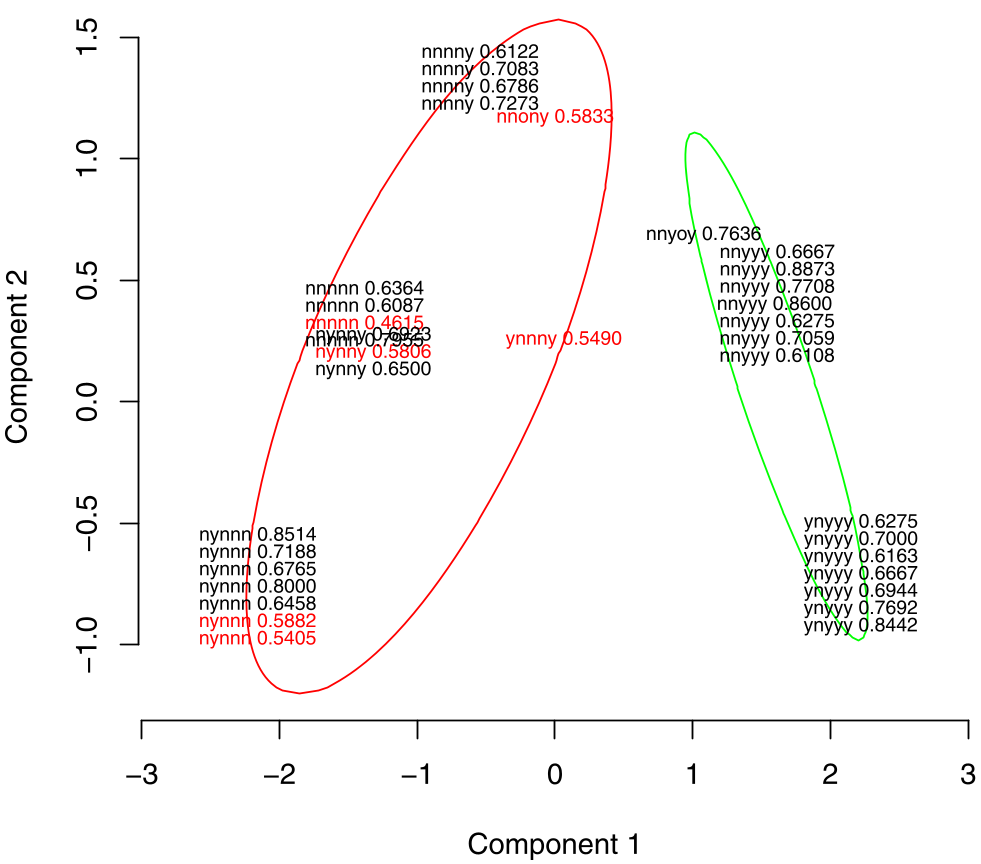 Fig 4: MDS plot showing that hearings with low accuracy (red) cluster together, suggesting certain personality profiles are inherently harder to detect.
Critical Analysis & Conclusion
Takeaway
The study shifts the focus from "What does a lie look like?" to "Who is telling the lie?" It highlights that automated forensic tools must be personality-aware to be truly effective.
Limitations
- Sample Size: With only 31 subjects, the diversity of personality types is limited.
- Unsupervised Labels: The personality labels were generated by an automated system, not clinical psychologists, which introduces a layer of algorithmic proxy.
- Contextual Bias: The "neurotic" and "introverted" tendencies observed might be a byproduct of the stressful courtroom environment rather than the subjects' baseline personalities.
Future Outlook
The next frontier for this research involves expanding the speaker database and applying similar "Personality-Style" mappings to other domains, such as detecting deception in social media influence or autonomous agent interactions.