
EHR-MF: Mining Cognitive Knowledge for Precision API Recommendations in Industrial Systems
17463_Personalized APIs Recommendation With Cognitive Knowledge Mining for Industrial Systems.
The paper introduces a personalized API recommendation framework named EHR-MF, which integrates cognitive knowledge mining with joint Matrix Factorization (MF). By uncovering hidden relationships among users and APIs from following records and content descriptions, it achieves state-of-the-art performance in industrial software development scenarios.
TL;DR
As the Internet-of-Things (IoT) and web technologies expand, the sheer number of available Application Programming Interfaces (APIs) has become a bottleneck for industrial developers. This paper introduces EHR-MF, a framework that treats user behavior and API documentation as "cognitive knowledge." By applying joint Matrix Factorization to these hidden relationships, the researchers achieved significant accuracy gains over traditional Collaborative Filtering, particularly when data is sparse.
Problem & Motivation: The Sparsity Trap
Most recommendation systems in the industrial sector rely on Collaborative Filtering (CF). However, they face a recurring "sparsity trap":
- Sparsity: Most developers only ever use a tiny fraction of available APIs.
- Context Ignorance: High-level relationships—such as two developers sharing similar architectural styles or two APIs providing complementary functions—are often ignored in favor of raw interaction counts.
- Cold-Start: New APIs or users with few records cannot be effectively matched using traditional MF.
The authors' insight is simple yet powerful: Cognitive knowledge, hidden within developer "following" records and API text descriptions, can bridge these gaps.
Methodology: The EHR-MF Architecture
The researchers developed three models to tackle the problem from different angles:
1. UHR-MF (Users Hidden Relationship)
This model focuses on developer behavior. If two users follow the same set of APIs, they likely share a functional focus (e.g., Map services). The similarity is calculated using the Jaccard Coefficient and fed into a joint factorization process.
2. AHR-MF (APIs Hidden Relationship)
This model focuses on the "content" of the APIs. Since quality-of-service (QoS) data is often hard to access, the authors use TF-IDF vectorization and Cosine similarity on API documentation to find functional twins.
3. EHR-MF (Ensemble model)
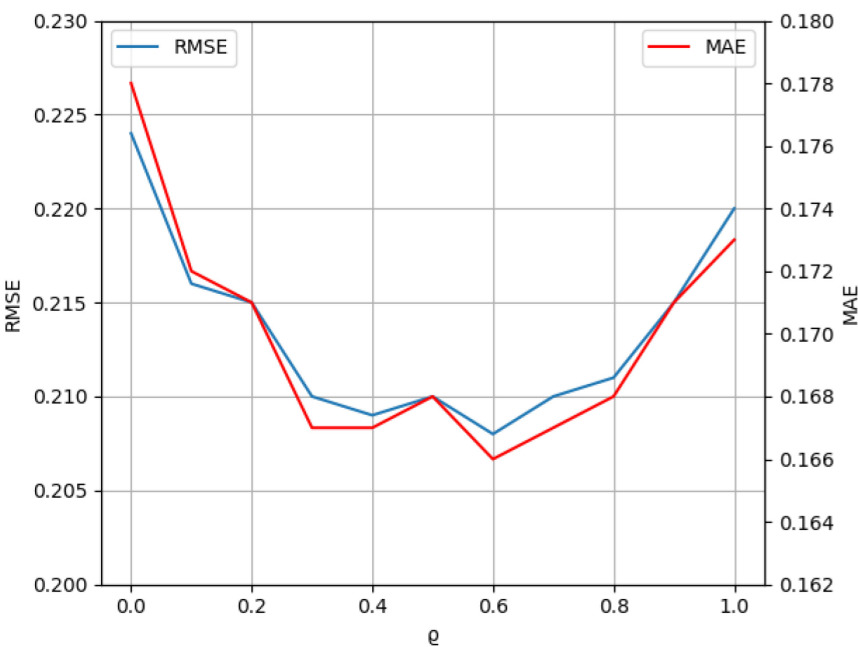
The final framework combines both viewpoints into a unified objective function: Where is the weighting factor (optimized at 0.6 in the experiments).

Experiments and Results
The authors crawled a massive dataset from ProgrammableWeb, encompassing over 17,000 APIs.
Performance vs. Baselines
The framework was tested against traditional methods like UPCC (User-based Pearson), IPCC, and even Deep Learning approaches like Autoencoders.
- Consistent Superiority: Across all data densities (from 90% down to 10%), EHR-MF consistently showed lower MAE and RMSE.
- Cold-Start Resilience: At 10% density, while standard MF models failed (high error), EHR-MF remained remarkably stable thanks to its use of auxiliary content similarity.

Parametric Insights
- Latent Factors (d): The optimal number of hidden features was found to be between 15 and 20. Too many features led to overfitting.
- Fusion Weight (): The best performance occurred at , suggesting that user-side behavioral similarity is slightly more predictive than API content similarity in this specific industrial context.
Critical Analysis & Conclusion
Takeaway
The EHR-MF framework proves that industrial system recommendations cannot rely on usage data alone. By mining the "cognitive" intent of developers and the semantic meaning of APIs, we can create a much more robust recommendation engine that handles the vast, sparse landscape of modern software development.
Limitations & Future Work
While TF-IDF is effective, it is a "bag-of-words" approach that misses deep semantic nuances. The authors suggest that future work will incorporate contextual information (time and device data) and likely move toward more advanced embedding techniques to further refine the "cognitive knowledge" extraction process.
This research marks a significant step toward "intelligent" industrial ecosystems where the tools proactively find the developers, rather than the other way around.