
Beyond Similarity: Mastering Fashion Recommendation with Social Circles and Style Consistency
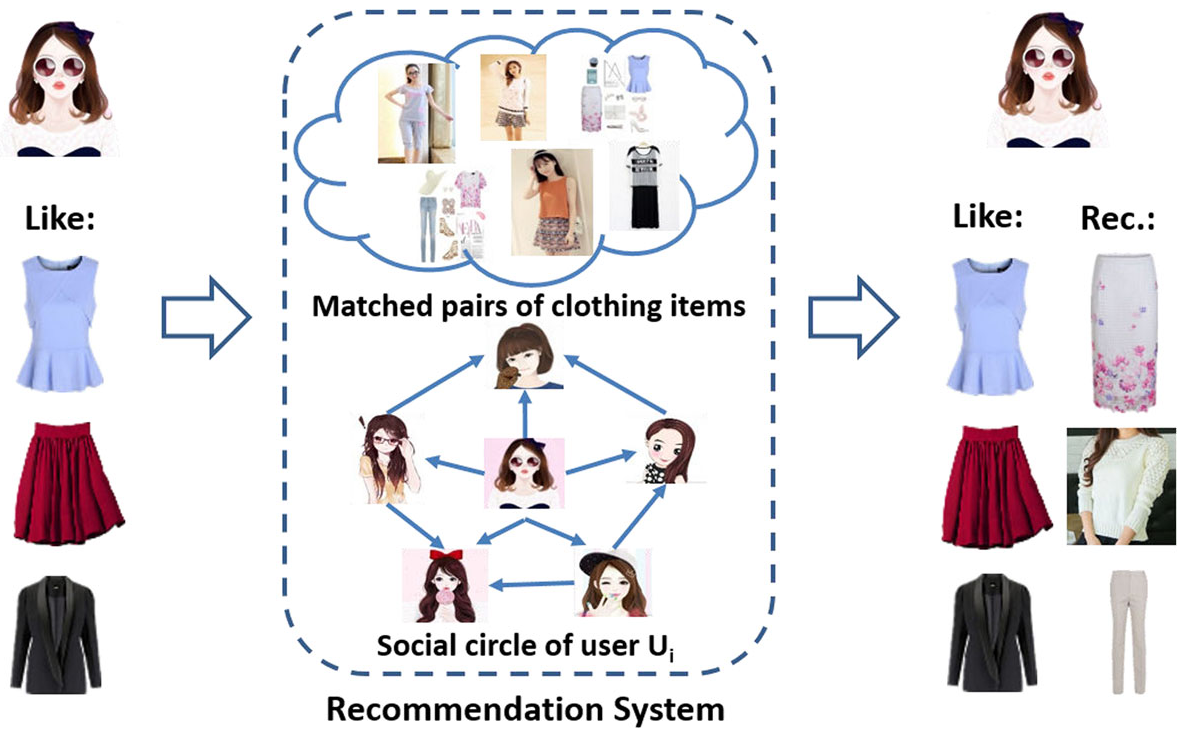
Personalized clothing recommendation combining user social circle and fashion style consistency
This paper introduces a personalized clothing recommendation framework that integrates user social circles with visual fashion style consistency. It utilizes a Siamese Convolutional Neural Network (SCNN) with a feature-based sampling strategy to model style compatibility and incorporates these visual insights into a Probabilistic Matrix Factorization (PMF) model.
Executive Summary
TL;DR: This research tackles the complexity of clothing recommendation by moving beyond simple "item similarity." The authors propose a unified framework that balances who you follow (Social Circle) with what looks good together (Fashion Style Consistency). By training a Siamese CNN to recognize compatible styles and embedding these relationships into a Probabilistic Matrix Factorization (PMF) model, they achieved a massive 30% improvement in recommendation accuracy.
Positioning: This work bridges the gap between vision-based "fashion matching" and social-based "collaborative filtering," establishing a new SOTA for personalized fashion discovery.
The "Style" Problem: Why Traditional RS Fails Fashion
Most recommendation systems (RS) treat clothes like movies or books. However, fashion is unique:
- Visual Primacy: Users buy based on visual aesthetics, not just metadata.
- Compatibility vs. Similarity: A user who buys a leather jacket doesn't necessarily want another leather jacket (similarity); they want boots or jeans that match it (consistency).
- Social Influence: Style is often aspirational, heavily influenced by "fashion icons" or friends within a social circle.
Existing models struggle with data sparsity (most users only rate a few items) and fail to capture why a specific pair of items from different categories (e.g., a floral top and a denim skirt) belong together.
Methodology: The Secret Sauce
The authors solve this using two core components:
1. Modeling Style Consistency via SCNN
To teach the machine "what matches," the authors used a Siamese Convolutional Neural Network (SCNN).
- The Sampling Innovation: Instead of random sampling, they used a deep-feature strategy. If a negative sample is too visually similar to a positive one, the model gets confused. Their strategy ensures negative samples are distinct enough to create a clear latent "style space."
- The Goal: Map disparate items (tops and bottoms) into a shared latent space where "compatible" items are mathematically close.
 Caption: The SCNN architecture maps visual features into a latent fashion style space.
2. The Unified Recommendation Framework
The researchers didn't stop at vision. They integrated four distinct "forces" into their PMF model:
- Interpersonal Influence: How much your friends' tastes affect you.
- Interpersonal Interest Similarity: Finding users with historically similar aesthetic tastes.
- Personal Interest: Your own consistent historical preferences.
- Fashion Style Consistency: The visual compatibility score derived from the SCNN.
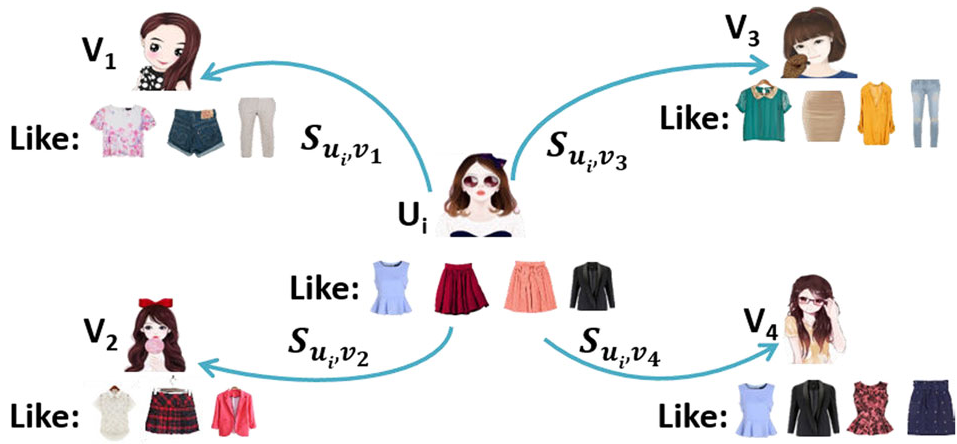 Caption: The interplay between social circles and visual consistency in the proposed framework.
Experiments and Results
The model was tested on a massive dataset from Mogujie, a leading Chinese social fashion platform.
Key Findings:
- Accuracy Leap: Their model reached an RMSE of 0.259, compared to 0.692 for basic Matrix Factorization and 0.362 for CombinedMF (the previous best).
- Style is Key: In ablation studies, adding "Fashion Style Consistency" (R+Y) provided a more significant boost than adding social factors alone.
- Sparsity Resilience: Even for users with very few friends or ratings, the visual consistency constraint acts as a "fallback," maintaining high recommendation quality.
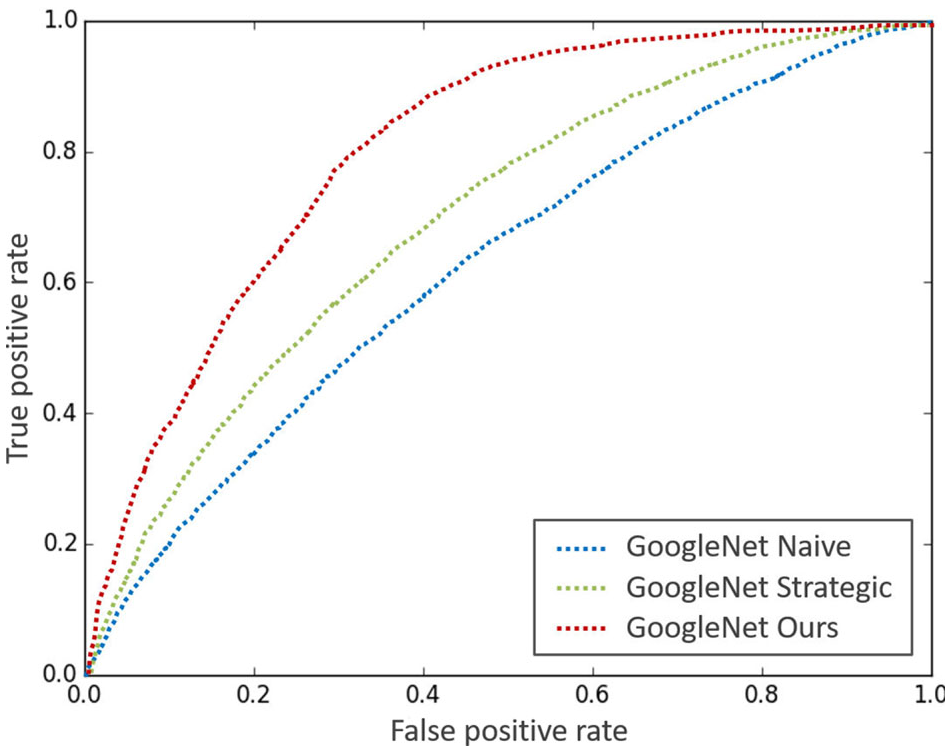 Caption: Comparison of different sampling strategies for SCNN, showing the superiority of the deep-feature approach (Blue line).
Critical Insight & Conclusion
The true takeaway of this paper is the symmetry of constraints. While previous research focused on refining user embeddings through social graphs, this work proves that refining item embeddings through visual compatibility is equally, if not more, important in fashion.
Limitations: The model currently assumes a static style. However, fashion trends evolve rapidly. Future iterations would benefit from temporal modeling—incorporating how "consistency" changes from season to season.
Conclusion: By mathematicalizing "good taste" through SCNNs and social graphs, the authors have provided a blueprint for the next generation of aesthetic-aware e-commerce.