
Beyond Objective Truth: Leveraging Social Context for Personalized Content Credibility
A personalized credibility model for recommending messages in social participatory media environments
This paper proposes a personalized credibility model for participatory media (like blogs and news) using a Bayesian network framework. By integrating sociological theories such as the "strength of weak ties," the method—evaluated on Digg.com data—significantly improves collaborative filtering recommendation performance by capturing individual social contexts.
TL;DR
In the era of "participatory media" (blogs, citizen journalism, social feeds), the sheer volume of content makes manual verification impossible. This paper moves away from the idea of "universal truth" and introduces a Bayesian model that predicts credibility based on a user's unique social context. By distinguishing between strong ties (friends who provide context) and weak ties (acquaintances who provide diversity), the authors achieved a staggering 16x performance boost over traditional collaborative filtering.
The Core Insight: Credibility is Subjective
Why does a professor trust one book review while a student trusts another? It isn't because one review is "wrong"; it's because their social contexts—background, profession, and goals—differ.
The authors argue that existing systems like PageRank (which measures importance) or EigenTrust (which measures objective reliability) fail in social settings because they ignore the observer's perspective. They propose that credibility is a multi-dimensional construct built on:
- Context: How easy a message is to understand given your background.
- Completeness: The breadth of perspectives provided.
Methodology: The Bayesian Credibility Network
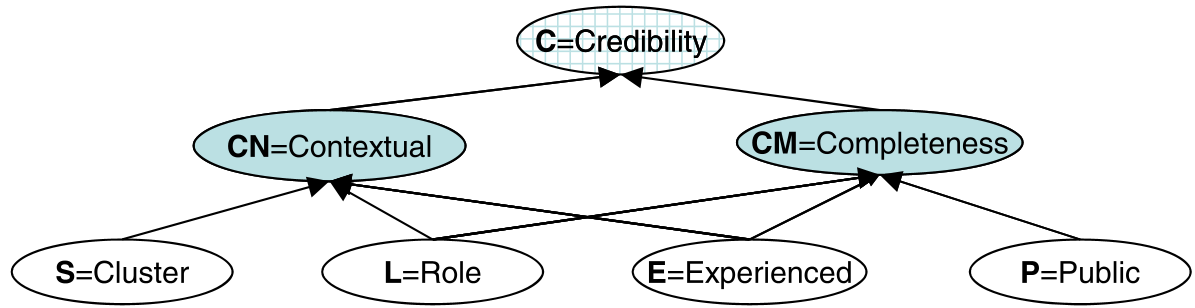
The researchers developed a Bayesian network designed to learn a user’s "credibility profile." The model (shown below) fuses multiple evidence variables into a single probabilistic prediction: Is this message credible to User A?
The Four Dimensions of Evidence
- Cluster Credibility (s): What do people in your immediate "strong-tie" circle think? This provides Context.
- Public Credibility (p): What is the general consensus? This provides Completeness.
- Experienced Credibility (e): What is your personal history with this specific author?
- Role-based Credibility (l): Do you trust someone because they are a "Professor" or a "Journalist"?
Mathematical Engine: Eigenvector Propagation
To compute these variables, the authors used a recursive axiomatic approach. For example, a user is considered credible if they write messages that other credible users rate highly. This recursion is solved using fixed-point Eigenvector computations, similar to how PageRank evaluates web pages, but weighted by social proximity.
Validating the "Weak Tie" Hypothesis
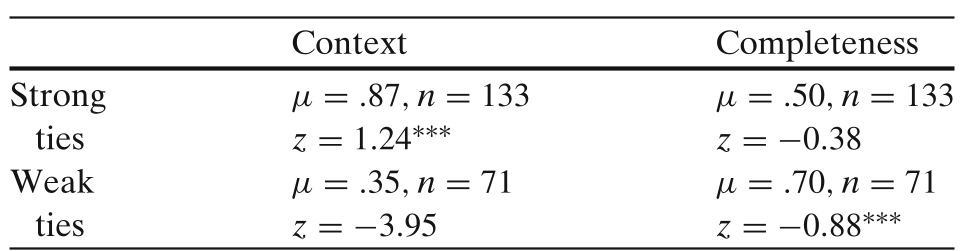
A critical contribution of this work is the empirical bridge between sociology and CS. Using Orkut.com data, the authors proved through Welch t-tests that:
- Strong Ties are the primary source of contextual understanding.
- Weak Ties are the primary source of diverse/complete information.
Experimental Results: A 16-Fold Leap
The model was tested on real-world data from Digg.com. The researchers compared their Bayesian approach against established giants:
- Eigentrust & PageRank: Performed near random (MCC ≈ 0), as they couldn't handle the subjective nature of social media.
- Collaborative Filtering (CF): The standard "people who liked this also liked..." approach.
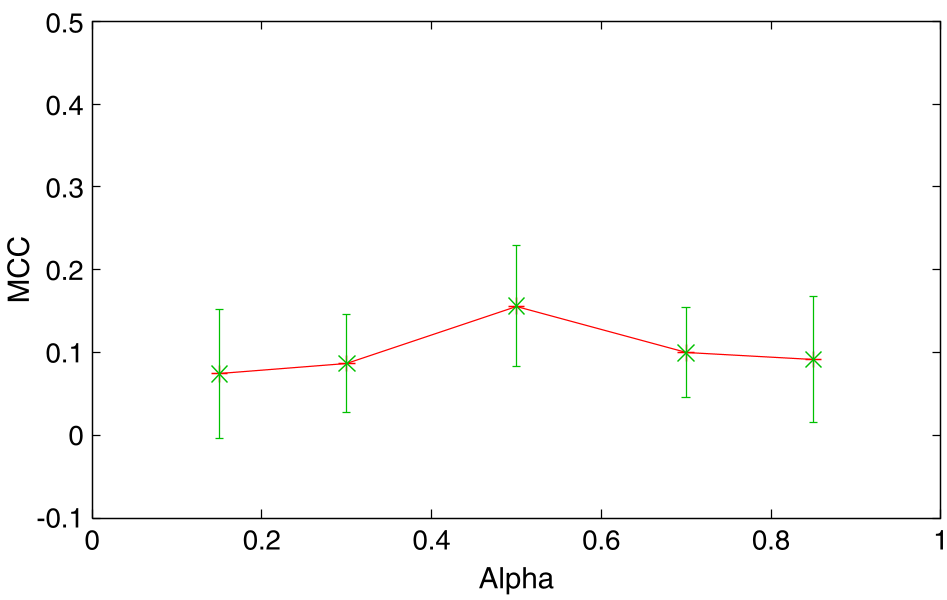
- The Proposed Enhanced CF: By breaking down user similarity into "contextual similarity" and "completeness similarity," they raised the Matthew’s Correlation Coefficient (MCC) from 0.017 to 0.278.
Critical Analysis & Takeaways
Why it works
The "magic" resides in the realization that a single "similarity score" between users is too reductive. By splitting behavior into Context and Completeness, the model captures why users agree, not just that they agree.
Limitations
- Cold Start: While authorship info helps, the model still relies heavily on initial ratings.
- Computation: Eigenvector calculations on massive graphs are expensive, though block-decomposition can mitigate this.
- Role Data: The Digg dataset lacked rich profile info (like "Professor" vs "Student"), leaving role-based credibility partially untested.
Conclusion
This paper serves as a blueprint for the "Adaptive Social Web." It moves us closer to a web that doesn't just show us what is popular, but what is trustworthy to us. For developers building the next generation of social apps, the lesson is clear: your recommendation engine must understand the user's social position as much as it understands the content's sentiment.