
Beyond Static Matching: Dynamic User Preference Analysis for EBSN Recommendations
Recommending personalized events based on user preference analysis in event based social networks
The paper introduces a personalized event recommendation method for Event-Based Social Networks (EBSNs) like Meetup. It integrates temporal relationships, hierarchical category preferences, and Matrix Factorization to predict unevaluated user properties, achieving a 10–30% improvement in precision and recall over traditional geographic or semantic baselines.
TL;DR
In the fast-paced world of Event-Based Social Networks (EBSN), static recommendation engines fail because events are ephemeral. This paper proposes a novel framework that predicts "unevaluated" features using Matrix Factorization and a specialized ranking algorithm. By weighing recent history and hierarchical categories, the system achieves a 10-30% boost in accuracy, ensuring users get invited to events they actually want to attend.
The Problem: The Ephemeral "Cold-Start"
Most recommendation systems rely on a long history of user-item interactions. In EBSNs (like Meetup or Eventbrite), events are often one-time occurrences. This creates a permanent cold-start problem: by the time a system learns an event is popular, the event is over.
Current SOTA methods focus heavily on:
- Geographic Proximity: Recommending what is nearby.
- Semantic Overlap: Matching keywords in profiles.
The authors argue these are insufficient because they ignore temporal dynamics (interests change over time) and implicit tendencies (users might like things they haven't explicitly listed in their profiles).
Methodology: Predictive and Relational Analysis
The proposed system operates through a three-stage pipeline: Participation History Collection, Data Preprocessing, and Personalized Recommendation.
1. Hierarchical Category Management
Unlike flat tag systems, the authors use a tree structure. A user interested in "Comedy" (sub-category) is given a higher weight for that specific interest than the broad "Movie" (main category) one. This allows for much finer granularity in matching.
2. Predicting the "Unknown" with Matrix Factorization
How do you recommend an event when the user hasn't provided a rating? The authors employ Matrix Factorization (MF) to estimate implicit feature values. This allows the system to fill in the gaps of a user-feature matrix, identifying "hidden" preferences that aren't visible in raw participation logs.

3. The Temporal Ranking Algorithm
The core "secret sauce" is the similarity ranking value ():
- (Temporal Relationship): Gives higher weight to more recent events, ensuring the model adapts to the user's current lifestyle.
- (Reputation Score): Prevents "ranking inversion" by factoring in how much users actually enjoyed past similar events.
Experimental Results
The authors compared their model against two baselines: Geographical (Quercia et al.) and Semantic (Zhang et al.).
- Precision & Recall: At the Top-5 recommendation level, the proposed method showed a staggering 40-80% improvement in precision. As the recommendation pool grew, it maintained a consistent 20-30% lead.
- User Satisfaction: Using reputation scores as a proxy for satisfaction, the proposed method consistently yielded events that users rated higher.
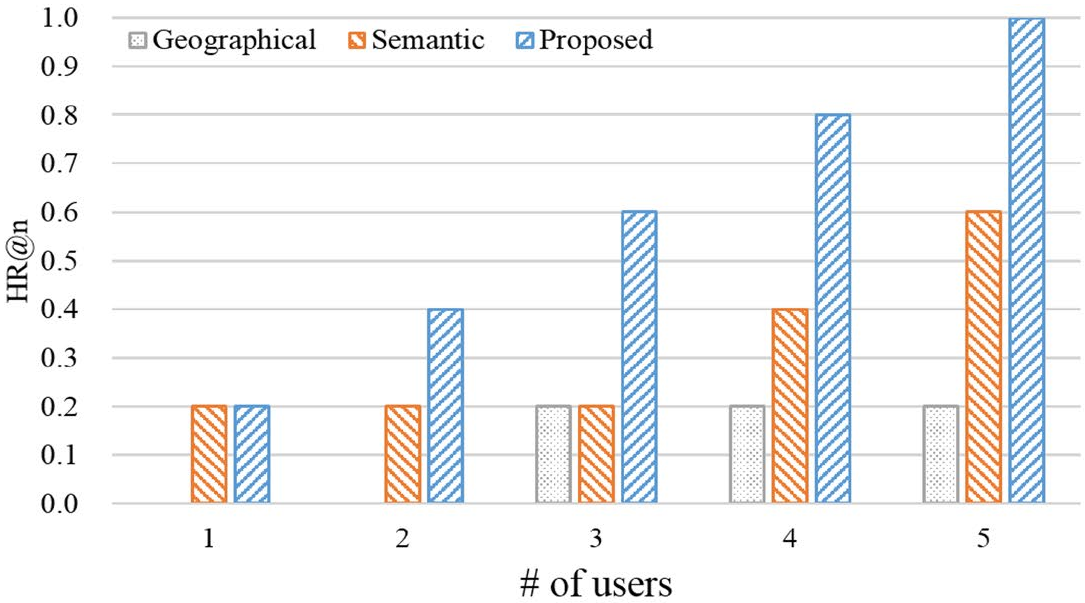 Figure: The proposed method (green line) shows significantly higher Hit Rates (HR@n) compared to geographic and semantic baselines.
Critical Insight & Conclusion
The true value of this work lies in its holistic view of the user. By treating "time" not just as a timestamp but as a decay factor for interest, and by using Matrix Factorization to look "under the hood" of user profiles, the authors move EBSN recommendations from simple keyword matching to genuine behavioral prediction.
Limitations: The study was conducted on a relatively small dataset (50 users over 12 months). While the logic is sound, future work must demonstrate how this scales to millions of users where the Matrix Factorization step becomes computationally expensive.
Final Takeaway: For developers in the social space, the message is clear: Stop recommending based on where a user is, and start recommending based on who they are becoming.