
PRESENT: Decoding the Social Pulse for Precision Event Recommendations
Personalized Event Recommendations Using Social Networks
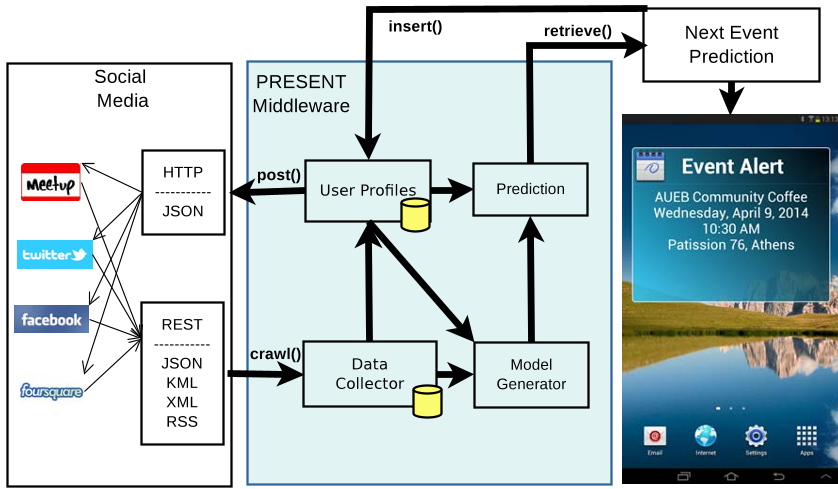
PRESENT is a personalized event recommendation middleware that utilizes a Mixed Markov Model (MMM) to extract behavioral patterns from social groups in Location-Based Social Networks (LBSNs). Tested on Meetup data with over 200,000 users, it achieves a high-precision event attendance prediction accuracy of over 73%, significantly outperforming traditional Collaborative Filtering and individual feature-based methods.
TL;DR
Researchers have developed PRESENT (PRediction of Event attendance in Social ENvironmenTs), a middleware that predicts which social event a user will attend next by analyzing the collective behavior of their social groups. By applying a Mixed Markov Model (MMM) to real-world Meetup data, the system achieves over 73% accuracy, crushing standard Collaborative Filtering and individual history-based models.
Perspective: Moving Beyond the "Individual"
Historically, recommendation engines have asked: "What does User A like?" This works for movies (Netflix) or products (Amazon), but social events are different. Human attendance is highly contagious—we go where our social circles go.
The authors of PRESENT argue that current SOTA methods fail because they ignore the group dynamic. They identify four major hurdles:
- Sparsity: Users don't RSVP to everything.
- Cold-Start: New users have no history.
- Dynamics: Group interests shift based on location and time.
- Unpredictability: Human factors (availability, weather) create "noisy" data.
Methodology: The Mixed Markov Logic
The core innovation lies in shifting the "unit of analysis" from the individual to the Feature-Based Group.
1. Grouping Strategy
Before predicting, PRESENT clusters users using two primary criteria:
- Attendance Criterion: Grouping users by their frequency of participation (activity level).
- Spatial Criterion: Grouping users by the geographic "centroids" of their past check-ins.
2. The Mixed Markov Model (MMM)
While a standard Markov Model assumes your next move depends only on your current state, and an HMM assumes it depends on a hidden personal state, the MMM strikes a balance. It assumes a user belongs to a group with shared transition probabilities but retains an individual latent component.
The model estimates Transition Probabilities ()—the likelihood of moving from event to event . Using the Expectation-Maximization (EM) algorithm, it iteratively refines these probabilities by maximizing the log-likelihood of observed attendances across the entire group.
Experimental Battleground: Meetup Dataset
The authors put PRESENT to the test using a massive dataset: 205,684 users and 89,952 events from the Meetup network.
Performance vs. Baselines
The results were conclusive. PRESENT didn't just win; it dominated:
- Collaborative Filtering (CF): Peak accuracy ~53.8%.
- Historical Venue Feature: Peak accuracy ~47.6%.
- PRESENT: Average accuracy 73%, peaking at 85.8%.
Why does it work?
As group sizes increase toward 30 members, the model gains enough statistical "mass" to smooth over individual missing data (the sparsity problem). Even if a specific user hasn't RSVP'd, the group behavior provides a strong prior that leads to a correct prediction.
Critical Insight & Future Outlook
Takeaway: The "Social Environment" is a more powerful predictor of event attendance than "Individual Interest." By modeling the sequence of events as a chain of transitions within a group, PRESENT solves the temporal overlap problem that plagues most recommenders.
Limitations:
- The model currently treats events as independent states without semantic understanding (e.g., it doesn't know that a "Java Workshop" is similar to a "Python Seminar").
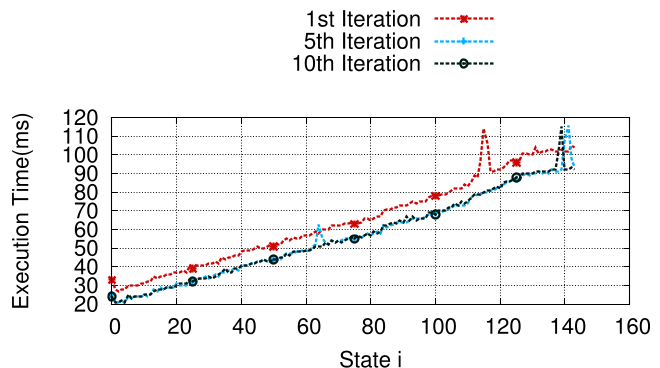
- The computational cost of updating the MMM in real-time for millions of users across different geographical regions requires further optimization (though current latency is low).
Future Work: The authors plan to integrate explicit social ties (who is friends with whom) to further refine the grouping logic. In a world of over-saturated notifications, PRESENT offers a path toward recommendations that are not just relevant, but socially synchronized.