
Who Influences Me? Moving from Global to Personalized Influence Maximization
Personalized influence maximization on social networks
This paper introduces the problem of Personalized Influence Maximization (PIM), which aims to identify the top-k most influential nodes for a specific target user rather than the entire network. The authors propose near-optimal algorithms (LGA, ELGA) and a scalable heuristic (LCA) that achieve significant performance gains over global influence baselines.
TL;DR
In social networks, "global influencers" (like celebrities) are often irrelevant to your personal decisions. This paper shifts the paradigm from global influence to Personalized Influence Maximization (PIM), providing a mathematical framework and efficient algorithms to find the nodes that have the highest probability of activating a specific target user.
The Problem: The "Celebrity" Bias
Most influence research asks: “How can we start a trend that covers the whole city?” But personalized services (ads, recommendations, search) need to ask: “Who are the top-10 people most likely to influence user ?”
The authors prove two counter-intuitive points:
- Neighbors aren't enough: Your direct friends might not be your biggest influences; often, a "second-nearest" node in a specific cluster carries more weight.
- Global stars are far away: Global top-k nodes often leave large "blanks" in coverage for specific local users.
Methodology: Solving the Local Optima
The PIM problem is NP-hard because calculating the exact influence probability (the probability that target is activated by seed set ) is #P-hard.
1. The Mathematical Intuition: Variance Reduction
Instead of simple Monte-Carlo simulations (which are high-variance and slow), the authors propose an unbiased estimator for influence degree : where is the set of activated neighbors of target . This formula essentially looks at the "last hop" of influence, providing a smoother, lower-variance gradient for optimization.
2. Algorithms
- LGA / ELGA (Greedy): By proving that the objective function is sub-modular, the authors show that a greedy "hill-climbing" approach can reach at least ~63% of the optimal solution. ELGA speeds this up by inducing smaller sub-graphs from the original network.
- LCA (Local Cascade Algorithm): For massive networks (like Wikipedia with 2.3M nodes), the authors ignore long, weak paths and focus only on the shortest-path community between potential seeds and the target.
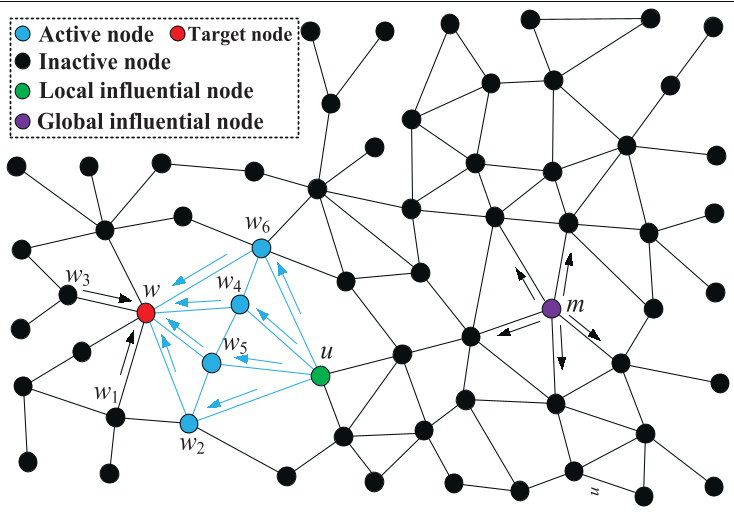 Figure 1: Comparison showing why local influencers (node u) outperform global ones (node m) for target w.
Experiments & SOTA Comparison
The authors tested their methods against standard baselines like Global Degree and Local Neighbors.
- Accuracy: The greedy algorithms (LGA/ELGA) consistently beat the competition. On the Weibo dataset, they outperformed global degree methods by over 120% in successfully reaching the target.
- Scalability: While the greedy method is accurate, it is slow (ms in some tests). The LCA heuristic, however, provided nearly the same accuracy in just 15ms, a massive leap for real-time applications.
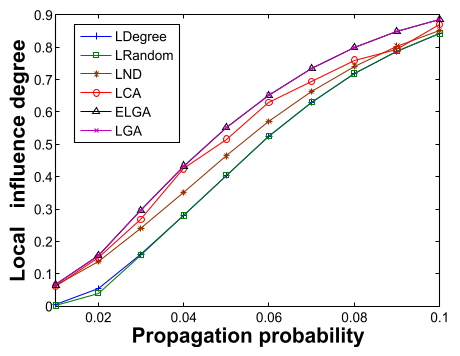 Figure 2: Influence degree comparison showing LGA/ELGA/LCA outperforming traditional global heuristics.
Critical Analysis & Conclusion
The value of this work lies in its scalability. By recognizing that social influence is "decaying" over distance, the authors justify ignoring the majority of a graph to focus on a target’s local neighborhood.
Limitations:
- The model assumes the "Independent Cascade" (IC) model, where each "push" is an independent event. In reality, social influence often requires reinforcement (Complex Contagion), which this paper doesn't address.
- The temporal aspect—how influence changes over time—is left as future work.
Takeaway for Practitioners: If you are building a recommendation engine, stop looking for the "Katy Perry" of your graph. Use the LCA approach to map shortest-path communities around your users to find the hidden "micro-influencers" that actually drive their behavior.