
Personalizing the Robot Coach: A Hybrid Approach to Post-Stroke Rehabilitation
Towards Personalized Interaction and Corrective Feedback of a Socially Assistive Robot for Post-Stroke Rehabilitation Therapy
This paper introduces an interactive robotic coaching system for post-stroke rehabilitation that combines machine learning (ML) and rule-based (RB) models to provide personalized corrective feedback. By integrating a data-driven Neural Network with expert-derived rules tuned to individual patient data, the system achieves SOTA-level agreement with human therapists.
TL;DR
Researchers have developed a socially assistive robot (SAR) coach that moves beyond "one-size-fits-all" rehabilitation. By combining the predictive power of Neural Networks with customizable clinical rules tuned to a patient's own healthy movements, the system provides transparent, frame-level corrective feedback that rivals human therapist expertise.
Academic Positioning: This work bridges the gap between high-performance "black-box" ML and the interpretability required for medical applications, specifically addressing the high variance in stroke patient physical capabilities.
The Problem: The "Generic Threshold" Trap
In post-stroke therapy, every patient’s "normal" looks different. Traditional robotic coaches use fixed thresholds—for example, "Raise your arm 45 degrees." However, for a patient with severe hemiparesis, 30 degrees might be a victory, while for another, it might involve a "compensation" move (like leaning the spine to lift the arm).
Prior systems failed because:
- Fixed Metrics: They couldn't adapt to individual baseline capabilities.
- Lack of Granularity: Assessment usually happened after the exercise, missing the "when" and "how" of errors during the motion.
Methodology: The Hybrid Synergy
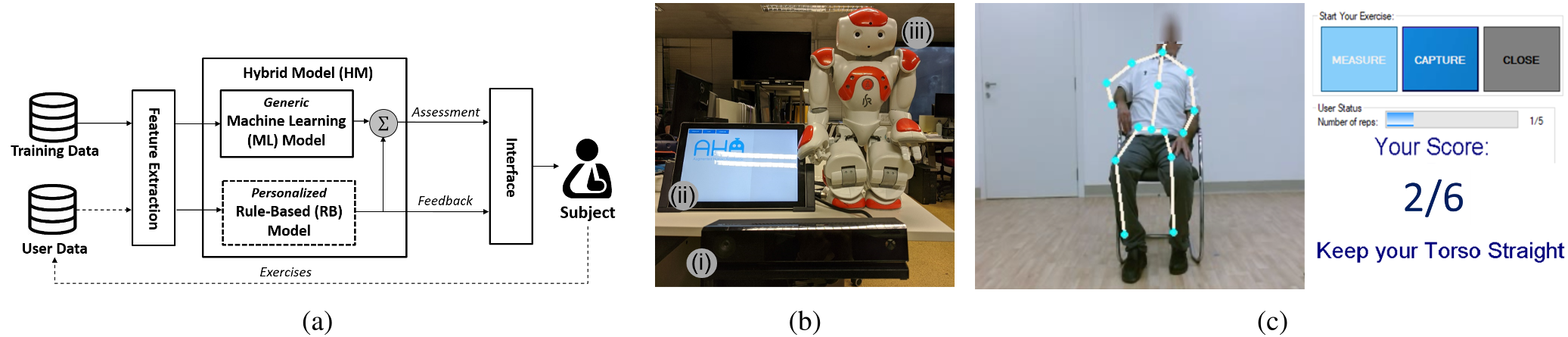
The core of this paper is an Interactive Hybrid Model (HM). It doesn't just choose between Machine Learning and Human Rules; it fuses them.
1. The Architecture
The system utilizes a Kinect v2 sensor to extract kinematic features. It then feeds these into two parallel streams:
- ML Stream (Neural Network): Trained on a broad dataset (15 subjects) to recognize general patterns of "good" vs "bad" motion.
- RB Stream (Rule-Based): Built on 15 if-then rules elicited from professional therapists.
2. Personalization via "Unaffected Motions"
The "Aha!" moment of this study is how it handles personalization. Before assessing a patient's affected side, the system observes their unaffected side. It uses this "healthy" data to tune the Rule-Based thresholds ().
3. Ensemble Voting for Stability
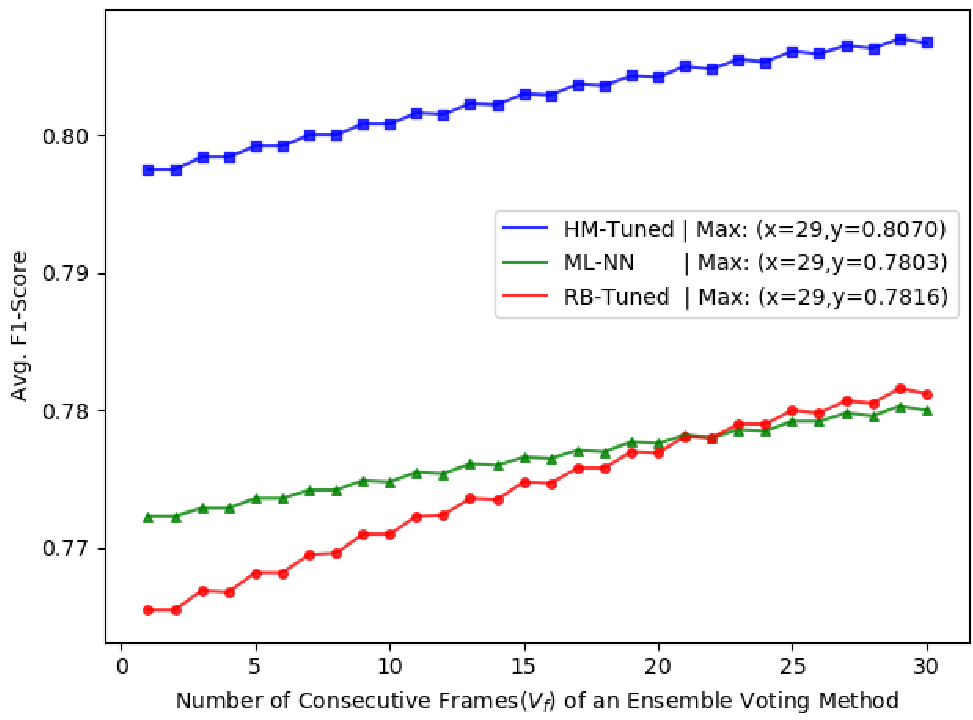
To avoid "flickering" feedback (where a robot shouts corrections too quickly due to sensor noise), the authors implemented an Ensemble Voting method. It looks at a window of frames (up to 30 frames or ~1 second) and only triggers a correction if the majority of frames agree that an error is occurring.
Experiments: Proving the Value of Hybridization
The team tested the system on three specific tasks: a drinking motion (Ex 1), touching a light switch (Ex 2), and elbow extension (Ex 3).
SOTA Comparison
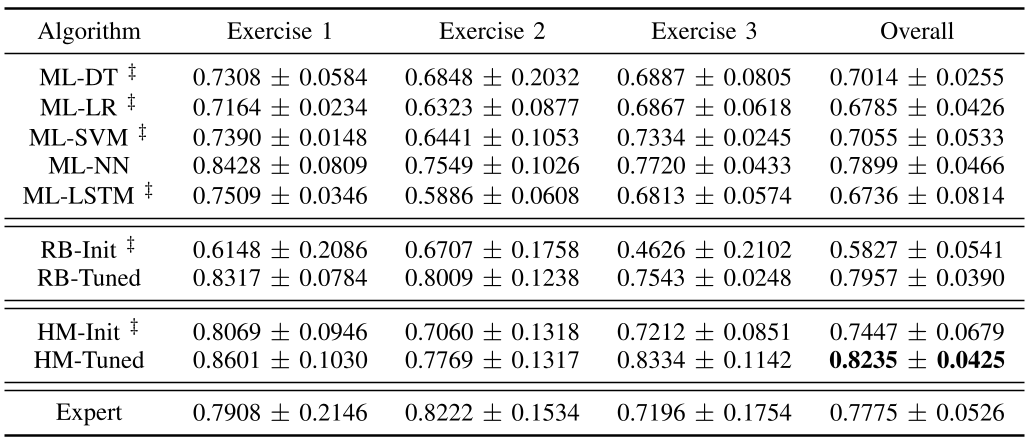
As shown in the data, the HM-Tuned (Hybrid Model with personalized tuning) achieved the highest overall agreement with experts (0.8235 F1-score), outperforming pure NNs, LSTMs, and even standard human-level agreement in some sub-tasks.
The Temporal Factor
By increasing the voting window (), the team demonstrated a significant increase in the robustness of frame-level assessment. The performance peaked around , proving that temporal context is vital for clinical accuracy.
Deep Insight: Why Not Just Use Deep Learning?
The authors make a compelling argument against "Deep Learning-only" approaches in healthcare. While an NN can tell you that a movement is wrong, it cannot easily tell you why in a way that a patient understands. By keeping the Rule-Based component, the robot can generate specific, transparent feedback like: "Keep your head straight and do not raise your shoulder." This level of transparency is non-negotiable for patient trust and effective motor relearning.
Conclusion & Future Outlook
This paper serves as a blueprint for Human-AI Collaboration in rehabilitation. By treating the patient's own body as the baseline (via unaffected limb tuning) and mixing expert logic with big-data insights, we move closer to robots that can truly replace a therapist's watchful eye during home-based recovery.
Future Work: The next step is evaluating the long-term clinical outcomes—does this personalized feedback actually lead to faster recovery compared to generic robot prompts?