
Personalized Language Modeling: Leveraging the Social Graph for Smarter Voice Access
Personalized language modeling by crowd sourcing with social network data for voice access of cloud applications
This paper introduces a personalized language modeling (PLM) framework for voice access on smartphones by leveraging social network data. It utilizes n-gram interpolation with weights derived from social relationships (REL), Latent Dirichlet Allocation (LDA) topic similarity, and Random Walk (RW) on user graphs to achieve SOTA-level personalization on Facebook datasets.
TL;DR
This research addresses the "cross-individual linguistic mismatch" in speech recognition by "crowd-sourcing" training data from a user's social network. By analyzing who a user interacts with on platforms like Facebook, the system builds an adaptive Language Model (LM) that understands personal slang, topics, and wording habits. The result? A significant boost in recognition accuracy and a massive drop in model perplexity.
Background: The Limits of One-Size-Fits-All Models
In the era of cloud-based voice assistants, most models are "domain-adapted" (e.g., they know "medical" vs. "sports" terms). However, they often fail to capture the nuances of individual users—what the authors call Personalized Language Modeling (PLM).
The problem is two-fold:
- Data Scarcity: A single user rarely writes enough text to train a robust N-gram model.
- Topic Volatility: Social media posts are disjointed. What you talk about today (a vacation) might have nothing to do with what you post tomorrow (a technology review).
The Insight: You Are Who You Follow
The authors' core hypothesis is that users with close social relationships share common subject topics, wording habits, and linguistic patterns. If I don't have enough of your data, I can use the data of your friends—weighted by how much you actually interact with them.
Methodology: From Social Graphs to Mathematical Weights
The framework (shown below) uses a web crawler to gather a target user's corpus () and their friends' corpora ().
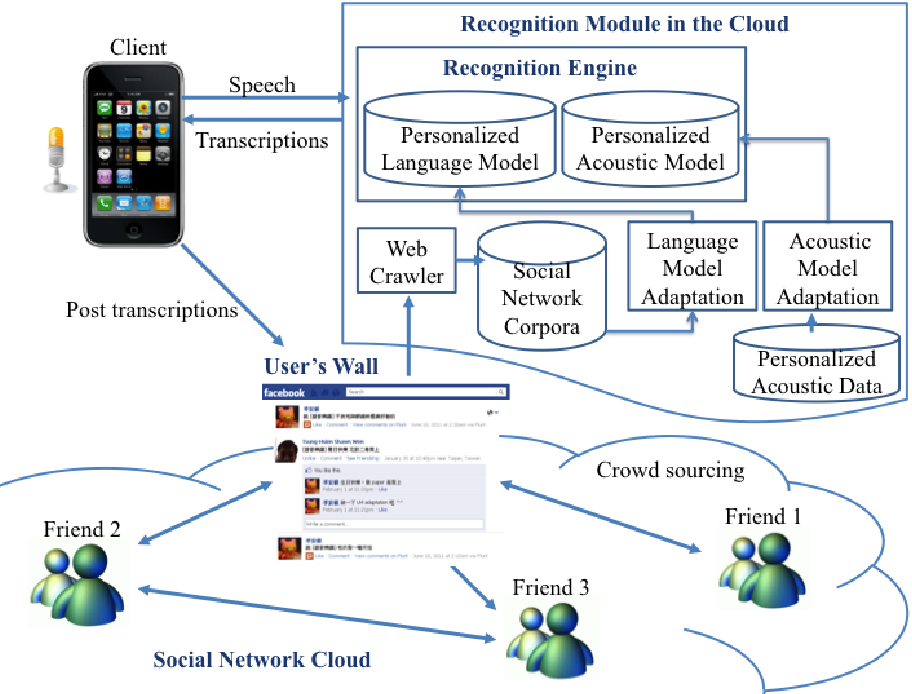
The paper proposes three sophisticated weighting schemes () for the interpolation:
1. Social Network Relationships (REL)
Instead of assuming all friends are equal, the model looks at interaction features:
- Number of common friends.
- Likes and comments exchanged between users.
- Commonly joined groups.
2. Latent Topic Similarity (LDA)
By treating each user's entire history as a "document," the system uses Latent Dirichlet Allocation to find users who discuss similar hidden topics, even if they aren't direct friends.
3. Random Walk Over a User Graph (RW)
To capture "global" influence, the authors built a directed graph where nodes are users and edges are topic similarities. They ran a Random Walk algorithm, allowing linguistic influence to propagate through the network. This ensures that a "friend of a friend" who shares your niche interests still contributes to your model.
Experimental Battleground: Facebook Data
The team tested the system on 21 target users and over 12,000 "other" users from Facebook, representing 280,000 sentences.
Key Findings:
- Perplexity Reduction: As more personal corpora were added, perplexity (a measure of how "confused" the model is) dropped sharply.
- REL vs. LDA: Social features (REL) worked best for the first 100 friends, but for scaling to thousands of users, the LDA topic-based similarity became more effective.
- Recognition Accuracy: The "Combined" method yielded the best performance, especially when paired with Speaker Adaptation (MLLR).
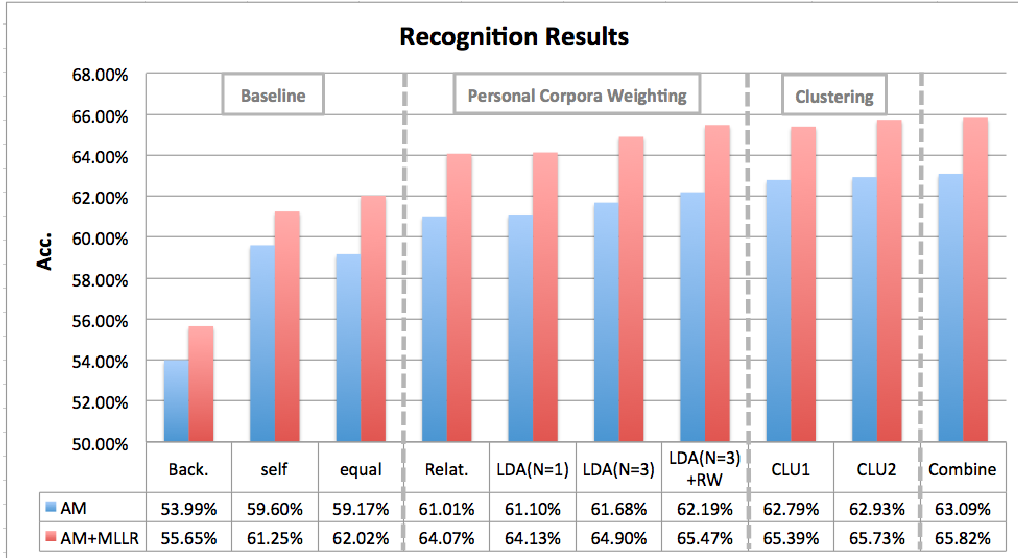
As seen in the chart, the proposed methods (REL, LDA, CLU) consistently outperform the baseline BACK (background model) and even SELF (using only the user's own data), proving that crowd-sourcing linguistic data from social circles effectively solves the data sparsity problem.
Critical Insight & Future Outlook
This work was a pioneer in treating social connectivity as a feature for NLP. While modern LLMs now use massive datasets, the "Personalization" problem remains unsolved for many edge devices and privacy-centric applications.
Limitations: The reliance on N-grams is dated by today's standards (compared to Transformers), and the framework requires explicit permission to crawl social data, raising modern privacy concerns.
The Takeaway: The next generation of personalized AI won't just look at your history; it will look at the context of your community to predict what you'll say next.