
PMPR: Beyond Follower Counts—Probabilistic Ranking for Optimal Social Mentions
Personalized Mention Probabilistic Ranking – Recommendation on Mention Behavior of Heterogeneous Social Network
The paper introduces Personalized Mention Probabilistic Ranking (PMPR), a recommendation system designed to suggest suitable users for "@mentions" on micro-blogging platforms like Weibo. By employing a factor graph model on a heterogeneous social network, it predicts which candidates have the highest capability and likelihood to facilitate information diffusion.
TL;DR
Mentioning the right person on social media ("@username") is more than just tagging a celebrity. This paper proposes Personalized Mention Probabilistic Ranking (PMPR), a factor-graph-based system that predicts not just who can spread your message, but who is actually likely to do so. By analyzing 20 million Weibo tweets, the researchers achieved an 80% improvement in ranking quality (NDCG) over traditional collaborative filtering.
The "Celeb-Mention" Fallacy: Why Current Recommendations Fail
Most users instinctively mention accounts with millions of followers to maximize exposure. However, from a recommendation system perspective, this is often a dead end. Prior works, such as "Whom-to-mention" (WTM), focused heavily on Capability—the potential reach based on a candidate's followers.
The authors identify two fatal flaws in this approach:
- Low Responsiveness: A celebrity with 10M followers who never interacts is less valuable than a peer with 1k followers who retweets your content.
- Query Invariance: If the recommendation is only based on follower count, the same list of users is suggested for every tweet, regardless of whether the topic is "AI research" or "Cooking recipes."
Methodology: The PMPR Factor Graph
To solve this, PMPR frames recommendation as finding the maximal capability AND possibility of interaction. They utilize a Factor Graph Model, which is uniquely suited for heterogeneous networks where both node attributes (user profiles) and edge relationships (who gets mentioned together) matter.
1. Feature Engineering: The Pillars of Prediction
The model relies on two categories of features:
- Individual Features: includes Historical Interaction Score (HIS)—the strongest predictor—alongside Social Influence (followers) and Recent Activity (how often they tweet/retweet).
- Tweet Features: Uses TF-IDF and Cosine Similarity to ensure the candidate's interests align with the tweet content.
2. The Factor Graph Architecture
The system models the joint distribution of mention probability. It uses Attribute Functions to capture the "fit" between a tweet and a user, and Edge Functions to capture the structural correlation (e.g., if User A is often mentioned alongside User B).
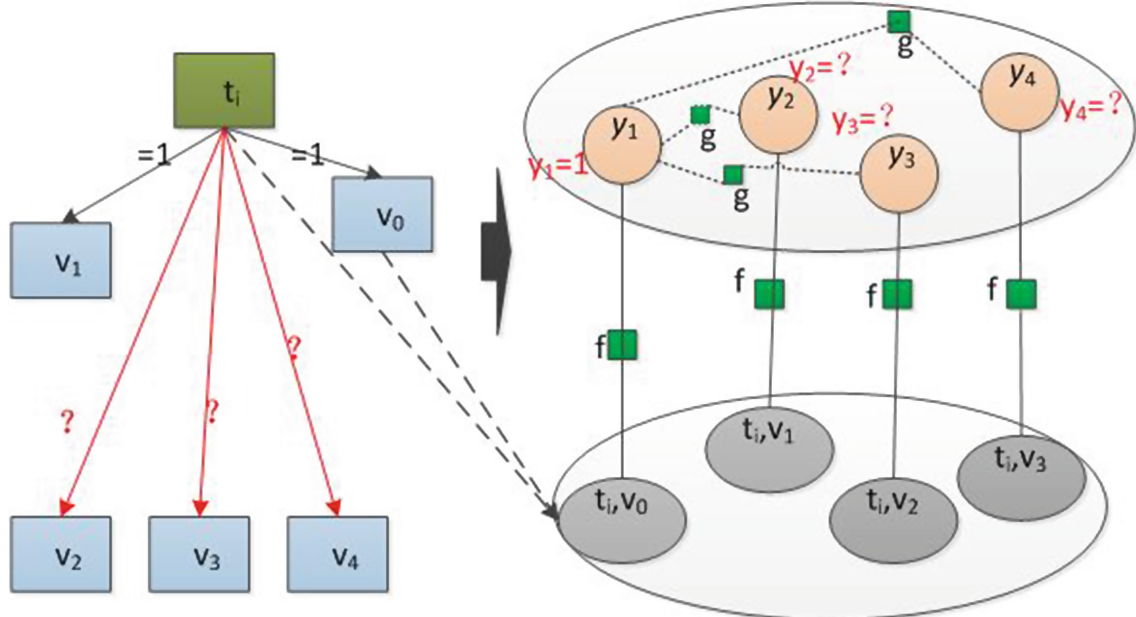 Figure 1: The Factor Graph representation showing the relationship between tweet nodes (t), user nodes (v), and the hidden mention probability (y).
Experimental Battleground: PMPR vs. The World
The researchers crawled a massive dataset from Sina Weibo (20,000 users) and compared PMPR against Baselines like Influence-based (IBR), Content-based (CR), and Collaborative Filtering (CF).
Key Result: Dominating the Metrics
PMPR consistently outperformed every baseline across Precision, Recall, MAP, and NDCG.
- Precision: Surpassed CF by over 50%.
- NDCG: Improved by 80% over CF, proving that the ranking order was significantly more accurate.
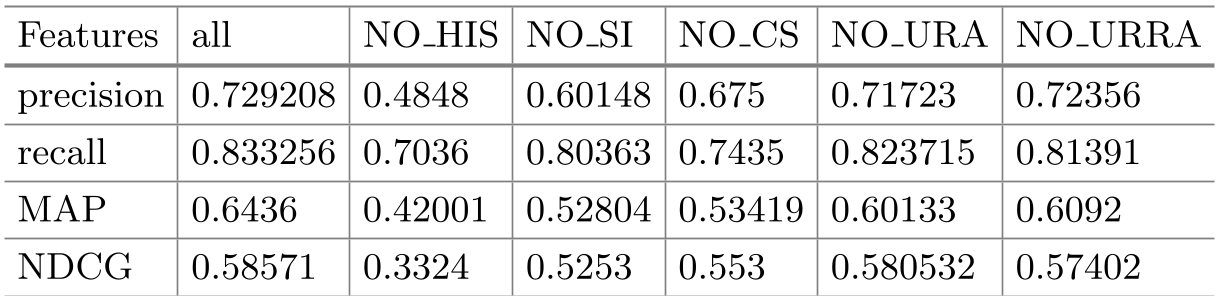 Table 1: Ablation study showing the impact of different features. Removing HIS (Historical Interaction) caused the most significant performance drop.
Deep Insight: What Truly Drives Mentions?
The ablation study (Table 1) reveals a striking truth about social behavior: Familiarity is King.
- HIS (History) was the most vital feature. Users tend to mention those they have interacted with previously, regardless of the person's fame.
- Social Influence matters but is secondary to content relevance.
- User Activity (how much they tweet generally) had surprisingly little impact, suggesting that the quality of past interactions matters more than the quantity of global activity.
Conclusion and Future Outlook
PMPR demonstrates that successful social recommendation isn't about finding the "biggest" node in the network; it's about finding the most "active link" between the content and the candidate. While the model is highly effective, the reliance on historical interaction suggests a potential "cold-start" problem for new users—a challenge that future iterations using Deep Graph Learning could potentially solve.
Takeaway for Practitioners: When building recommendation engines for social interaction, prioritize interaction history and topical alignment over vanity metrics like follower counts.