
Personalized Mobile SNS: Fusing Location Context with Collaborative Filtering
Personalized Mobile Social Network System Using Collaborative Filtering
The paper introduces a personalized mobile Social Network System (SNS) that integrates Location-Based Services (LBS) with Collaborative Filtering (CF). It features two core modules, the Distance Filtering Module (DFM) and the Preference Filtering Module (PFM), to provide real-time, location-aware content recommendations.
TL;DR
Mobile social networks often suffer from information overload. This research proposes a hybrid system that converges Location-Based Services (LBS) and Collaborative Filtering (CF). By using a Distance Filtering Module (DFM) to prune candidates and a Preference Filtering Module (PFM) to rank them, the system achieves a state-of-the-art Mean Absolute Error (MAE) of 0.5406, proving that geographic context significantly boosts recommendation accuracy.
The Motivation: Moving Beyond Static City Guides
Prior to the rise of intelligent mobile SNS, location services were largely "digital maps" with static annotations. They lacked the "social" and "personal" dimensions—knowing that a user is near a coffee shop is useless if the system doesn't know that specific user hates espresso but loves lattes.
The authors identified a critical gap: standard Recommendation Systems (RS) work well for e-commerce (like Amazon) but struggle with the real-time constraints and data sparsity of mobile environments. By filtering by distance first, they realized they could solve the "scalability problem" of memory-based CF.
Methodology: The Dual-Filter Architecture
The system's core intelligence resides in two distinct modules:
1. Distance Filtering Module (DFM)
The DFM acts as a spatial heuristic. It calculates the distance between the user and location-tagged content using latitude/longitude offsets. By restricting the recommendation engine to a specific radius, the system provides immediate local relevance and reduces the computational load on the recommendation engine.
2. Preference Filtering Module (PFM)
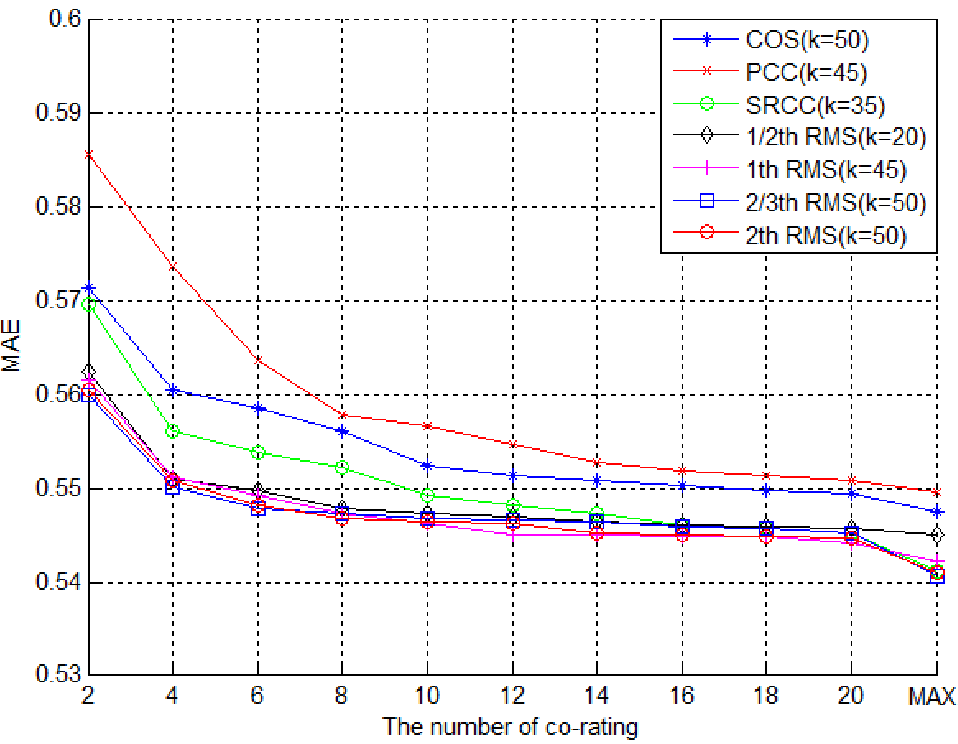
Once the candidates are spatially filtered, the PFM predicts the user's rating. While they compare standard Cosine and Pearson (PCC) metrics, the standout is the Row Moment-based Similarity (RMS), which handles cases where users have very few overlapping ratings (the sparsity problem).
Experiments and SOTA Analysis
The researchers collected 9,473 rating data points from 52 users over one year. The results were striking:
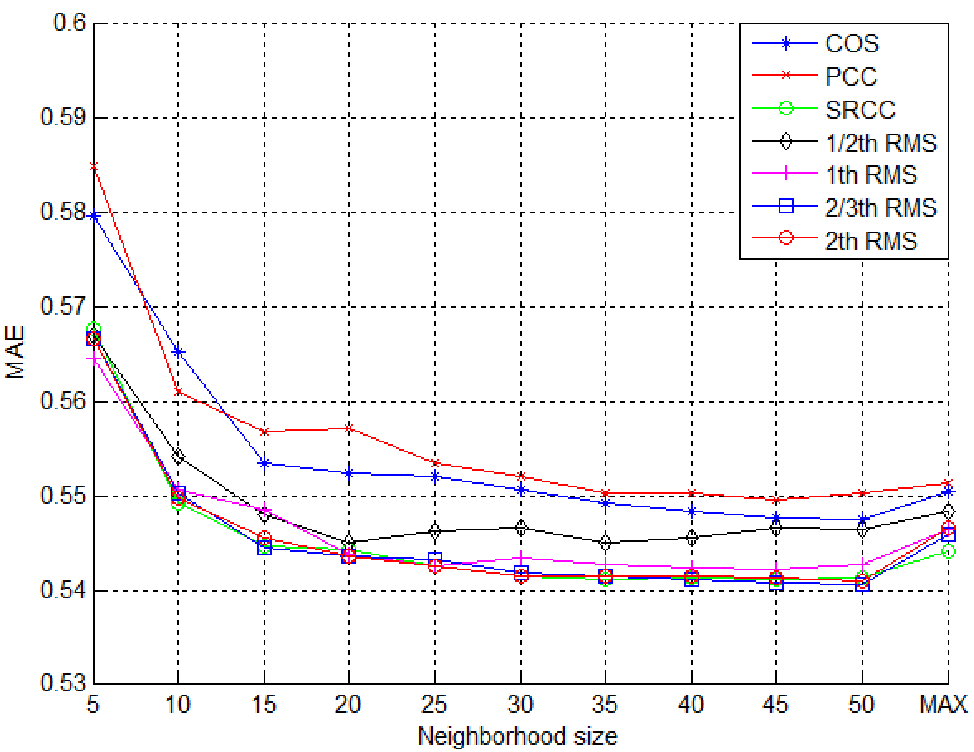
- Prediction Accuracy: The system achieved an MAE of 0.5406. For context, the standard MovieLens 100k benchmark for the same rating scale usually hovers between 0.73 and 0.75.
- Robustness: As shown in the sparsity experiments, as the number of "co-rated" items drops, traditional methods like Cosine Similarity fail rapidly. However, their proposed RMS-based filtering maintained much higher stability.
Critical Insight: Why Does LBS + CF Work So Well?
The "secret sauce" here isn't just a better math formula; it's the Inductive Bias of geography. People who visit the same locations often share similar demographic backgrounds or lifestyle preferences. By "hard-coding" distance into the recommendation pipeline, the model effectively eliminates the "noise" of irrelevant global content, allowing the CF algorithm to focus on a more homogenous and relevant subset of users.
Conclusion & Future Outlook
This work bridges the gap between social connectivity and spatial awareness. While the prototype focused on smartphone images, the authors envision this framework expanding into:
- Car Navigation: Recommending rest stops based on driver history.
- Smart TV: Fusing household location with viewing habits.
Limitations: The study relies on a relatively small user base (52 users). In a massive-scale deployment (millions of users), the memory-based CF might still require transition to a model-based (Latent Factor) approach to maintain real-time performance.
Summary Statement: This paper demonstrates that the convergence of LBS and RS identifies a "sweet spot" in mobile computing—where physical proximity acts as a powerful filter for digital preference.