
Personalized News Feeds: Beyond Convenience to Community Sustainability
Personalized Network Updates: Increasing Social Interactions and Contributions in Social Networks
This paper presents a personalized relevance model for social network (SN) news feeds, utilizing user-to-user relationship strengths and user-action interest scores. Implemented in a live eHealth portal, the system successfully filters content to increase user engagement and content contribution.
TL;DR
The "Information Overload" in social networks isn't just a nuisance—it’s a barrier to community growth. This paper introduces a personalized feed algorithm that ranks items based on relationship strength and action interest. Tested on a live eHealth platform, the results prove that visibility equals vitality: by surfacing the most relevant updates, users not only find info faster but also contribute significantly more to the community.
Problem & Motivation: The Breaking Point of Chronological Feeds
Modern social networks (SNs) like Facebook have long moved past the point where a simple reverse-chronological list (the "River of News") is sustainable. When a user has 130+ friends and follows 80+ communities, the noise-to-signal ratio spikes.
The authors argue that this "data deluge" doesn't just annoy users—it stops them from interacting. If you don't see what your friends are doing, you don't comment. If you don't comment, the community dies. Prior work concentrated on predicting tie strength, but this study asks a deeper question: Can personalized filtering actually change user behavior and increase content contribution?
Methodology: The Anatomy of Relevance
The authors define relevance through a linear combination of who you are interacting with and what they are doing.
1. The Scoring Formula
The relevance score is calculated as: By assigning 80% weight to the user relationship (), the model prioritizes who performed the action, which the authors argue is the primary driver of social interest.
2. Deep Tie-Strength Features
The system tracks 60 distinct factors across four categories:
- Direct Interaction (DIF): The most influential category (weight 0.61), tracking direct replies, ratings, and friendship duration.
- Mutual Connections (MCF): Social proximity based on shared friends.
- User/Subject Factors (UF/SUF): General activity levels of both the observer and the performer.

Experiments & Results: Sparking the Social Flame
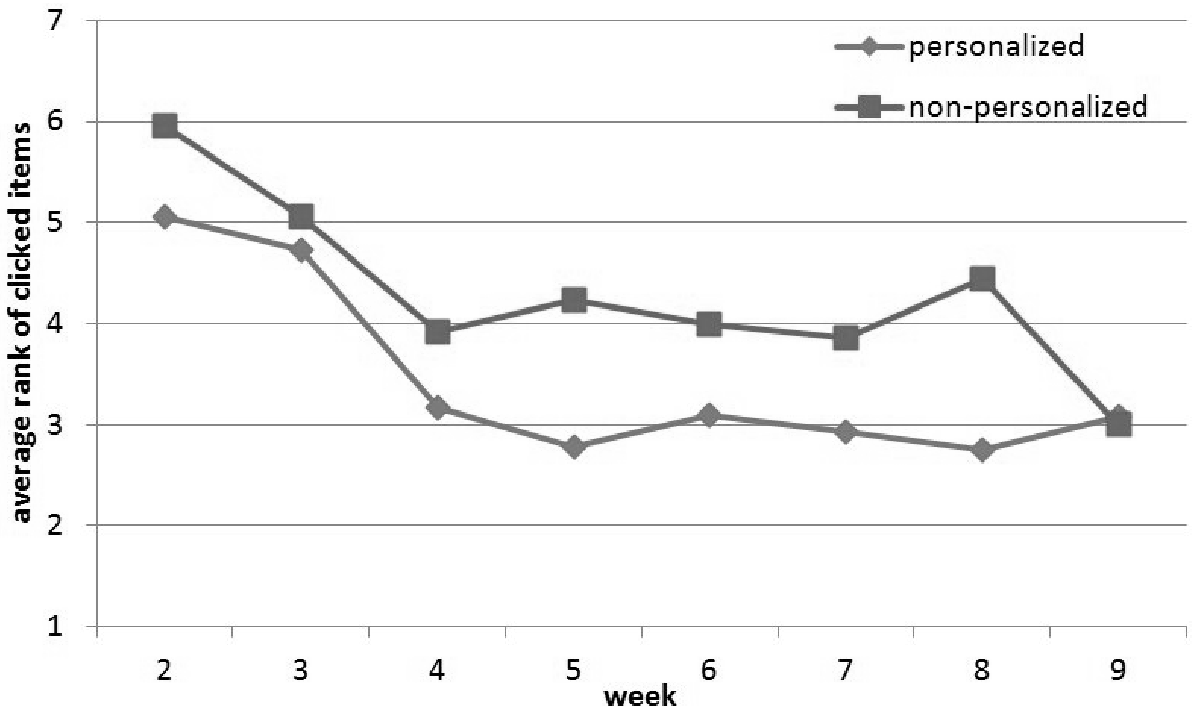
The study was conducted in a live eHealth portal (The TWD Portal) with a randomized control trial. Half the users saw personalized feeds; the other half saw standard chronological feeds.
Higher Precision, Better Engagement
Personalization successfully "pushed" relevant items to the top. The top position in personalized feeds captured 30.9% of all clicks, double that of the control group.
The "Knock-on" Effect on Contribution
The most striking finding was the impact on User-Generated Content (UGC). Users with personalized feeds didn't just consume more; they did more:
- Wall Postings: Increased from 0.31 to 0.71 per session (over 100% increase).
- Blog Contributions: Significant uptick in both posting and responding.
- Profile Views: Jumped from 4.16 to 7.35 per session.

Critical Analysis & Conclusion
The "Personalization Bubble" Myth
One common fear with personalization is the "Filter Bubble"—that users stop seeing new people. Interestingly, this study found the opposite: although the algorithm prioritized friends, over 70% of the feed content remained non-friend activities, ensuring users were still exposed to the wider community.
Limitations
- Weight Sensitivity: The 0.8/0.2 weight split was static. A more sophisticated model might learn these weights dynamically per user.
- Low Initial Interaction: The absolute number of "Feed Clicks" was lower than expected, suggesting that even with personalization, the Feed is only one secondary discovery channel.
Final Takeaway
For product designers and researchers, this paper proves that filtering is not just about saving time; it's about social reinforcement. By making the activities of close peers visible, algorithms can solve the "cold start" and "lurker" problems in online communities, driving meaningful contributions and long-term user retention.
Senior Editor's Note: This paper remains a foundation for understanding the behaviorist impact of Recommender Systems on social dynamics.