
PRemiSE: Bridging Content, Collaboration, and Implicit Social Experts for SOTA News Recommendation
Personalized news recommendation via implicit social experts
The paper introduces PRemiSE (Personalized news Recommendation via implicit Social Experts), a hybrid framework that integrates content-based filtering, collaborative filtering, and information diffusion models. By extracting a virtual social network from implicit feedback, it leverages "social experts" to achieve SOTA performance in handling news data sparsity and the cold-start problem.
TL;DR
The recommendation of news is a "moving target" problem due to rapid item decay and sparse user interaction. This paper presents PRemiSE, a hybrid framework that solves the cold-start issue by identifying implicit social experts from raw logs. By combining Probabilistic Matrix Factorization (PMF) with information diffusion theory, it transforms sparse binary clicks into a rich, semantically aware recommendation engine.
The "Short Shelf-Life" Challenge
Unlike movies or books, news stories have a "short shelf life." Standard Collaborative Filtering (CF) relies on finding users with similar taste, but if User A reads a story on Monday and User B reads a similar story on Tuesday, their interaction logs might never overlap because news moves too fast. This leads to:
- Extreme Sparsity: The user-story matrix is mostly zeros.
- Cold-Start Paralysis: Systems can't recommend a "New Item" because no one has clicked it yet, and can't serve a "New User" because their profile is empty.
Methodology: The PRemiSE Framework
PRemiSE approaches the problem through three distinct lenses:
1. Matrix Manipulation (The "Densitification" Step)
Instead of just using binary 0/1 (clicked/not clicked), the authors utilize Named Entities (e.g., "Apple", "Federal Reserve") as the bridge. If you haven't clicked a specific story but have clicked stories with the same entities, PRemiSE calculates a missing usage probability, filling the matrix before factorization begins.
2. The Expert Model (Implicit Social Network)
The authors observe that information "diffuses." If User A clicks a series of stories and User B consistently clicks them shortly after, User A is an Implicit Expert for User B.
- Global Experts: Users whose choices trigger widespread trends.
- Local Experts: Users who specifically influence an individual's niche interests.
3. Unified Probabilistic Model
The core of PRemiSE is a PMF objective function that balances:
- Personal Interest: The user's latent preference vector.
- Expert Influence: The weighted opinions of identified influencers.
- Content Semantics: Word distributions tied to latent factors.
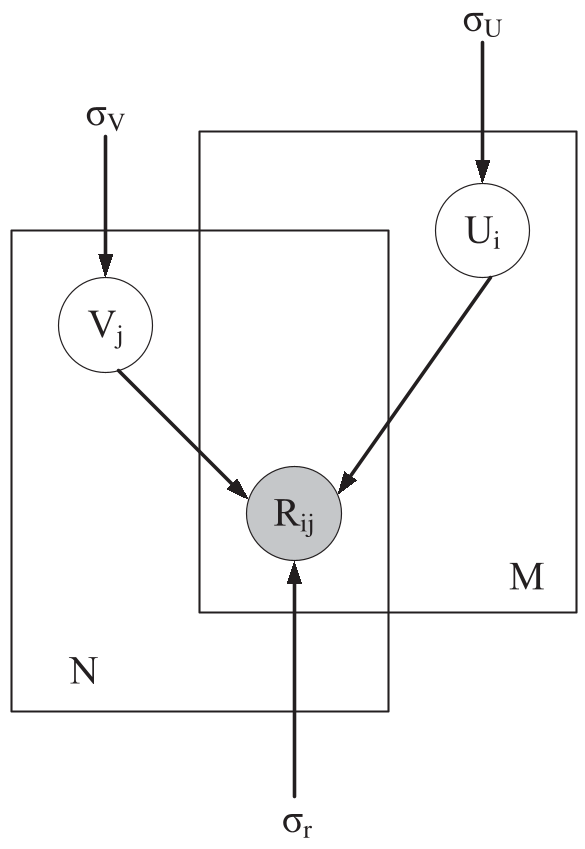 Note: The probabilistic graphical model (a) shows basic PMF, while (b) integrates expert influence and word distributions.
Experimental Insights
The authors tested PRemiSE against traditional benchmarks (CF, MF, and LDA) on a massive dataset of 2 million visiting records.
Performance in Cold-Start
A standout result of the paper is its performance in Cold-Start categories (New Item/New User). While standard Matrix Factorization falls apart with "Zero-shot" users, PRemiSE leverages the "Expert" latent factors to provide a high-quality initial recommendation.
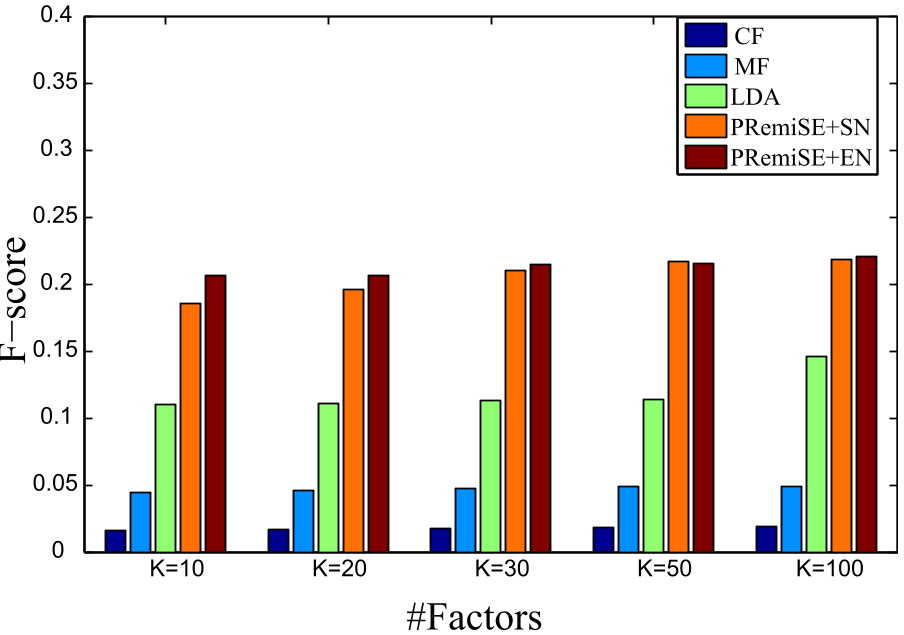 The charts clearly show PRemiSE (both Story and Entity-based versions) maintaining consistent F-scores across varying factor counts ().
Critical Insight: Why it Works
The "magic" of PRemiSE lies in its semantic interpretability. Unlike black-box CF, the factors in PRemiSE correlate directly with topical words (e.g., "Hollywood" for entertainment factors). By anchoring social influence to these semantic factors, the model ensures that an "expert" in Economics doesn't accidentally influence your recommendations for Movies.
Conclusion & Future Look
PRemiSE proved that "social" isn't just about who we follow on Twitter—it's about the implicit paths of information diffusion found in our behavior. While this work was pioneered using PMF, the same logic—mapping influence through implicit expert discovery—is now a foundational concept in Graph Neural Networks (GNNs) for modern recommendation systems.
Key Limitation: The computational overhead of constructing the implicit social network is high, requiring O(N) linear complexity but large memory for edge weights. Moving forward, dynamic graph sampling could make this framework even more scalable for real-time portals.