
Linking Social Islands: A Semantic Approach to Cross-Domain Photo Recommendation
Personalized Photo Recommendation By Leveraging User Modeling On Social Network
The paper introduces a cross-domain photo recommendation framework that integrates Facebook and Flickr data using Semantic Web technologies. By leveraging Linked Open Data (LOD) via DBpedia and the FOAF ontology, it builds enriched user profiles to provide personalized image suggestions based on social interactions and semantic tags.
TL;DR
This research tackles the "Data Island" problem by merging Facebook's rich social graph with Flickr's high-quality metadata. By using Linked Open Data (LOD) and Semantic Web ontologies, the authors create a unified user profile that significantly improves personalized photo recommendations by understanding the "why" behind a user's social interactions.
Background: The Fragmented Social Web
In the early 2010s, the web began to fracture into closed silos. Facebook held the social context (who you know), while Flickr held the artistic context (high-quality photos and technical tags). However, these platforms didn't talk to each other. Facebook's compression stripped EXIF data, and its "tags" were often just notifications to friends rather than descriptive keywords. The authors identified that to offer truly personalized recommendations, one must bridge these islands into a "Web of Data."
Methodology: Semantic Enrichment & User Modeling
The core innovation lies in the Extraction Manager and the subsequent Semantic Enrichment phase.
1. Cross-Domain Identity Resolution
The system attempts to link Facebook and Flickr profiles using a multi-field similarity function. It doesn't just look at names; it uses a weighted approach:
- High Weight: Email (the "gold standard" for identity).
- Medium Weight: Full name and Nickname.
- Low Weight: Overlapping social tag sets.
2. The Power of Linked Open Data (LOD)
Instead of treating tags as mere strings, the authors use DBpedia Spotlight to transform them into semantic entities. For instance, the word "Oslo" is no longer just a four-letter string; it is linked to http://dbpedia.org/resource/Oslo. This allows the system to understand that "Oslo" is a place, enabling it to pull in geospatial information via the GeoNames Ontology.
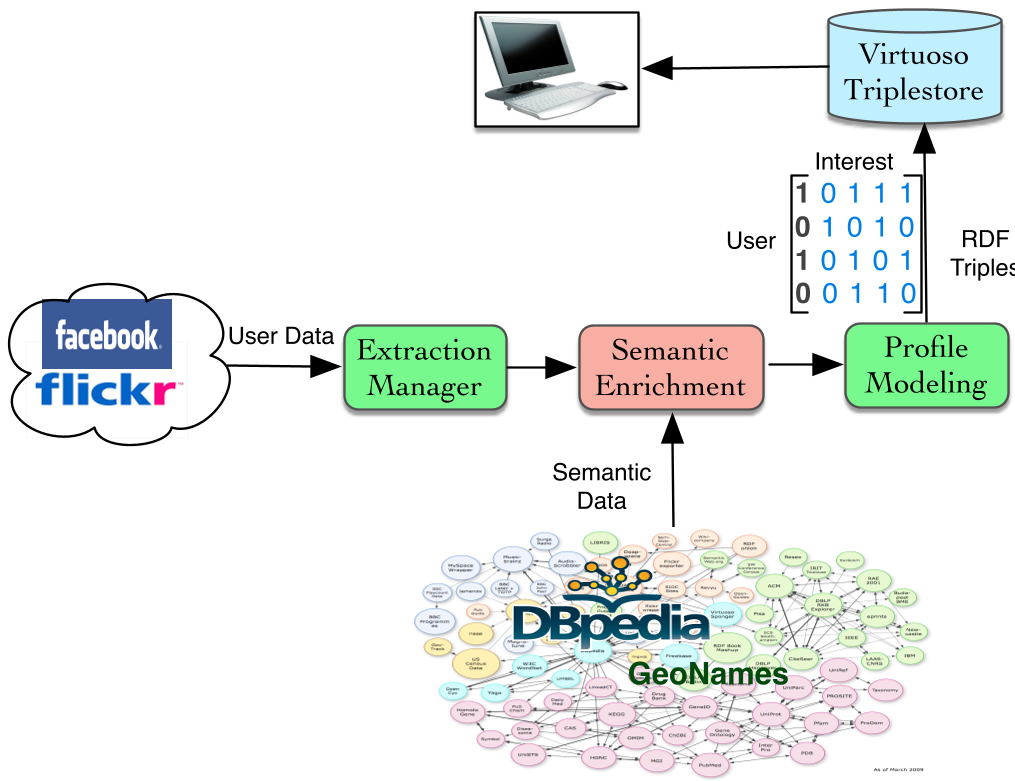 Figure 1: The architecture of the cross-domain recommendation framework, showing the flow from raw social data to semantic RDF triples stored in Virtuoso.
3. Ontology Modeling
The researchers extended the FOAF (Friend of a Friend) ontology to include "SocialThings." This allowed the model to represent not just who a person is, but the nuances of their interactions—such as what photos they are "depicted" in vs. what photos they simply "like."
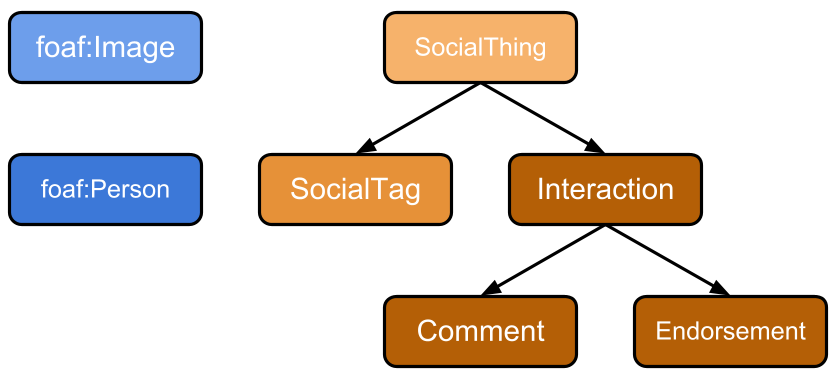 Figure 2: The expanded ontology classes used to bridge FOAF personal data with social interactions and tags.
Experiments & Results: Beyond Individual Interests
A key insight in the recommendation logic is the use of Ranked Friends. The system doesn't just recommend photos based on your tags; it considers your "Group Interest Set" ().
If your closest friends are all interested in "Sunsets," the system assumes a higher likelihood that you will enjoy sunset photos even if you haven't explicitly tagged one. The recommendation is calculated using the Euclidean distance between a photo's tag vector () and the group interest vector ():
This approach mitigates the cold-start problem and addresses the sparsity of social tags. By analyzing interactions like "likes" and "comments" (as opposed to just static profile fields), the system captures the dynamic reputation and relationship strength between users.
Critical Analysis & Conclusion
Takeaway
The paper successfully demonstrates that the Semantic Web is not just a theoretical construct but a practical tool for data integration. By using URIs instead of strings, recommendation engines can "understand" context across platform boundaries.
Limitations
- Email Privacy: As the authors noted, users are often wary of sharing emails, which is the most reliable bridging feature.
- Latency: Real-time RDF triple generation and DBpedia lookups can be computationally expensive compared to traditional collaborative filtering.
- Evolution of Platforms: In the modern era, API restrictions (like those implemented by Meta/Facebook) make this type of automated harvesting significantly more difficult than it was in 2013.
Future Outlook
This work pre-empted the current move towards Knowledge Graph-based Recommendation Systems. Applying Large Language Models (LLMs) to the semantic triples captured here could provide even deeper reasoning capabilities, moving from "distance-based" matches to "intent-based" understanding.