
Collective Intelligence: Personalizing the Web for Language Learners
Personalized reading support for second-language web documents by collective intelligence
The paper introduces a personalized glossing system for second-language web documents that uses "Collective Intelligence" to predict unknown words. It combines Item Response Theory (IRT) with Logistic Regression (LR) to estimate both user language ability and word difficulty from click logs, significantly reducing the need for manual dictionary consultation.
TL;DR
Reading a foreign language on the web often feels like a constant battle with the dictionary. This paper presents an intelligent system that predicts which words you specifically don't know and automatically provides translations (glosses) for them. By treating word clicks as "test responses," the system uses Item Response Theory (IRT) and Stochastic Gradient Descent (SGD) to map your vocabulary size in real-time, reaching 80% prediction accuracy with minimal user input.
Background: Beyond the Static Dictionary
Most reading aids are passive; they wait for you to hover over a word. This creates significant "interaction friction." The authors argue that a system should be proactive. However, predicting what a user knows is hard because word difficulty isn't just about frequency—it's about the learner's specific level. The core insight here is to harness Collective Intelligence: if many users click a "common" word for its meaning, that word is objectively difficult for that cohort, regardless of what a corpus says.
Methodology: The Math of Knowing
The researchers bridge the gap between psychometrics and machine learning by using the Rasch Model.
1. The Probabilistic Model
The probability that a user knows a word is modeled using the sigmoid function: Where:
- : The user's latent language ability.
- : The inherent difficulty of the word.
2. Implementation via Logistic Regression
By reframing this as a Logistic Regression problem, the authors can add additional features () like Google 1-gram frequencies and the Standard Vocabulary List (SVL) levels to bolster the prediction, especially when data for a specific user is sparse.
3. Online Adaptation with SGD
Since web users need immediate results, the system couldn't wait for batch processing. They used Stochastic Gradient Descent (SGD). This allows the model to update the user's ability parameter () immediately after every single click, allowing the "personalized" experience to improve within seconds of browsing.
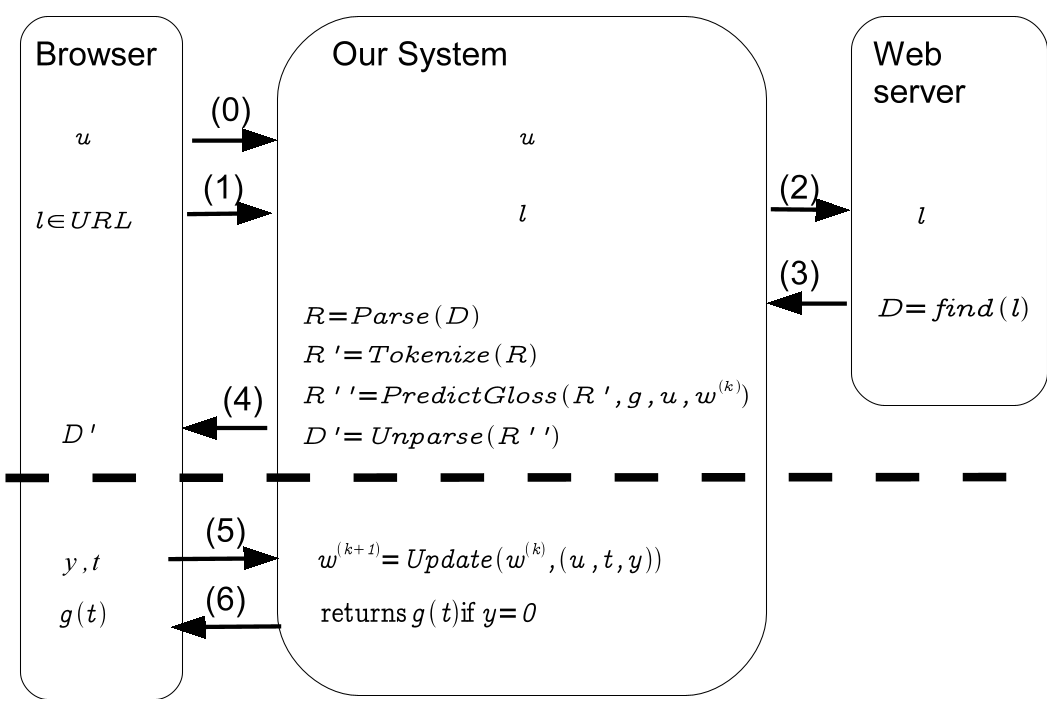 Figure 1: The system workflow—extracting text, predicting unfamiliar words, and updating the model via AJAX-based click logs.
Experiments & Results
The study evaluated the system on 16 human subjects across 12,000 words.
- Feature Power: Adding word difficulty features (LR) improved accuracy by over 5% compared to the basic Rasch model (IRT).
- Speed of Learning: SGD was the clear winner for "cold-start" scenarios. With only 10 clicks, SGD was more accurate than complex batch-trained Support Vector Machines (SVM), showing its utility for rapid user adaptation.
- Performance Ceiling: The system hit a "saturation point" at around 80% accuracy. This suggests that while collective intelligence is powerful, some word knowledge is highly idiosyncratic or context-dependent.
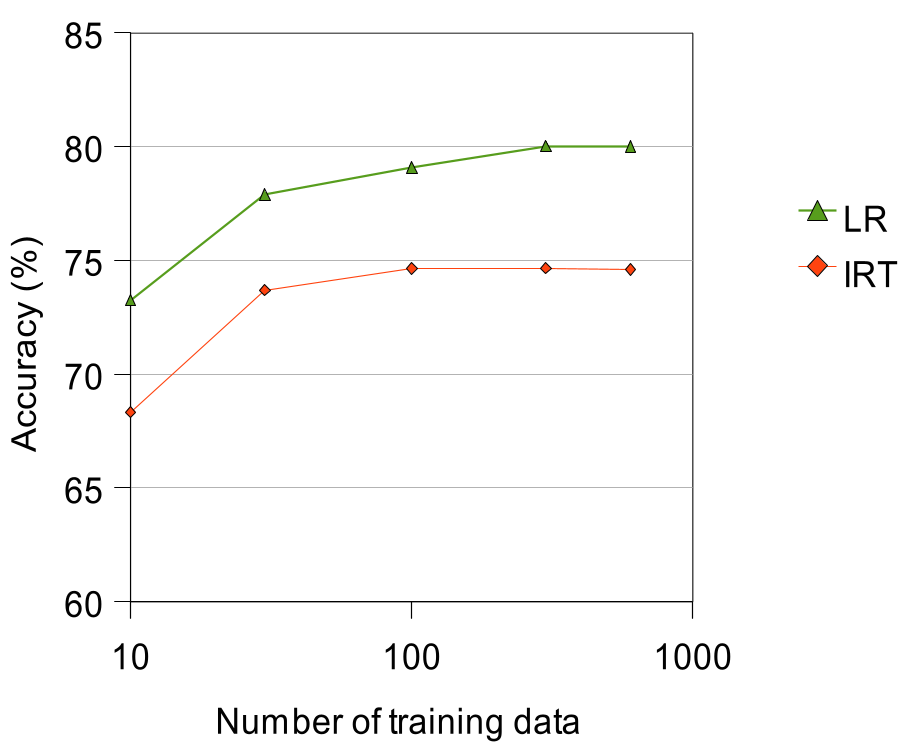 Figure 2: Performance gap between basic IRT (blue) and the proposed Logistic Regression model with word features (red).
Critical Insight & Conclusion
This paper is a classic example of Implicit Feedback design. Instead of making users take a placement test, the system treats the "act of reading" as the test itself.
Takeaways:
- Inductive Bias: Incorporating domain-specific knowledge (like IRT from the testing industry) into standard ML classifiers (Logistic Regression) provides a better starting point than "blind" ML.
- Online is Key: In UX, the ability to adapt to a user within 5 minutes (30 clicks) is far more valuable than a perfect model that requires 1,000 data points.
Limitations: The 80% accuracy ceiling indicates that future work should perhaps look at sentence context. A user might know "bank" in a financial context but not in a geographical one—a nuance current IRT-based word-level models miss.