
Harmonizing Location and Interest: A Real-time Architecture for Mobile Content Recommendation
15099_Personalized real-time location-tagged contents recommender system based on mobile social networks.
This paper introduces a personalized real-time recommender system specifically designed for location-tagged multimedia content in mobile social networks. By integrating a Distance Filtering Module (DFM) and a Preference Filtering Module (PFM) using Collaborative Filtering (CF), the system achieves state-of-the-art accuracy in predicting user interests within specific geographic radii.
TL;DR
The explosion of location-tagged media (photos, videos, check-ins) has created a "needle in a haystack" problem for mobile users. This paper presents a dual-layer system that first filters content by physical proximity (Distance Filtering) and then ranks it using high-accuracy Collaborative Filtering (Preference Filtering). The result is a highly responsive system that outperforms traditional recommendation benchmarks with a superior MAE of 0.548.
Contextual Positioning
While most recommendation engines (like those on Netflix or Amazon) operate in a non-spatial vacuum, the mobile experience is inherently tied to where the user is. This research serves as a bridge, successfully converging Location-Based Services (LBS) with personalized Social Network Services (SNS).
The Core Conflict: Scalability vs. Personalization
Traditional Collaborative Filtering (CF) is notoriously "heavy." As the number of users and contents grows, the calculation cost for finding similarities skyrockets. In a mobile environment, waiting seconds for a recommendation is unacceptable.
The authors' insight is elegant: Why calculate preferences for content 1,000 miles away? By using the user's GPS data as an initial "hard filter" (DFM), the system reduces the candidate set to a manageable size, allowing the preference engine (PFM) to run in real-time without sacrificing accuracy.
Methodology: The Two-Stage Filter
The proposed system architecture is divided into two distinct logical units:
- Distance Filtering Module (DFM): This module treats the world as a 2D coordinate system. Based on a user-selected radius (e.g., 1km), it prunes all content outside the circle.
- Preference Filtering Module (PFM): Once the local candidates are identified, a memory-based CF algorithm calculates predicted ratings based on historical user behavior.
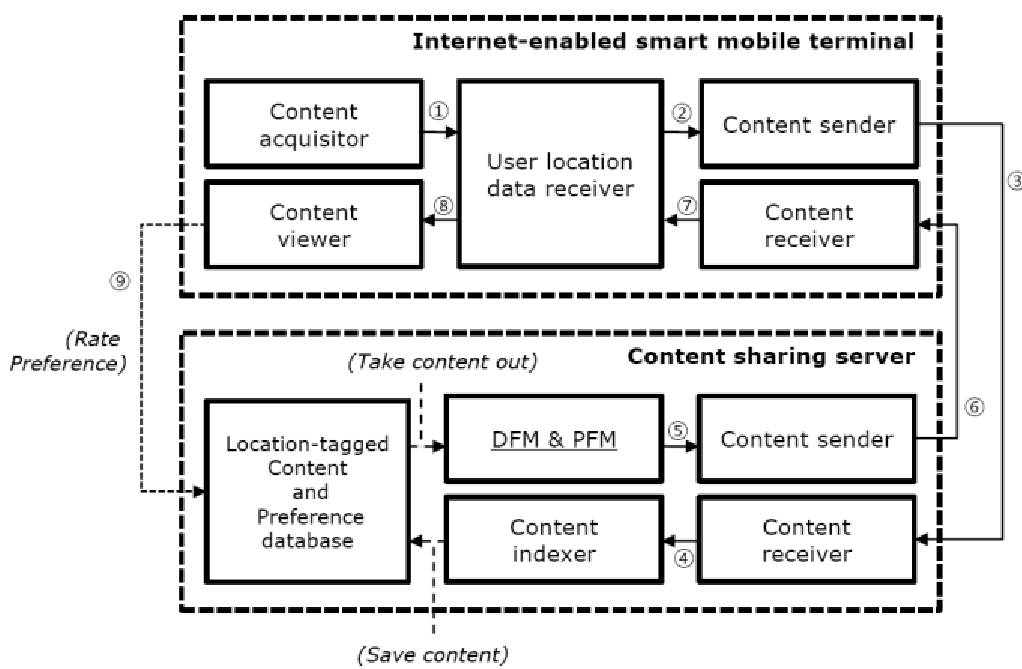 Fig 1. The System Architecture: From content registration (GPS tagging) to personalized request handling.
Furthermore, the system leverages sophisticated similarity measures. While many systems rely on basic Cosine similarity, this research evaluates Pearson Correlation (PCC) and Raw-moment similarity (RMS) to find the most "like-minded" neighbors for the user.
Experimental Validation
To test the system, the authors collected 6,810 rating data points from real-world users over a six-month period.
1. User Interface (UI)
The prototype implementation shows a seamless integration of maps and lists. The user sees not just "what" is nearby, but a predicted score of "how much" they will like it.
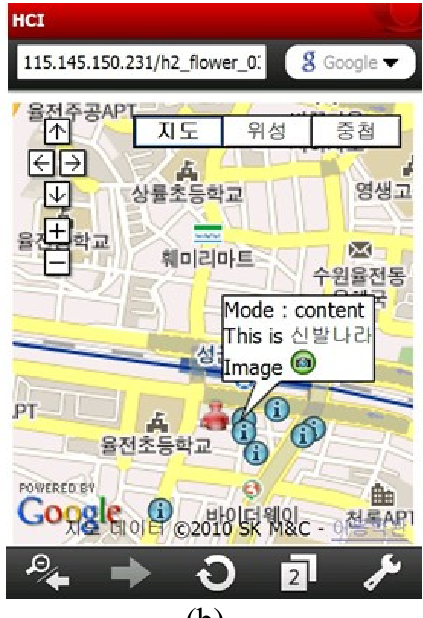 Fig 2. The Content Receiver Interface: Visualizing predicted preference scores on a mobile map.
2. Accuracy Comparison
The most striking result is the prediction accuracy. By narrowing the scope to local nodes, the system achieved an MAE (Mean Absolute Error) as low as 0.548. Compared to the industry-standard MovieLens 100k benchmark (0.73-0.75), this suggests that location-based preferences are more densely clustered and predictable than general media preferences.
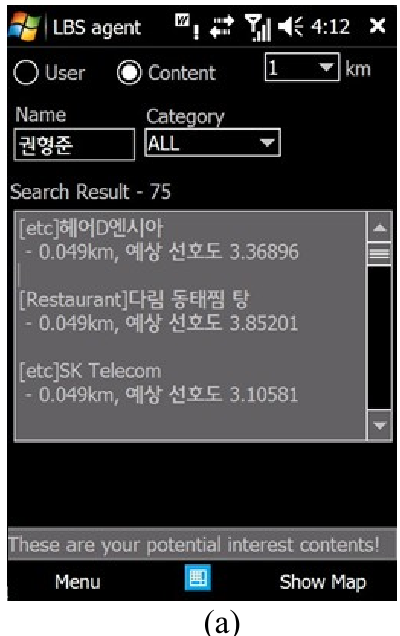 Fig 3. Performance Metrics: Comparison of various similarity methods (PCC, COS, RMS).
Critical Insight & Future Outlook
Takeaway: The success of this model lies in its use of "Physical Context" as a dimensionality reduction technique. It proves that LBS data isn't just an extra feature—it's a computational optimizer for recommendation logic.
Limitations: The dataset size (24 users, 451 contents) is relatively small for a definitive claim on global scalability. Future iterations will need to address the "Cold Start" problem (new users with no history) and "Data Sparsity" (locations with very few ratings).
Future Work: This architecture is ripe for integration into broader ecosystems like IPTV or Autonomous Vehicle navigation, where "POI" (Points of Interest) recommendations can be tailored to the vehicle's route in real-time.