
Beyond Social Influence: Balancing Individuality and Circles in Personalized Recommendations
Personalized Recommendation Combining User Interest and Social Circle
2013-11-19
Summary
Problem
Method
Results
Takeaways
Abstract
This paper proposes PRM (Personalized Recommendation Model), a unified probabilistic matrix factorization framework that fuses user personal interest, interpersonal interest similarity, and interpersonal influence. Tested on Yelp, MovieLens, and Douban datasets, it successfully addresses cold-start and data sparsity issues, achieving state-of-the-art performance in rating prediction.
## TL;DR
Modern recommendation systems (RS) often face a dilemma: rely purely on historical data (which is sparse) or follow the "wisdom of friends" (which may ignore personal taste). This paper introduces **PRM (Personalized Recommendation Model)**, a sophisticated framework that combines personal interest, social similarity, and trust influence into a single probabilistic matrix factorization model. It doesn't just ask "who do you trust?", but also "what do you actually like?" and "who shares your specific taste?"
## The Core Challenge: The Sparsity and Personality Trap
Most social-based recommenders operate on a simple assumption: you like what your friends like. However, the authors identify a critical flaw—**The Diversity Erasure**. Experienced users (power users) often have distinct tastes that their social circle doesn't reflect. Conversely, "cold-start" users have so little data that neither personal nor social cues are sufficient if treated in isolation.
The challenge lies in making the social factors category-aware (you might trust a friend for "Night Life" but not for "Home Services") and balancing these against a user's "Expertise Level."
## Methodology: The Three Pillars of PRM
The PRM model expands the standard Probabilistic Matrix Factorization (PMF) by adding three distinct social-contextual terms to the objective function:
1. **Personal Interest (Individuality)**:
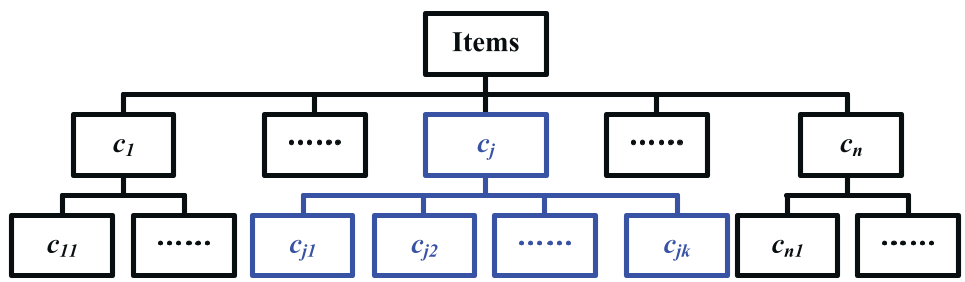
The authors utilize a hierarchical tree structure (Category -> Sub-category) to define item topics and user interest distributions. They calculate a relevance matrix $Q$, which measures the alignment between a user's unique interest profile and an item's specific topic.
2. **Interpersonal Interest Similarity (The Taste Circle)**:
Beyond just "friendship," this factor looks at the similarity of interest vectors between users. If two friends both enjoy "Alternative Rock," their latent features are pulled closer together in the latent space.
3. **Interpersonal Influence (The Trust Circle)**:
Based on the *CircleCon* model, this leverages explicit trust or the density of a friend's rating history in a specific category to weight their influence on the user.
### Model Architecture Overview
*The illustration shows how the three factors—Influence, Interest Similarity, and Individual Interest—converge to refine the user and item latent feature vectors.*
## Mathematical Intuition
The objective function $\Psi$ is designed to minimize the error between predicted and actual ratings while regularizing user features $U_u$ based on their circles. A highlight of the approach is the inclusion of $|H_u^{c*}|$, a normalized factor representing a user's experience. Experienced users see a higher weight on their **Personal Interest** term, effectively allowing their latent feature to be "self-determined" rather than "friend-determined."
## Experimental Insights
The authors conducted a massive evaluation using **Yelp**, **MovieLens**, and **Douban Movie** datasets.
### SOTA Comparison
The results were decisive. In the "Restaurants" category of Yelp (one of the densest), PRM achieved an RMSE of 1.083, significantly lower than the BaseMF's 1.884 and CircleCon's 1.340.
### Impact of User Experience
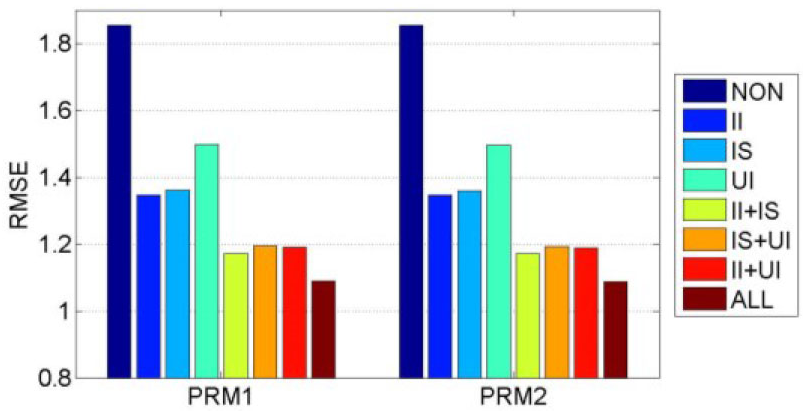
*The figure demonstrates that PRM maintains high accuracy across both "Cold-start" users (0-9 ratings) and "Experienced" users (40+ ratings), whereas prior models struggled with one or the other.*
## Critical Analysis & Conclusion
**Conclusion**: PRM successfully moves the needle by proving that "social" isn't a monolith. By decomposing social relations into *Trust* and *Interest Similarity*, and then counterbalancing them with *Hierarchical Personality*, the model reaches a new level of precision in sparse environments.
**Limitations**: The model relies heavily on the availability of category tags. In domains where item metadata is poor or unstructured, the hierarchical interest mining would require more complex NLP techniques (like LDA or BERT embeddings) to function.
**Future Work**: The authors suggest incorporating **Geo-Location** data. In local services like Yelp, a friend's influence might be high, but if they are 1,000 miles away, their restaurant recommendation is functionally useless. Adding the "Spatial" dimension to this "Social-Personal" framework represents the next frontier.