
Unified Social Identity: Breaking the Silos with Portable Personality (P²)
Personalized social networking: an applied scenario in a portable personality environment
The paper introduces a "Smart Social Network" (SSN) scenario built upon the Portable Personality (P²) open-source platform. It utilizes the Friend of a Friend (FOAF) standard to aggregate and merge social interdependencies from disparate messaging services like Skype and MSN into a unified, portable profile for personalized mobile services.
TL;DR
Social networking has historically been trapped in platform-specific "walled gardens." This paper explores the Smart Social Network (SSN), an application of the Portable Personality (P²) framework. By utilizing the FOAF (Friend of a Friend) XML standard and a specialized merging engine, the authors demonstrate how to aggregate social data from Skype and MSN into a single, portable profile that enables personalized features—like finding friends in a shared WLAN—on mobile devices.
The "Silo" Problem: Fragmented Identities
As of the late 2000s, the digital ecosystem was burgeoning with specialized social tools: Skype for voice, MSN for chat, LinkedIn for business. The friction was palpable:
- Redundancy: The same friend appeared across multiple independent tools.
- Management Overhead: Users had to manage distinct accounts and privacy settings for every niche.
- Lack of Physical Context: These digital networks didn't "know" when two friends were physically at the same conference or university unless manually updated.
The authors argue that while multi-messenger clients like Trillian existed, they were merely UI layers. The real challenge was data-level interoperability.
Methodology: The P² Core and Merge Logic
The heart of this solution is the P² Environment, a middleware composed of three parts:
- Provider Clients (Sensors): These "scrape" contact data from local APIs (e.g., Skype4COMlib) and convert them into FOAF-compliant XML.
- P² Service (The Brain): This central (or distributed) service reconciles incoming data.
- Consumer Clients (The Sink): Mobile applications that use the merged profile to provide real-world value.
The Art of the Merge
To merge two XML profiles (identifying that "Max" on Skype is the same "Max" on MSN), the authors introduced the Generic Metadata Handler (GMH). It uses logic-driven attributes embedded in XML:
p2:mergekeys: Functional identifiers (like a global email address) used to match nodes.p2:mergemodes: Rules defining what to do when a match is found (e.g.,IFEQUAL_MERGE_INSAFTto concatenate or update attributes).
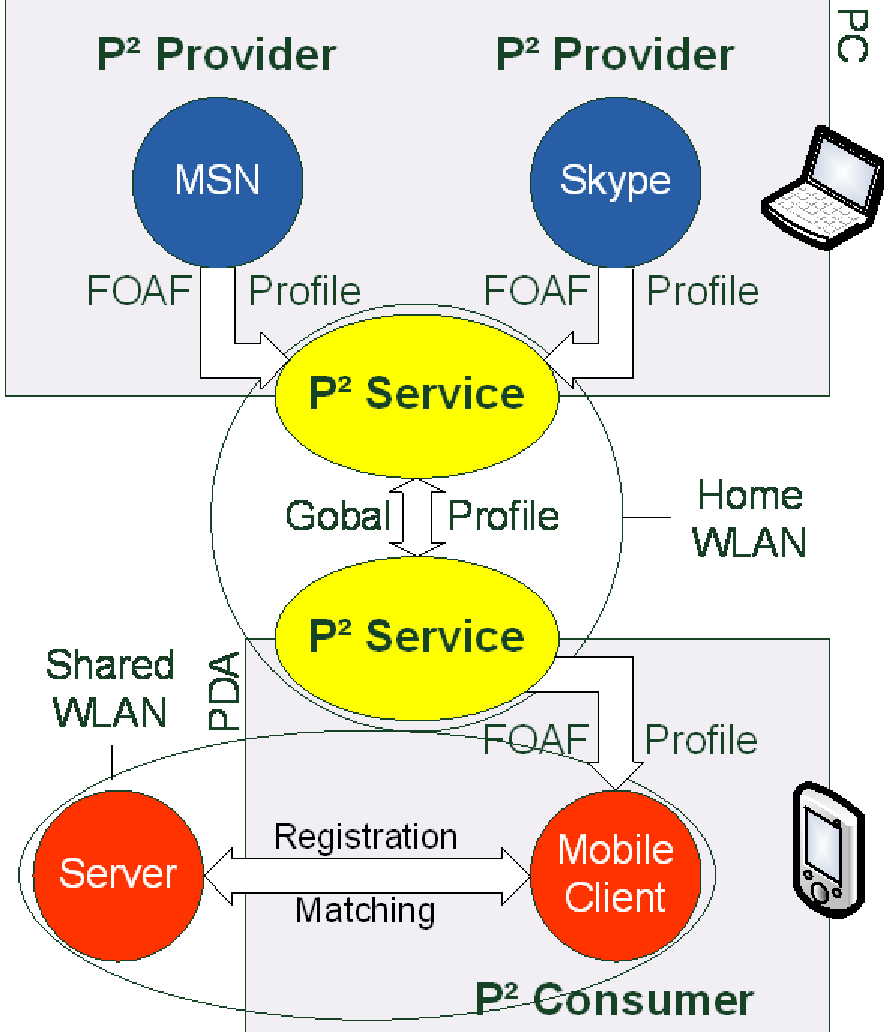 Figure 1: The P² Architecture showing the flow from Sensor Data to Global Profile to Consumer Applications.
Experiments: Real-World Collaboration
The authors validated this with a prototype involving Windows PCs and a Windows Mobile PDA.
- The system gathered online contacts from Skype and MSN.
- It identified users via a global email identifier in the
foaf:mboxfield. - A unified XML profile was generated and pushed to a PDA.
- SSN Logic: When a user entered a specific WLAN (like a university campus), the SSN Server cross-referenced the PDA's merged profile with other active users, notifying friends of their mutual proximity.
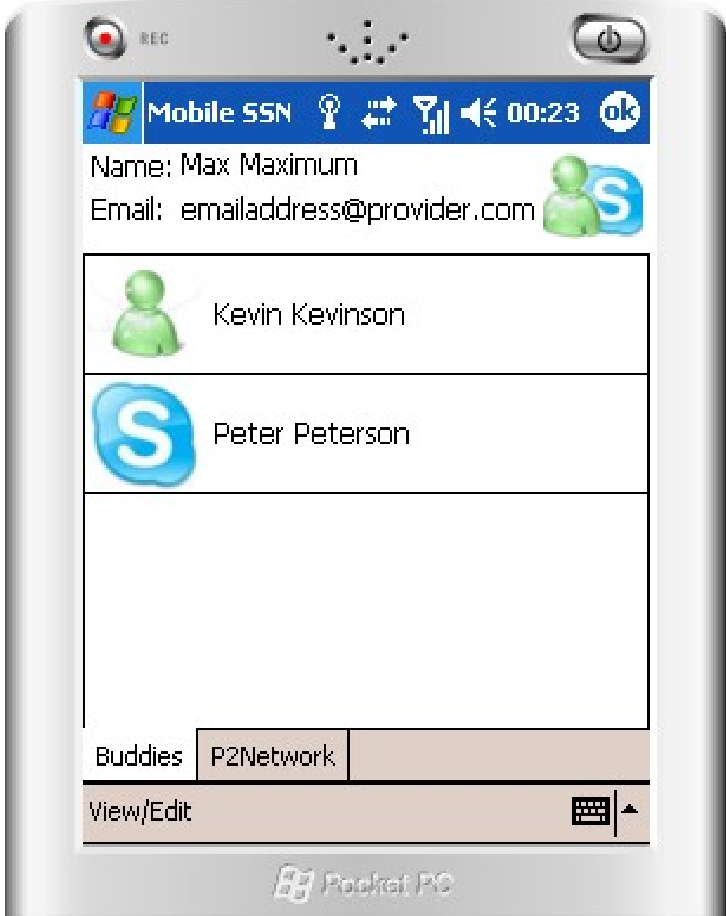 Figure 2: The SSN Consumer Client on a PDA, displaying integrated contact availability in a local network.
Critical Insight: The Legacy of Portable Personality
While this work predates the modern era of OAuth2 and centralized social graph dominance (like the modern Facebook Graph API), its core philosophy remains highly relevant in the context of Web3 and Decentralized Social (DeSo).
- Value: It was a pioneer in advocating for "Personality Data" as a portable asset rather than a company-owned commodity.
- Limitation: The reliance on XML and manual COM library hooking (Skype/MSN) was brittle; modern APIs and JSON-LD have since replaced these, but the logic components (
mergekeys) are still the foundation of modern Master Data Management (MDM). - Takeaway: The "Smart Social Network" scenario—using digital identity to facilitate physical-world serendipity—remains the gold standard for location-based social applications today.
Conclusion
The Portable Personality project reminds us that the goal of technology is not just to connect screens, but to bridge communities. By treating social interdependencies as a standardized, mergeable, and portable profile, the P² model offers a blueprint for a user-centric digital life.