
Personalized Story Recommendations: Optimizing User Engagement in Forum-Based Social Media
Personalized recommendation of stories for commenting in forum-based social media
The paper introduces a personalized recommendation system tailored for forum-based social media, specifically for suggesting stories users are likely to comment on. It proposes an efficient Collaborative Filtering (CF) method based on user co-commenting patterns and a novel Hybrid approach that integrates CF and Content-Based Filtering (CBF) features using a Learning-to-Rank (LTR) framework. The hybrid method achieves SOTA performance on Vietnamese forum datasets (VOZ and Webtretho), significantly outperforming traditional techniques.
TL;DR
This study tackles the "Information Overload" problem in massive online forums by predicting which stories a user is most likely to comment on. By leveraging a hybrid framework that blends content analysis (LDA/TF-IDF) with a high-speed, incremental Collaborative Filtering (CF) algorithm via Learning-to-Rank, the authors achieved massive gains in recommendation accuracy (MAP up to 0.905 on specific datasets).
The "Comment-Worthy" Challenge: Why Standard RecSys Fails
Most recommendation engines are built for e-commerce (Amazon) or video streaming (Netflix), where the goal is to predict a "star rating" or a "purchase." However, Forum-based Social Media is fundamentally different:
- Implicit Feedback Only: Users rarely rate a story; their participation is defined by the act of commenting.
- Extreme Volatility: Stories are posted every minute. Re-calculating complex matrix factorization models in real-time is too costly.
- The Cold-Start Trap: Fresh stories have zero or few comments, making traditional CF "blind" to new content.
Methodology: The Hybrid Learning-to-Rank Framework
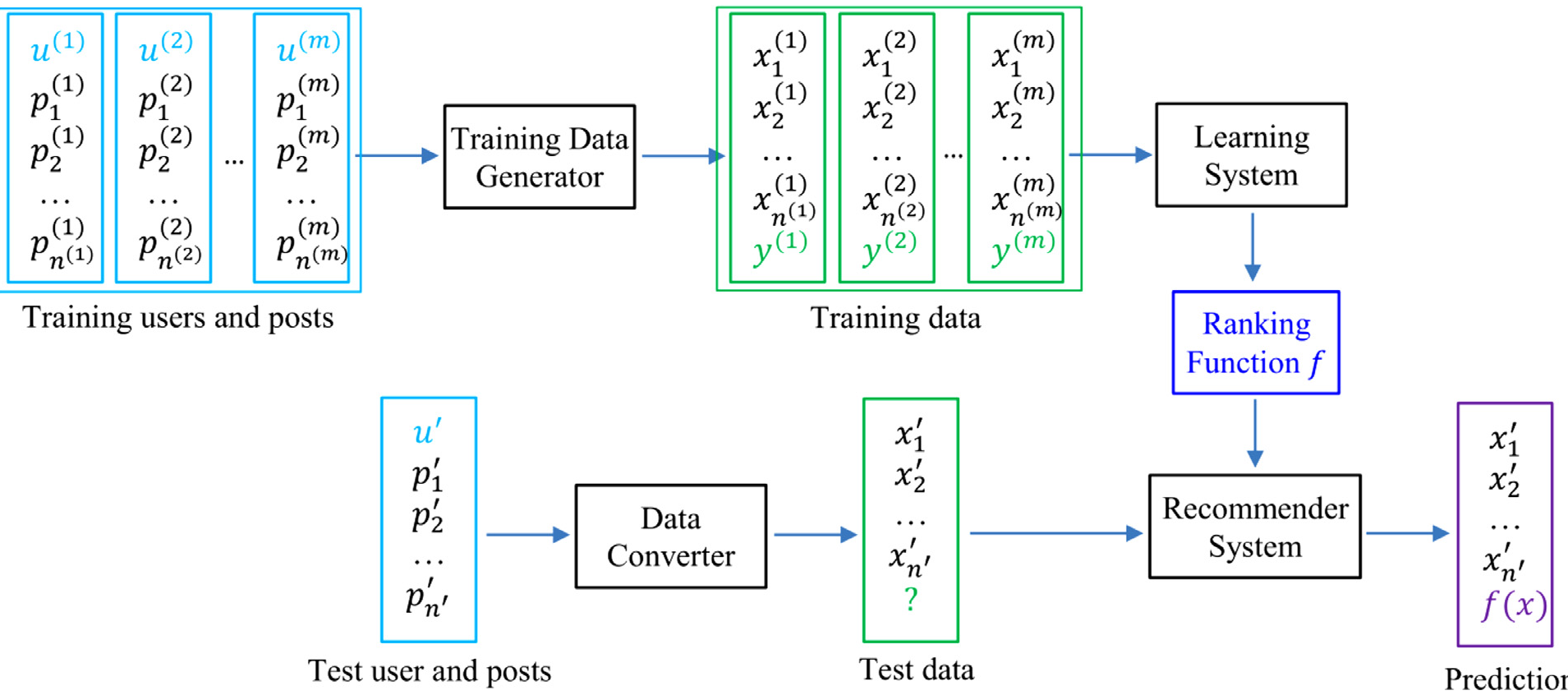
The core innovation lies in the transition from a simple "Heuristic" (combining scores) to a "Learning" approach.
1. Incremental Collaborative Filtering
Instead of complex latent factors, the authors use a co-commenting probability model. It calculates the likelihood that User A will comment on a post if User B has already done so: This can be updated incrementally. When a new comment arrives, the system simply updates a running counter rather than retraining the whole model.
2. Feature Engineering & LTR
The system extracts five core technical features for every user-story pair:
- Content Features: TF-IDF scores (word-level) and LDA Topic Distributions (semantic-level).
- Social Features: Three variations of the CF score (Max, Sum, and Average).
These features are fed into a Learning-to-Rank (LTR) engine. Unlike classification which looks at one item at a time, LTR looks at the relative order of a list of stories, optimizing the model to push "comment-worthy" stories to the top.
Experimental Battleground: VOZ vs. Webtretho
The authors tested their methods on two distinct Vietnamese datasets: VOZ (a tech-heavy forum) and Webtretho (a massive forum for mothers).
SOTA Comparison
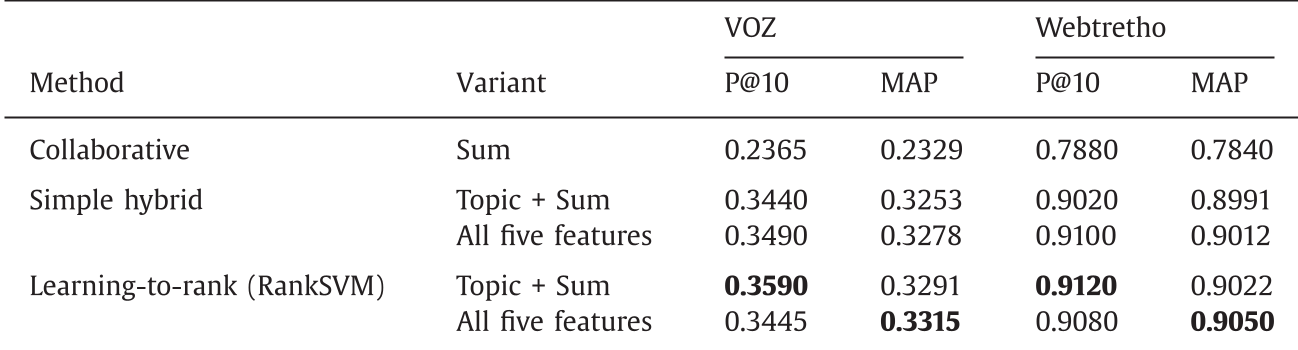
As shown in the results below, the Hybrid Learning-to-Rank model (using RankSVM) outperformed both pure Content-Based and pure Collaborative models by significant margins. In the Webtretho dataset, the MAP score reached a staggering 0.905, nearly solving the recommendation task for that specific community.
Solving the Cold-Start
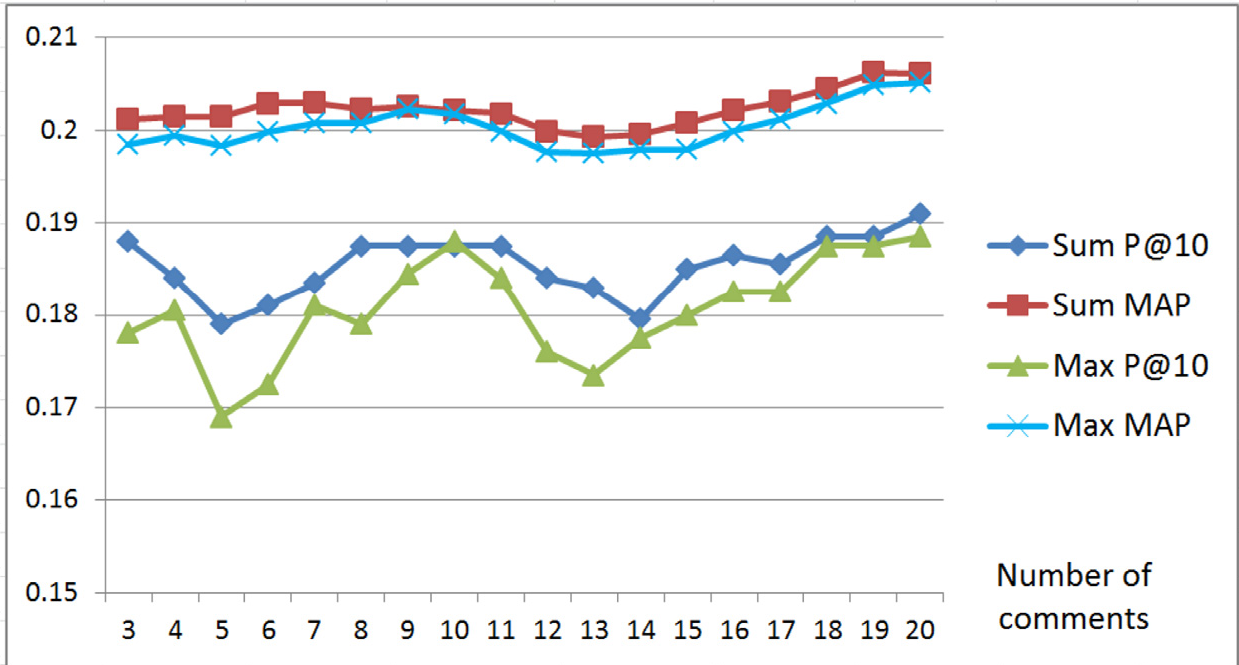
A critical test was performance on "Fresh Stories" (posts with <20 comments). The proposed CF-Sum method remained stable and outperformed the random baseline even when a story had only 3 initial comments, proving its robustness for real-time news feeds.
Critical Insight & Conclusion
The genius of this paper isn't in a single "silver bullet" algorithm, but in the architecture of the hybrid system. By identifying that content-based features are good for "what it's about" and co-commenting is good for "who interacts with what," and then using RankSVM to decide the importance of each, the authors created a system that is both accurate and computationally feasible for production environments.
Future Outlook: While this paper uses LDA and TF-IDF, the framework is "feature-agnostic." Today, we could easily swap these out for BERT or Llama-based embeddings to capture even deeper semantic meanings, potentially pushing these scores even higher.