
Personalizing Health: Can AI Help Us Stick to Our Diets?
Personalized Techniques for Lifestyle Change
This paper presents a large-scale evaluation of a personalized eHealth portal designed for lifestyle intervention. It introduces three core intelligent tools—a Personalized Meal Planner, Network Activity Feeds, and Social Comparison—aiming to improve user "stickiness" and sustained dietary change through collaborative filtering and social relevance modeling.
TL;DR
The struggle with healthy lifestyle changes isn't a lack of information—it's a lack of engagement. This study evaluates an eHealth portal for 5,000 users that uses Collaborative Filtering and Social Relevance Scoring to personalize meal planning and social interactions. Results show that while personalization makes tools "stickier" and more detailed, social comparison remains a double-edged sword that can alienate users if not handled delicately.
The Engagement Gap in eHealth
The World Health Organization has long signaled an obesity epidemic, yet most digital solutions are digital versions of pen-and-paper logs. These systems fail because they are high-friction: they ask users to do all the heavy lifting of planning and searching. The authors argue that the "valuable user preference data" generated by these systems should be harnessed to reduce cognitive load. If the system knows what you like and who you care about, it can transition from a passive logbook to an active, personalized coach.
Methodology: The Three Pillars of Personalization
1. The Personalized Meal Planner
Instead of a static "one-size-fits-all" diet, the system uses a Collaborative Filtering (CF) algorithm. It computes similarity between users based on Pearson’s correlation:
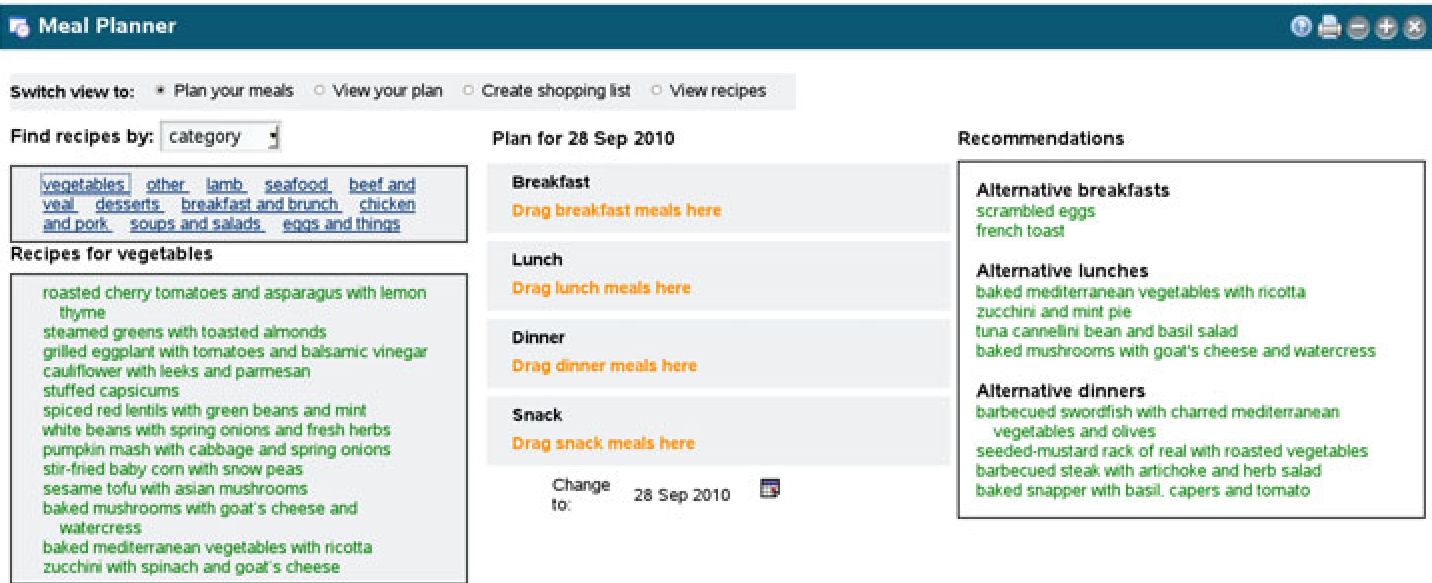
The system doesn't just look at what you say you like (explicit ratings); it tracks what you actually put in your plan (implicit feedback). A decay strategy (Exponential Decay) ensures that the recommendations don't become repetitive, suggesting new recipes while respecting the "rhythm" of your past consumption.
2. Personalized Network Activity Feeds
Standard social feeds are chronological, leading to information overload. The authors implemented a scoring mechanism: This formula balances User-to-User relevance (how close are you to Bob?) and User-to-Action relevance (do you actually care about "adding photos" as an activity?). By weighting direct interaction factors higher, the feed ensures that updates from close friends and relevant activities (like hitting a weight goal) appear at the top.
3. Personalized Social Comparison
This experimental tool asked users to compare peers (e.g., "Who is more active, Alice or Bob?"). The personalization logic prioritized users who hadn't received much feedback recently to ensure "social capital" was distributed across the network, aiming to drive healthy competition.
Experimental Insights: What Worked?
The 12-week live study revealed a nuanced picture of how users interact with AI-driven health tools:
- Meal Detail vs. Efficiency: Users with personalized planners didn't necessarily plan more days, but their plans were more detailed (4.93 vs 4.42 entries per day). This suggest that the recommender filled in the "gaps" (snacks, side dishes) that users usually omit.
- The "Own Recipe" Trap: A fascinating finding was that 80% of items in meal plans were custom-added by users. This indicates that a static database of recipes is insufficient; recommenders must be flexible enough to handle user-generated content.
- Social Feed Success: Personalization clearly worked for social engagement. The personalized group showed significantly higher Click-Through Rates (CTR), proving that relevance-based sorting is superior to simple reverse-chronology in health contexts.

The Failure of Social Comparison
The most striking result was the low uptake of social comparison (7.2%). Users reported feeling "uncomfortable" judging others. This highlights a critical Inductive Bias in persuasive technology: while competition works in sports, it can feel punitive or intrusive in the sensitive domain of weight loss.
Critical Perspective & Conclusion
This paper proves that personalization is not a silver bullet but a friction reducer. It successfully increased the "density" of user interaction with meal plans and feeds. However, the study also warns that health is deeply personal; the "judgment" aspect of social comparison backfired.
Future Outlook: For lifestyle change products to succeed, they must move beyond "Big Data" and incorporate "Small Data"—the subtle, daily preferences of individual users—while maintaining a social environment that focuses on support rather than comparative judgment.