
Personalized Top-n Influential Community Search: Beyond Simple Connectivity
Personalized top-n influential community search over large social networks
The paper introduces a personalized top-n influential community search framework over large social networks using a novel maximal pk-Clique model. By incorporating edge propagation probabilities and a diverse search strategy, it achieves a SOTA balance between structural cohesiveness and influence relevance.
TL;DR
This research tackles the challenge of finding the most influential "social circles" (communities) around a specific user in a massive network. It moves beyond simple structural count (like having neighbors) to an influence-centric model called pk-Clique. By combining intensive pruning techniques with a specialized DS-Tree for diversification, the authors provide a way to find relevant, non-overlapping communities with high computational efficiency.
Background: The Limits of Structural Cohesion
In the world of social network analysis, finding a "community" usually means looking for dense subgraphs. Concepts like k-core (everyone has neighbors) are popular but often lack "tightness." A user might have many neighbors but very little actual influence over them. This paper argues that for applications like personalized recommendations or marketing strategy adjustment, we need to measure the propagation probability—how likely a piece of information is to actually travel from one user to another.
Methodology: The pk-Clique and Heuristic Pruning
The authors define the pk-Clique: an induced subgraph where every pair of nodes is connected by a Maximum Influence Path (MIP) with a weight greater than a threshold .
1. Pruning the Search Space
Because finding maximal cliques is NP-hard, the authors leverage Constraint Programming (CP) principles:
- Upper Bounding: They calculate the maximum potential influence a branch can achieve. If it's lower than the -th best community found so far, the branch is "pruned" (discarded).
- Filtering: Vertices with a degree lower than are removed immediately, as they can never form a -sized clique.
2. Diversification via DS-Tree
Standard algorithms often return 10 communities that are 90% identical. To solve this, the authors introduce l-diversity. They use a DS-Tree (a modified Red-Black Tree) to index intervals of vertex IDs. This allows the algorithm to check for similarity in "one-pass" during the search, instead of doing a costly post-processing step.
 Figure 1: Illustration of a subgraph surrounding a query node s, highlighting the influence zones.
Experimental Validation
The authors tested their approach on datasets including Twitter (81k nodes) and Google+ (107k nodes).
Efficiency Gains
The "Improved Top-n ICS" (using Heuristic Search - HS and Filtering - FS) showed massive improvements over the Basic Search (BS). On the Twitter dataset, the basic search took over 131 seconds, while the optimized versions finished in roughly 10 seconds.
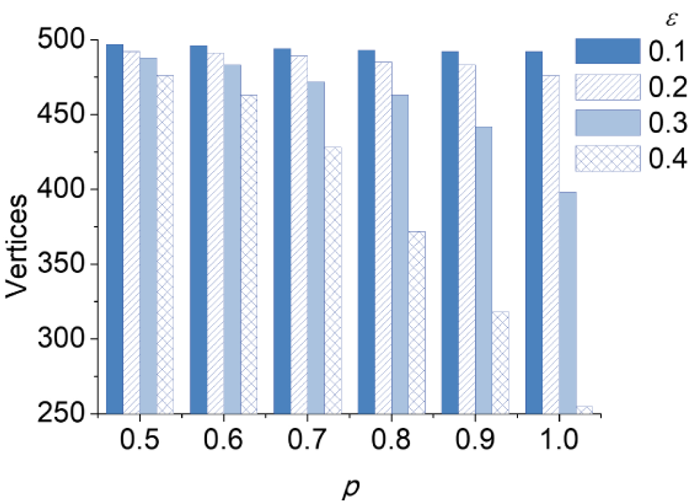 Figure 2: Impact of varying influence thresholds (p and ε) on the number of candidate nodes.
The "Similarity" Problem
The research proved that as cliques grow larger, they tend to overlap more (often sharing over 90% of nodes). The Diversified search successfully lowered this redundancy without significantly increasing the runtime (less than 9% overhead).
Case Study: DBLP Co-authorship
Searching for influential communities around "Alexanderm T" in a co-author network revealed distinct research circles. While the exact search returned several variations of the same group (e.g., subsets of Jiawei Han's group), the diversified search surfaced distinct groups representing different collaboration contexts.
Critical Insight & Conclusion
The pk-Clique is a more "physical" model for social networks because it acknowledges that not all edges are equal. The real breakthrough here isn't just the model, but the DS-Tree index, which provides a scalable way to handle the "redundancy problem" that plagues almost all clique-based community detection.
Takeaway: When building recommendation engines, don't just look for who is connected; look for who is effectively connected, and ensure your algorithm isn't just recommending the same group of people over and over again.