
Personalized Influence: Navigating Top-n Communities via pk-Cliques
Personalized top-n influential community search over large social networks
2020-03-31
Summary
Problem
Method
Results
Takeaways
Abstract
This paper introduces a personalized top-n influential community search framework using a novel maximal pk-Clique model. It addresses the task of finding cohesive, highly influential user groups surrounding a query node in large social networks, achieving over 2x efficiency improvement through specialized pruning and heuristic algorithms.
## TL;DR
Finding influential circles around a specific person in a massive social network is like finding needles in a haystack. This paper proposes a new "pk-Clique" model that defines communities not just by how they are connected, but by how effectively information flows between members. By introducing pruning and heuristic search strategies, the authors make personalized community search twice as fast as traditional methods while ensuring result diversity.
## Problem & Motivation: Beyond Structural Connectivity
Most community detection algorithms look for "density"—clusters of nodes with many edges. However, in modern social networks, an edge doesn't guarantee influence.
The authors argue that **influence is dynamic and probabilistic**. A user might be surrounded by music fans, but only a subset of those fans actually impacts the user's behavior. The challenge is two-fold:
1. **Complexity**: Finding maximal cliques is NP-hard.
2. **Noise**: Influential communities are often highly redundant and overlapping, leading to "clutter" in search results.
## Methodology: The pk-Clique Model
The core innovation is the **maximal pk-Clique**. Unlike a standard clique where every node must be connected, a pk-Clique requires that for any two nodes $u, v$, the **Maximum Influence Path (MIP)** between them has a propagation probability $w(P) > p$.
### 1. Influence-based Cohesiveness
Influence is calculated using the Independent Cascade (IC) model:
$$w(P) = \prod w(v_i, v_{i+1})$$
This treats a community as a "probability manifold" where connectivity represents the likelihood of information spread.
### 2. Search Space Refinement
To handle large graphs, the authors prune the search space before enumeration begins. Using **Lemma 1**, they prove that any node $u$ with an MIP to the query node $s$ less than $p\epsilon$ cannot be part of an influential community. This effectively "shrinks" the social network to a relevant local subgraph.

### 3. Optimized Search (PS & HS)
Instead of a naive Bron-Kerbosch enumeration, the authors propose:
* **Pruning (PS)**: Calculates an upper bound for the "Aggregated Influence" of a potential vertex set. If the bound is lower than current results, the entire branch is discarded.
* **Heuristics (HS)**: Reorders the search to prioritize nodes that have the highest number of neighbors already identified as "highly influential" ($V_{in}$).
## Experiments & Results
The researchers tested their methods on diverse datasets including Twitter and Facebook.
### Efficiency Gains
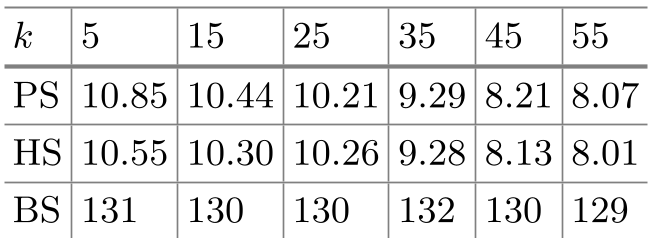
The results in Table 4 and Table 5 show a dramatic reduction in computation time. While the Basic Search (BS) took ~130 seconds on Twitter, the **Pruning (PS) and Heuristic (HS) methods finished in ~10 seconds**—a speedup of over 10x in specific local contexts.
### Redundancy Control
The paper also highlights the "necessity of l-diversity." Without it, top-n results are often 90% identical. By applying diversity filtering, the system ensures that the $n$ returned communities provide a broader perspective of the user's social environment.
## Critical Analysis & Conclusion
### Takeaway
The **pk-Clique** is a sensible evolution of graph theory for the social media age. It acknowledges that a link is not a binary 1 or 0, but a weight of influence. The shift from "finding all cliques" to "finding the top-n most influential diverse cliques" makes this theoretically sound work practically applicable to recommendation engines.
### Limitations
* **Parameter Sensitivity**: The results depend heavily on $p$ and $\epsilon$. Choosing these requires domain expertise.
* **Directionality**: While the model works on directed graphs, the propagation probabilities are often difficult to estimate accurately in real-world scenarios without historical interaction data.
### Future Outlook
This method could be extended beyond social networks into **biological pathway analysis** (finding influential gene clusters) or **financial fraud detection** (identifying tight-knit groups with high propagation of suspicious transactions).