
Beyond Search-Select: Scaling Personalized Travel via Crowdsourcing and Quality Control
A Personalized Travel System Based on Crowdsourcing Model
This paper introduces a personalized online tourism platform powered by a novel crowdsourcing model. It addresses the critical challenge of data quality in user-generated travel recommendations by proposing three specific schemes: Content Analysis (CA), Behavior Analysis (BA), and a Hybrid approach, achieving superior accuracy in identifying valid scenic spots compared to traditional "search-select" models.
TL;DR
Current travel platforms are often too rigid for the modern independent traveler. This paper proposes a transition to a Crowdsourcing Model, supported by a robust data quality control framework. By combining Content Analysis (what guiders say) and Behavior Analysis (how visitors react), the system filters out commercial noise to deliver highly personalized and accurate scenic spot recommendations.
The Problem: The "Big Team" vs. "The Wisdom of the Crowd"
Traditionally, providing "personalized" travel services required a massive team of human experts—an approach that cannot scale with millions of users. While the Internet offers a vast pool of "local guiders," the quality of their input is inconsistent. Crowdsourcing platforms frequently face the "Garbage In, Garbage Out" problem, where advertisements for hotels or restaurants mask genuine scenic recommendations.
The core motivation of this work is to bridge this gap: How can we harness the scale of the crowd while maintaining the quality of an expert agency?
Methodology: The Triple-Defense Quality Control
The authors don't just take user input at face value. They pass it through a sophisticated pipeline designed to distill "Valid Data" from "Noisy Crowdsourcing."
1. Content Analysis (CA) - The Statistical Filter
The system aggregates recommendations from local guiders for a single city. It uses word frequency statistics and the Quick Sort algorithm to identify consensus. If 50 guiders mention "Lingyin Temple" but only one mentions a specific "Seafood Restaurant," the temple is ranked higher.
2. Behavior Analysis (BA) - The Feedback Loop
Recommendation isn't a one-way street. The BA scheme incorporates visitor feedback. A credibility value is assigned based on positive and negative ratios: This ensures that even if a spot is frequently mentioned (High CA score), if it receives universal negative feedback, its ranking will plummet.
3. The Hybrid Model - The Gold Standard
The Hybrid scheme is the "brain" of the system, calculating a comprehensive credibility score .
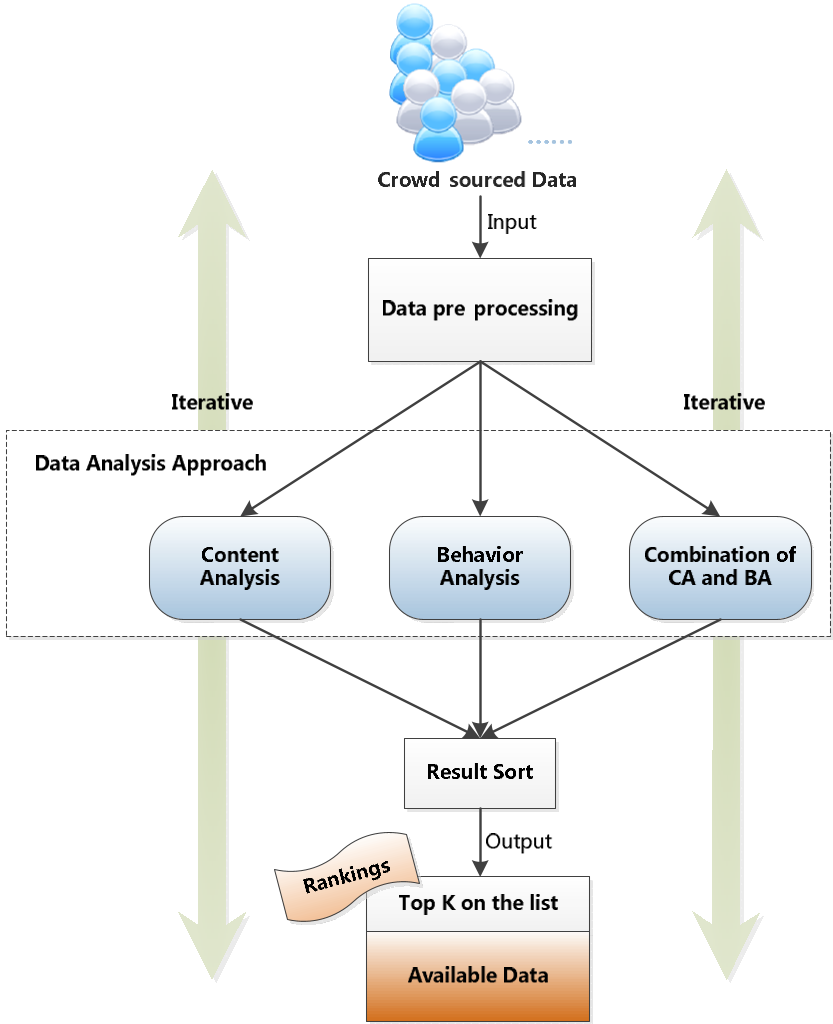 Fig 1: The proposed data quality control framework for crowdsourced travel data.
Experiments: Validating the Wisdom
The authors tested their system using real-world data from 50 guiders across Beijing, Hangzhou, and Nanjing, benchmarking against a ground-truth set of popular attractions.
Key Performance Metrics:
- Precision and Recall: The Hybrid model consistently showed superior curves. As the candidate set grew, the Hybrid model maintained a higher density of valid attractions than either CA or BA alone.
- Noise Reduction: The system successfully filtered "noise" (like hotel ads) while understanding abbreviated synonyms (e.g., "Lingyin" instead of "Lingyin Temple").
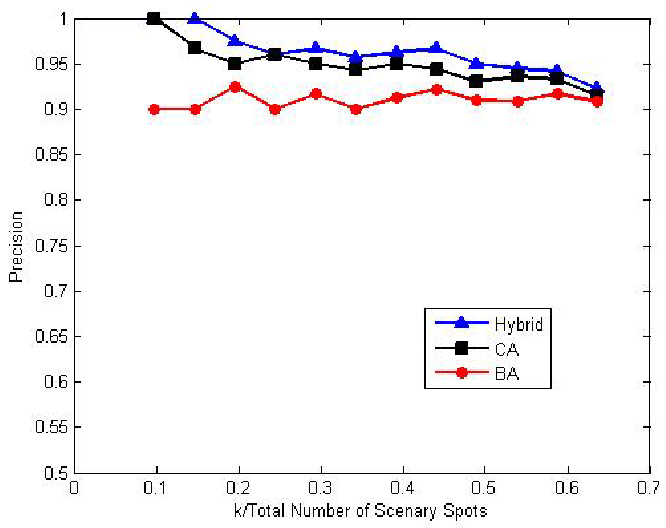 Fig 7: Performance comparison (Recall-Precision) showing the Hybrid scheme outperforming standalone methods.
Critical Analysis & Conclusion
The Takeaway
The success of this personalized travel system proves that dynamic crowdsourcing is viable, provided you have a mechanism to mathematically weight the "morality and expertise" of the contributors. The shift from "Search-Select" to "Analyze-Recommend" is essential for the future of independent travel.
Limitations & Future Work
While effective, the current model relies on relatively simple statistical methods for CA. In the age of Large Language Models (LLMs), the "Content Analysis" could be significantly enhanced by Semantic Analysis rather than just word frequency. Furthermore, the "Negative Feedback" classification ( value) in the BA scheme is currently static; making this dynamic based on the "reputation" of the visitor would be a powerful next step.
Academic Keywords: Independent Travel, Crowdsourcing, Quality Control, Content Analysis, Behavior Analysis.