
Personalized Word Representations: Capturing the Unique Semantics of Social Media Users
Personalized word representations carrying personalized semantics learned from social network posts
2017-12-01
Summary
Problem
Method
Results
Takeaways
Abstract
This paper introduces a framework for learning personalized word representations by adapting universal Word2vec models to individual users' social media posts. The authors propose two methods—Model Retraining and User Adaptive Layer insertion—to capture user-specific semantics, achieving State-of-the-Art performance in user prediction and sentence completion tasks.
## TL;DR
Standard NLP models treat words as having "universal" meanings, ignoring that individual users have unique wording habits and emotional associations. This paper, authored by researchers from National Taiwan University, proposes an efficient way to create **Personalized Word Vectors**. By adapting a universal Word2vec model to small, user-specific social media datasets using an **Adaptive Linear Layer**, they successfully captured personal semantics, doubling prediction accuracy on user identification tasks.
## Problem & Motivation: The Illusion of Universal Meaning
In traditional Word2vec or GloVe training, the vector for "Soccer" is the same whether the speaker is a die-hard fan or someone who finds the sport "Boring." This "one-size-fits-all" approach causes a significant semantic mismatch in personalized applications like recommendation systems or private assistants.
The core challenge is **Data Sparsity**. An individual's social media history (Facebook or Plurk posts) is tiny compared to Wikipedia-scale background corpora. Training a model from scratch on personal data leads to poor representation, while fine-tuning thousands of word vectors (Retraining) often leads to overfitting or leaves "unseen" words un-updated.
## Methodology: From Universal to Personal
The authors propose a two-stage training pipeline:
1. **Universal Background Learning**: A standard Skip-gram model learns general semantic and syntactic relationships from a massive social network corpus (2.6M sentences from Plurk).
2. **Personal Adaptation**: The model is adapted to the specific user's vocabulary and habits.
### The "Adaptive Layer" Breakthrough
While simple retraining updates the word vectors directly, the authors found that inserting an **Adaptive Linear Layer** between the hidden and output layers is far more effective.
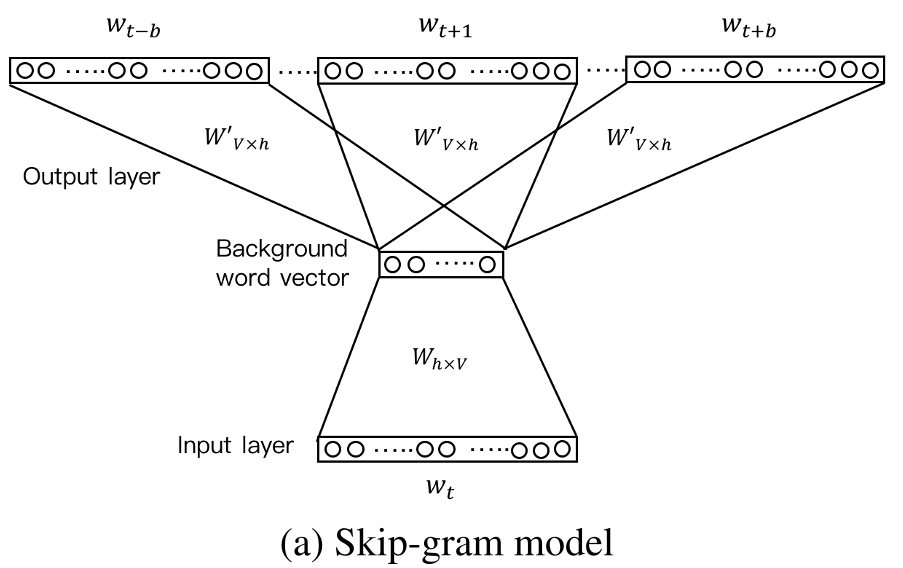
* **How it works**: Instead of modifying the $V imes h$ word vectors (where $V$ is vocabulary size), the model fixes the background weights and only trains a small $h imes h$ matrix (the "Adaptive Layer").
* **The Intuition**: This matrix performs a **global manifold transformation**. It shifts the entire semantic space to align with the user’s perspective. Because it transforms even the words the user hasn't typed yet (unseen words), it preserves the global structure of the language while injecting personal bias.
## Experiments & Results
The researchers evaluated their methods on two tasks: **User Prediction** (identifying which of 40 users wrote a post) and **Sentence Completion**.
### Quantitative Breakdown
As shown in the table below, the "Adaptive Layer" (Approach 2) consistently beat the "Retrain" method and the "No Background" baseline.
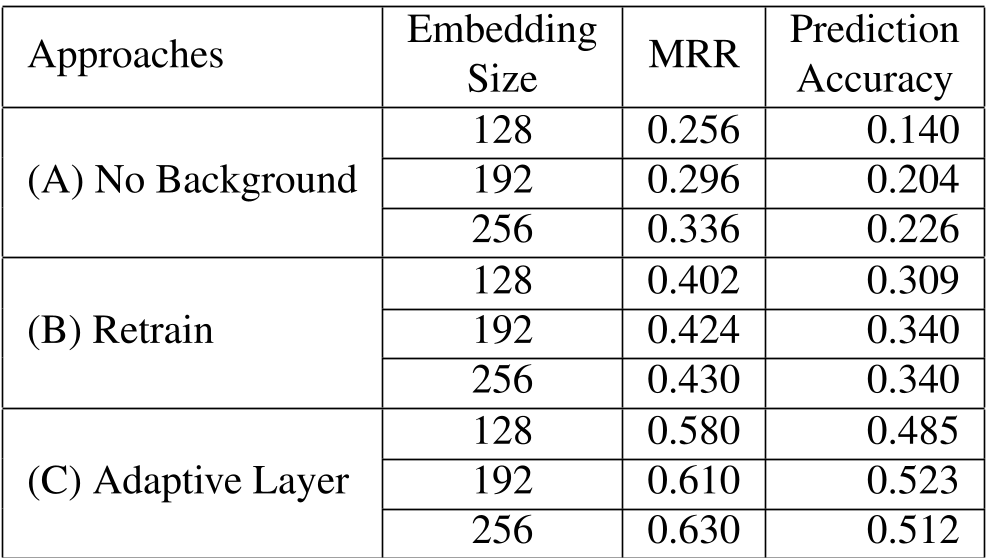
* **Parameter Efficiency**: The Adaptive Layer requires training only $h^2$ parameters (e.g., $256^2 \approx 65k$), whereas Retraining involves $2 imes V imes h$ (e.g., $2 imes 42k imes 256 \approx 21M$). This explains why the Adaptive Layer performs better on small personal datasets—it is much harder to overfit.
### Qualitative Proof: The "Emotion Triangle"
To prove that the vectors actually captured personal feelings, the authors used t-SNE to visualize word clusters. In the figure below, we see how the word "Soccer" (⊗) moves closer to the "Positive Emotion" triangle (happy, enjoy) for a soccer fan, but remains neutral for others.
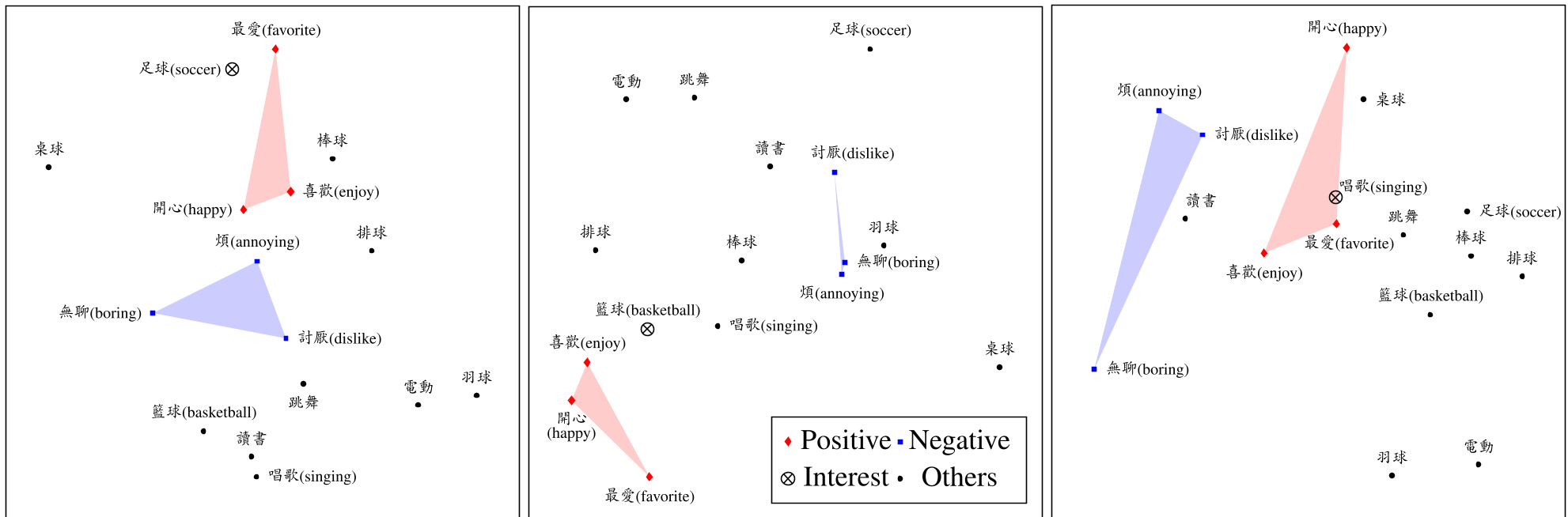
*(Example visualized for User C who enjoys singing; the word for singing moves closer to positive emotion nodes.)*
## Critical Analysis & Conclusion
### Takeaways
This work highlights that **personalization is a transformation, not just a modification**. By using a linear transformation layer, the authors provide a precursor to modern "Adapter" methods used in LLMs today. It proves that the "flavor" of a user's language is a systemic shift in how they relate concepts.
### Limitations & Future Work
* **Vocabulary Mismatch**: The model still relies on a fixed lexicon from the background corpus. It might struggle with highly specific personal slang or brand-new emojis not present in the Plurk data.
* **Static vs. Dynamic**: The paper treats a user's semantics as static. In reality, personal interests evolve over time.
* **LLM Era**: While this study focuses on Word2vec (static embeddings), the underlying principle of using an adaptive layer (similar to LoRA or prompt-tuning) is highly relevant to contemporary efforts in personalizing models like Llama or GPT.
In conclusion, this research marks a significant step toward NLP systems that don't just understand "what" is being said, but "who" is saying it.