
Personalizing the Fast-Forward: Turning Social Media Interests into Smarter Hyperlapses
Personalizing Fast-Forward Videos Based on Visual and Textual Features from Social Network
The paper introduces a personalized fast-forward (hyperlapse) method for first-person videos (FPVs) that aligns video content with user interests mined from social networks. By mapping both textual data (e.g., Twitter posts) and visual concepts into a shared "Bag of Topics" (BoT) space, it adaptively adjusts playback speeds to emphasize segments relevant to the specific user.
TL;DR
Researchers have developed a system that reads your Twitter feed to figure out what you like and then automatically "fast-forwards" your long first-person videos (like GoPro footage) so that the parts you care about play at normal speed, while the boring parts are zoomed through. It achieves superior personalization (F1 score +12.8%) without making the video feel shaky or disjointed.
Context: The Long Video Problem
First-person videos (FPVs) are easy to record but painful to watch. Whether it's a three-hour hike or a bike commute, the "meat" of the video—a rare bird, a cool car, or a group of friends—is often buried in hours of monotonous footage.
While Hyperlapse algorithms (like Microsoft's or Instagram's) make these videos smoother and faster, they are "content-blind." They speed up everything equally. Previous "semantic" fast-forward methods tried to fix this by looking for faces or pedestrians, but what if you're a car enthusiast or a botanist? One-size-fits-all semantics don't work for social media sharing.
Methodology: Bridging the Gap Between Text and Vision
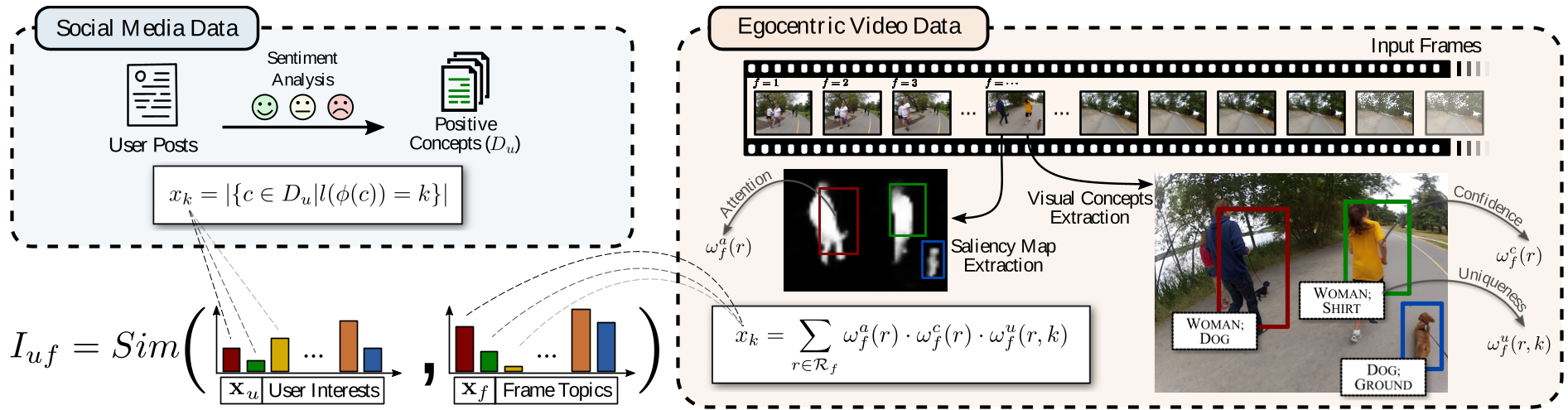
The core innovation of this paper is the shared representation space. Instead of just looking for specific objects, the authors created a "Bag of Topics" (BoT) model.
1. From Tweets to Topics
The system pulls a user’s social media posts (e.g., Twitter), filters for positive sentiment, and extracts nouns. These nouns are mapped to word embeddings (word2vec) and clustered into topics. If a user tweets about "parrots" and "eagles," the system generalizes this to the "Nature" topic.
2. From Frames to Topics
For each video frame, the system uses DenseCap to identify regions and generate natural language descriptions. These are weighted by three factors:
- Attention: Is the object physically prominent or moving?
- Confidence: How sure is the AI about the detection?
- Uniqueness: Using a TF-IDF-like approach, it rewards concepts that appear rarely in the video (making them more "interesting").
3. Adaptive Playback Optimization
Once every frame has an "Interestingness Score," the algorithm solves an optimization problem. It assigns a low speed-up rate () to relevant segments and a high speed-up rate () to irrelevant ones. It uses a graph-based shortest-path approach to ensure the transition between selected frames is smooth, minimizing "shaking" and "jerkiness."
Experimental Performance
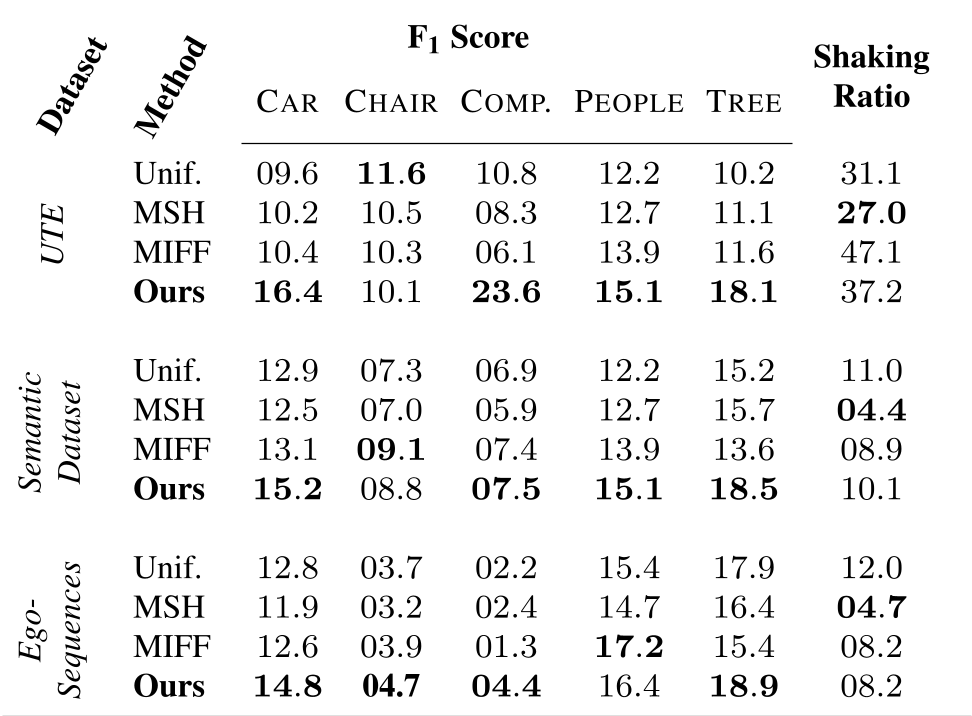
The researchers tested their method against Microsoft Hyperlapse (MSH) and Multi-Importance Fast-Forward (MIFF) across three datasets: UT Egocentric, Semantic Dataset, and EgoSequences.
- Personalization Win: In the UTE dataset, the method hit an F1 score of 23.6 for "Computer" enthusiasts, nearly tripling the effectiveness of generic methods.
- Stability: While MSH is still the king of smoothness (because it prioritizes it above all else), this method remained in the "Tolerable" to "Smooth" range in user studies, which is impressive given the complex constraint of variable speeds.
Deep Insight: Why This Matters
The "Visual-Textual" fusion here is key. By using Uniqueness weights, the authors tapped into a fundamental human truth: we are more interested in things that don't happen every second. Even if you love "trees," a video of a 2-hour forest walk makes any specific tree less interesting. This model recognizes that and looks for the "singular moments."
Future Outlook and Limitations
The primary limitation identified is cluster separation. In the current -means setup, if "Trucks" and "Cars" fall into different clusters, a car lover might miss out on cool truck footage.
However, the transition to a multi-modal approach (incorporating the user's photos and audio) is the next frontier. Imagine a world where your wearable camera knows you're a bird-watcher not because you told it, but because of the photos on your Instagram—and it automatically edits your weekend hike into a 30-second highlight reel of the rare species you encountered.
Conclusion
This research moves us away from "Generic AI" toward "Empathetic AI"—systems that understand that "interestingness" is not a universal constant, but a deeply personal variable stored in our digital social interactions.