Personalizing Play: Turning Social Networks into Game Mechanics
Personalizing Game by Using Social Network
The paper introduces a personalized social network game (SNG) framework that integrates real-time and historical social media data directly into gameplay logic. Using the Facebook API and Unity3D, the authors demonstrate a system where friend interactions and profile data dynamically alter game environments and mechanics, moving beyond traditional "invite-spam" promotion.
TL;DR
This research moves social gaming away from annoying "invite-only" spam towards a deeper, personalized integration. By using the Facebook API, the authors created a version of Tetris where your friends' real-time "Likes" help you win, and their "Dislikes" actively sabotage your controls, turning the social network into a living part of the game loop.
Beyond the Invite: The Motivation for Change
In the early eras of social gaming (think FarmVille), the "social" aspect was often synonymous with "marketing." Players were encouraged to spam friends with notifications to unlock features. The authors identify this as a source of "displeasure" and social friction.
The core insight of this paper is that social data—birthdays, profile pictures, and real-time status updates—can be repurposed as gameplay assets. Instead of the game pushing users back to the social network for marketing, the social network flows into the game to enhance immersion and personalization.
Methodology: The Two Pillars of Social Interaction
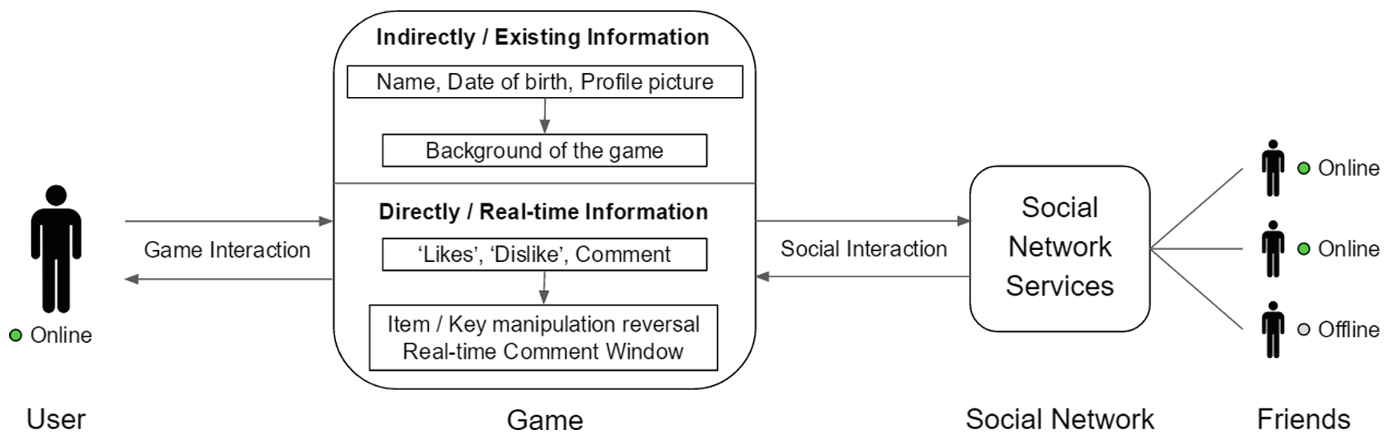
The authors categorize the integration of social data into two distinct architectural flows:
1. Asynchronous Interaction (Indirect Influence)
This uses "cold" data—information already stored on a user's profile.
- In-Game Application: The game background (wallpaper) is dynamically generated using friends' names, birthdays, and profile pictures.
- Purpose: To provide a "reality-reflecting" environment that increases user recognition and psychological comfort without affecting the game's difficulty.
2. Synchronous Interaction (Direct Influence)
This is "hot" data—live communication between the game and the social network.
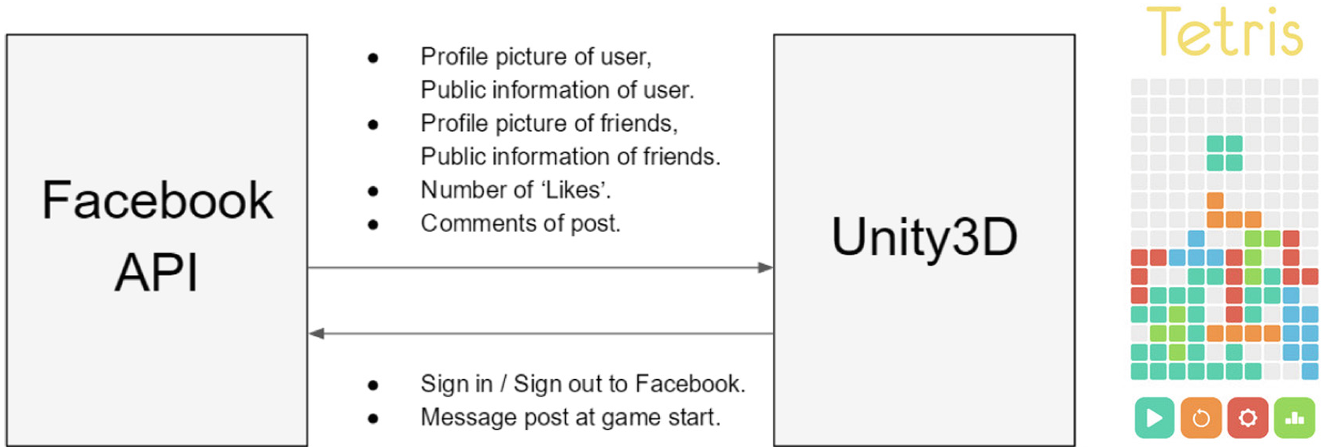
- In-Game Application: When a game starts, a message is auto-posted. If friends online react with a "Like," the player receives a power-up (clearing blocks). If they react with "Dislike," the player's controls are reversed for 3 seconds.
- Purpose: To create a real-time bridge where the social community acts as either "helpers" or "obstacles."
Implementation: The "Social Tetris" Experiment
Using Unity3D and the Facebook API, the authors modified the classic Tetris formula. The technical stack allowed for multi-platform distribution while maintaining a constant handshake with Facebook's servers to fetch updates.
| Interaction Type | Information Flow | Effect on Gameplay | Example |
|---|---|---|---|
| Asynchronous | SN → Game | Indirect | Background visuals |
| Synchronous | SN ↔ Game | Direct | Items / Obstacles |

In the experimental results, the authors found that players naturally detected the "situation" of their social network (e.g., knowing whose birthday it was) without leaving the game environment, effectively increasing "Social Interaction" density significantly.
Critical Insights & Future Outlook
While the system successfully links social actions to game reactions, the authors note a crucial limitation: Latency and Feedback Loops. Currently, friends might not know exactly when their "Like" matters relative to a specific high-pressure moment in the game.
Takeaway for Developers:
The future of SNGs lies in meaningful feedback. If a friend's comment can change the weather in a game, or their profile can become a character in a quest, the "spam" problem disappears because the interaction becomes a core part of the entertainment value.
Future research is required to refine real-time game-state broadcasting, allowing friends to watch the game situation live and respond strategically, essentially turning "social followers" into "active spectators or co-players."