
Personalizing Group Recommendation via Profile Analysis and Noise Filtering
Personalizing Group Recommendation to Social Network Users
This paper proposes a personalized group recommendation framework for social network users using a combination of supervised entropy for feature selection, D-Tree (C5.0) for classification, and Association Rules for multi-group suggestions. The system achieves a precision of 45.18% and coverage of 66.27% on a real-world dataset from the Parsi-Yar social network.
TL;DR
The explosion of variety in social network groups often leaves users paralyzed by choice. This paper introduces a personalized framework that predicts group membership by analyzing 30 core user features. By filtering out "noise" members using hierarchical clustering and employing a hybrid D-Tree/Association Rule approach, the system achieves over 66% coverage, crucially providing recommendations for new users with no prior social ties.
Problem & Motivation: The Cold Start and The Noise
Most recommender systems fall into two camps: Content-based Filtering (recommending similar items to what you liked) or Collaborative Filtering (recommending what similar users liked). However, both hit a wall when a new user joins a platform—they have no history and no friends, known as the Cold Start problem.
Furthermore, the authors observe that group data is "dirty." Many users join groups out of curiosity or by mistake. These "Noise" users distort the profile of a group, making it harder for algorithms to understand what the real core members look like.
Methodology: The Three-Step Refinement
The authors propose a systematic pipeline to move from raw, unstructured profile data to precise recommendations.
1. Data Cleaning and Feature Selection
Starting with 52 features (age, job, favorite sports, etc.) from the Parsi-Yar social network, the authors used Supervised Entropy to identify which features actually help distinguish group membership. This "pruning" reduced the feature set to 30, removing irrelevant noise that could lead to overfitting.
2. Identifying "Main Users" (Noise Removal)
The paper posits that a group's true identity is found in its core members. They utilized Hierarchical Clustering with the Ward algorithm and Euclidean distance to group users.
- The Filter: They applied a Normal Distribution analysis. Users whose distance from the cluster centroid exceeded were labeled as "Absolute Noise" and removed.
- Activity Normalization: For users in multiple groups, a "Degree of Activity" was calculated (Posts + Replies / Membership Duration) to map them to their primary interest group.
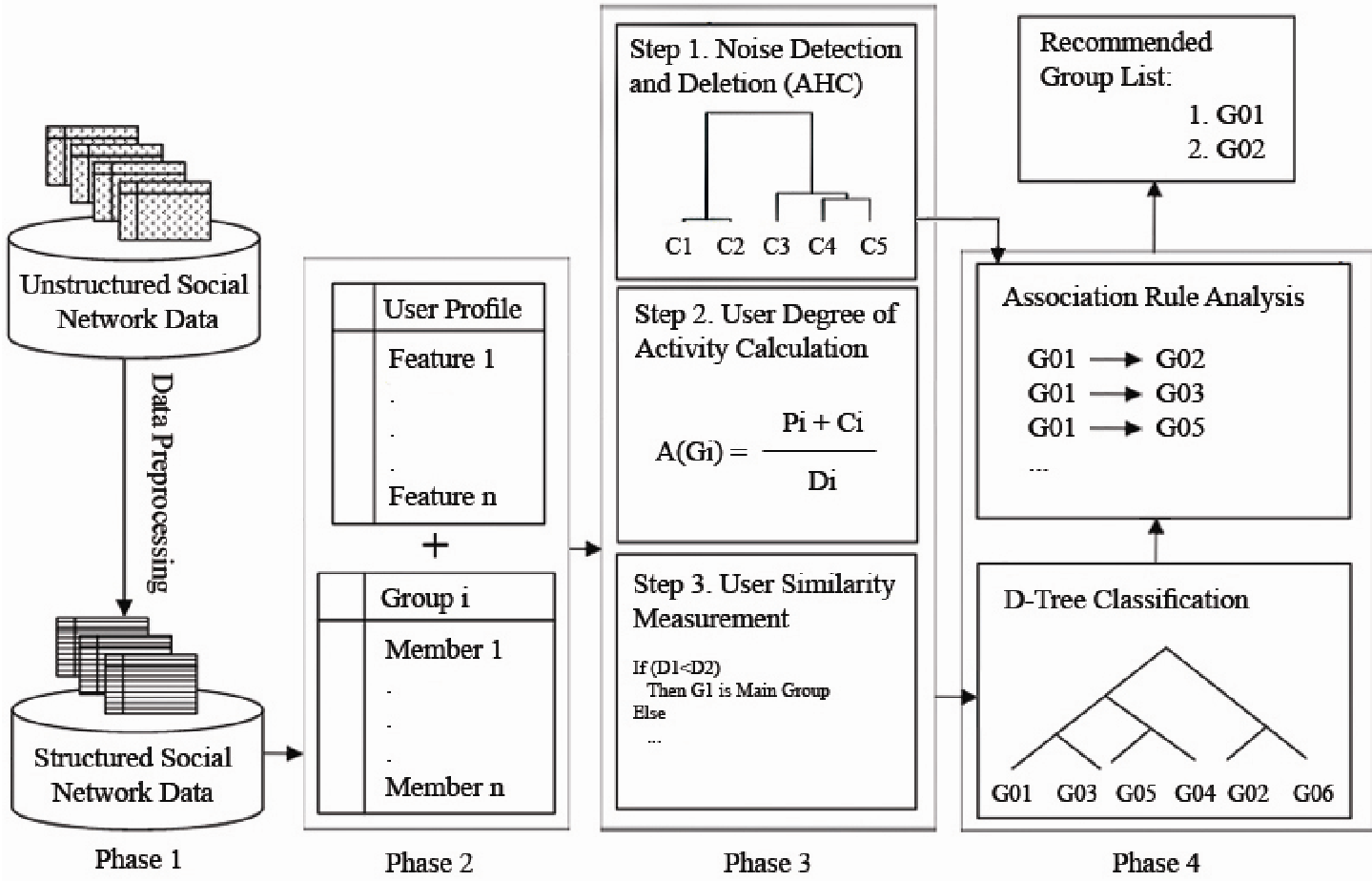 Figure 1: The general framework of the proposed social network recommender system.
3. Classification and Rule Mining
- D-Tree (C5.0): Used to predict a user's primary group based on their 30 features.
- Association Rules: Since users typically join more than one group, the system uses Association Rules (min support 5%, min confidence 15%) to find groups that "frequently go together." If the D-Tree predicts "Group A," the Association Rule might suggest "Group B" as a secondary recommendation.
Experiments & Results
The study analyzed 15 major categories from 1,797 active users. By splitting data into 75% training and 25% testing sets, they measured how often the recommended groups matched the users' actual favorite groups.
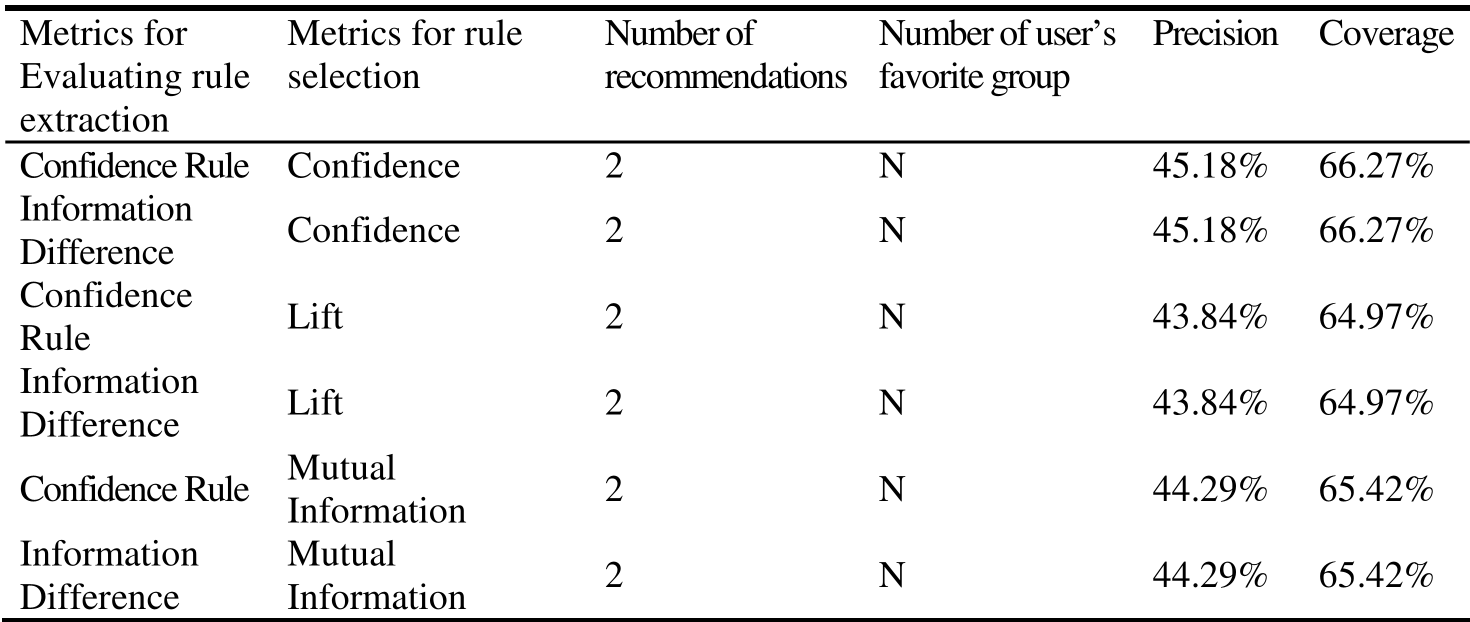 Table 1: Evaluation results showing Precision and Coverage across different rule selection metrics.
Key Findings:
- Precision (45.18%): Nearly half of the recommendations were a perfect match.
- Coverage (66.27%): The system successfully covered two-thirds of the users' group preferences.
- Metric Robustness: Whether using Confidence, Lift, or Mutual Information for rule selection, the precision remained remarkably stable, indicating the robustness of the underlying feature selection.
Critical Analysis & Conclusion
Takeaway
The primary strength of this work is its independence from social graphs. Because the system relies on profile features rather than "who you follow," it is uniquely positioned to help users the very second they finish filling out their profile.
Limitations
- Manual Feature Engineering: Converting unstructured Persian text to structured data was done manually or via interviews, which isn't scalable for millions of users.
- Static Profiles: The model assumes user features are relatively static. In reality, user interests in social networks evolve rapidly over time.
Future Outlook
The authors suggest that future iterations will incorporate Graph Theory to analyze how interpersonal relationships influence group membership, potentially creating a "hybrid-hybrid" system that combines the strength of profile-matching with social-linkage dynamics.