
The Cognitive Architecture of Friendship: Why Your Brain Limits Your Social Circle
Perspective-taking and memory capacity predict social network size
This study investigates the cognitive constraints on human social networks, specifically comparing the roles of memory capacity and Theory of Mind (ToM). It identifies that while the inner "support clique" is limited by mentalising skills, the broader "sympathy group" is primarily predicted by factual memory capacity.
TL;DR
Why can some people maintain large groups of close friends while others struggle with a few? This seminal study by Stiller and Dunbar reveals that our social world is architected by two distinct cognitive limits: Theory of Mind (ToM) governs our inner circle of emotional support, while Memory Capacity dictates the size of our wider social network.
The Problem: The Mystery of Individual Variation
The "Social Brain Hypothesis" suggests that primate group sizes are constrained by neocortex volume. In humans, this averages to the famous "Dunbar’s Number" (roughly 150). However, within this average lies massive individual variation. Some people have support cliques of three, others ten.
The researchers asked a fundamental question: Is the bottleneck Storage (Memory) or Processing (Mentalising)?
- Memory: The ability to recall who is who and how they relate.
- Theory of Mind (Intentionality): The ability to understand recursive "I know that you know" states.
Methodology: Testing the Limits of the Mind
The study utilized a sophisticated narrative-based testing system. Participants were read social stories (e.g., "Emma's Dilemma") and then asked questions that tested:
- Factual Memory: Simple recall of events.
- Intentionality Levels: High-order perspective-taking (e.g., "Jenny thought that Emma believed the boss knew...").
These cognitive metrics were then correlated with the participants' actual social networks, categorized into the Support Clique (core confidants) and the Sympathy Group (monthly contacts).
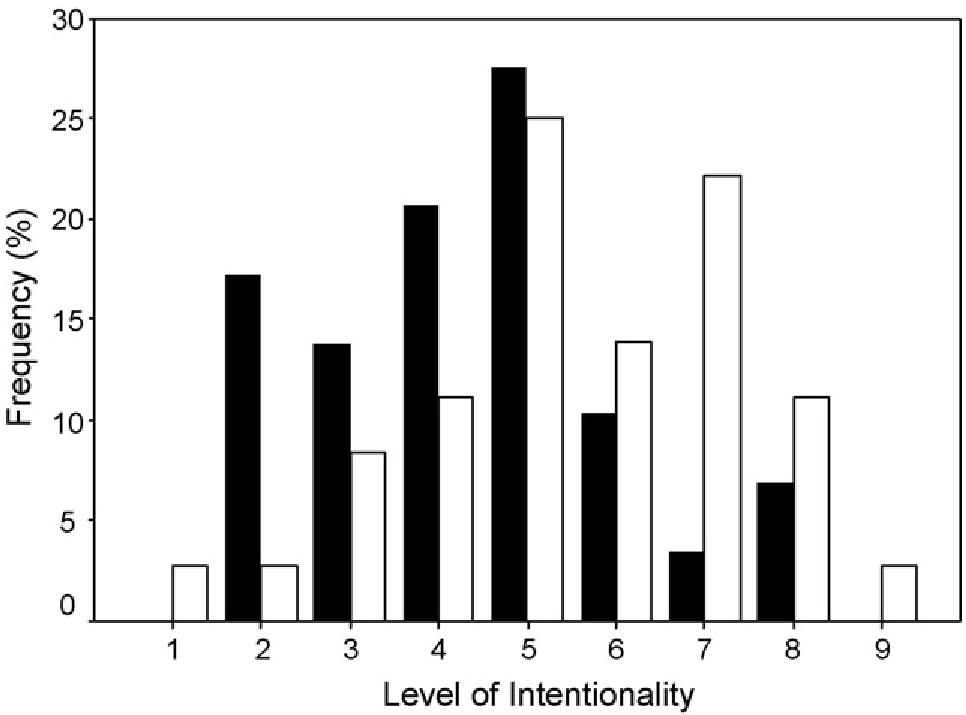 Graph showing the distribution of intentionality levels, peaking at level 5—the "cognitive ceiling" for most adults.
The Core Insight: Different Layers, Different Limits
The findings provide a surgical distinction between types of "friendship":
1. The Support Clique (The Inner 5)
The size of an individual’s innermost circle is predicted by their Intentionality Score. To maintain a high-stakes emotional bond, you must hold the other person's perspective—and their perspective of your perspective—simultaneously. This "mental rotation" in social hyperspace is computationally expensive. As the study shows, once you hit the 5th order of intentionality, most human brains "redline."
2. The Sympathy Group (The Frequent 15)
Surprisingly, Intentionality does not predict the size of the broader sympathy group. Instead, Memory Capacity is the key driver. This suggests that maintaining a regular social circle is more about "database management"—keeping track of facts and recent interactions—rather than deep, recursive mentalizing.
 The regression data: Note how Memory uniquely predicts the Sympathy Group, while Intentionality uniquely predicts the Support Clique.
A Polygonal Reality
One of the study's most fascinating observations is that high cognitive capacity doesn't force you to have a large clique; it merely sets the Upper Bound.
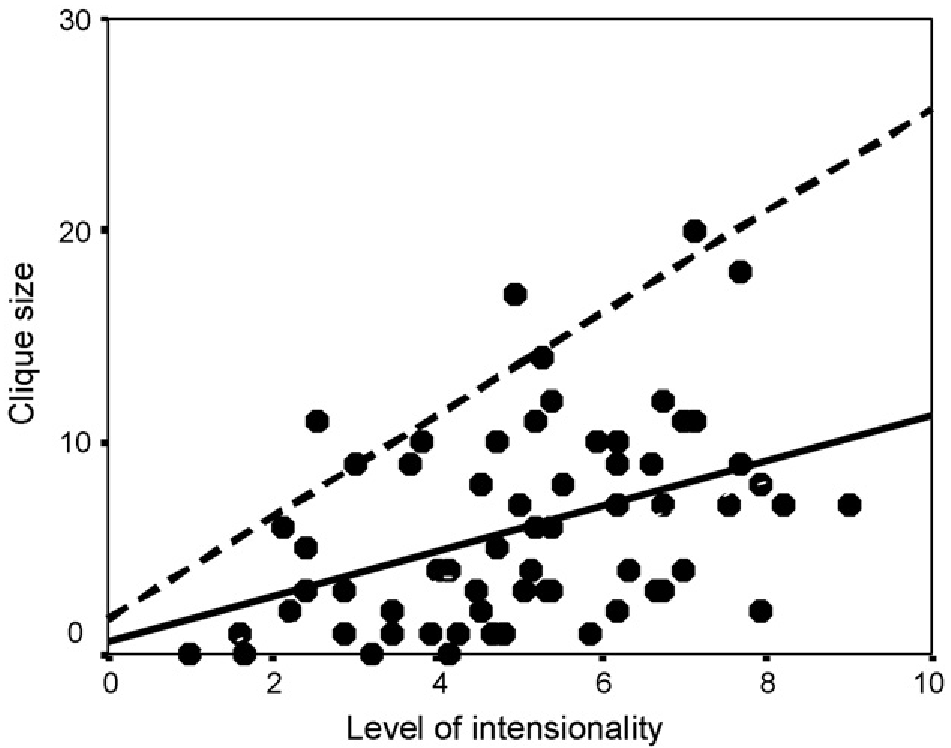 The "Upper Bound" slope (dashed line) shows that while cognitive skill limits the maximum possible friends, life factors (time, environment) determine the actual number.
Critical Insight & Conclusion
This paper shifts the focus of social science from "how many friends can we have?" to "what kind of thinking does each friend require?"
Key Takeaways:
- The Intentionality Ceiling: Humans generally max out at the 5th level of "he thinks that she thinks..."
- Cognitive Specialization: Socializing isn't a single skill. Real-time empathy (ToM) and social record-keeping (Memory) are distinct modules.
- Limitations: The study uses short-term memory as a proxy; future research might investigate long-term associative social memory.
Ultimately, your "Support Clique" is limited by your ability to navigate the complex mental maneuvers of someone else’s mind. If you want a deeper inner circle, it’s not your memory you need to train—it’s your perspective-taking.