
PDTAP: Marrying Sociological Persuasion with Topic-Level Social Influence
Persuasion driven influence analysis in online social networks
This paper introduces PDTAP (Persuasion-Driven Topical Affinity Propagation), a social influence analysis model that integrates sociological persuasion metrics into the existing TAP framework. By combining topic-level affinity with interpersonal persuasion factors like authority and tie strength, the model achieves state-of-the-art accuracy in identifying influential nodes across diverse social networks.
TL;DR
Social influence isn't just about what you talk about; it's about who is saying it and their perceived standing in the community. This paper presents PDTAP, a model that upgrades the well-known Topical Affinity Propagation (TAP) framework by embedding sociological persuasion metrics. By focusing on Authority, the researchers boosted influence detection accuracy by up to 36% across academic and movie industry networks.
Background & Motivation: Why Topical Similarity is Not Enough
For years, models like TAP have successfully identified "Topic Leaders" by clustering users based on their affinity for specific subjects (e.g., Data Mining vs. Image Processing). However, these models often suffer from a "relational blindness." They assume that if two people are interested in the same topic and are connected, they influence each other equally.
In reality, influence is asymmetric and driven by persuasion. A novice researcher might be highly influenced by a professor (Authority), but the professor is unlikely to be influenced by the novice, regardless of their topical overlap. The authors identified that existing models lacked this sociological depth.
Methodology: Infusing Persuasion into Factor Graphs
The core innovation lies in the transition from a standard Topic Factor Graph (TFG) to a Persuasion-Driven one.
1. Beyond Binary Edges
In the original TAP, edge functions were binary (1 if connected, 0 otherwise). PDTAP replaces this with a quantitative Persuasion-Driven Peer Influence Probability.
2. The Two Pillars of Persuasion
The authors explored two primary sociological drivers:
- Tie Strength: Measured by the overlap of mutual neighbors. The authors refined this to ensure that even users with no mutual friends have a non-zero influence probability.
- Authority: This is the "secret sauce." Using PageRank and HITS algorithms, the model calculates a user's prestige within the network hierarchy.
3. The PDTAP Architecture
The model integrates these probabilities into the message-passing mechanism of Affinity Propagation. It passes "Responsibility" and "Availability" messages across the graph, now weighted by the persuasion factor.
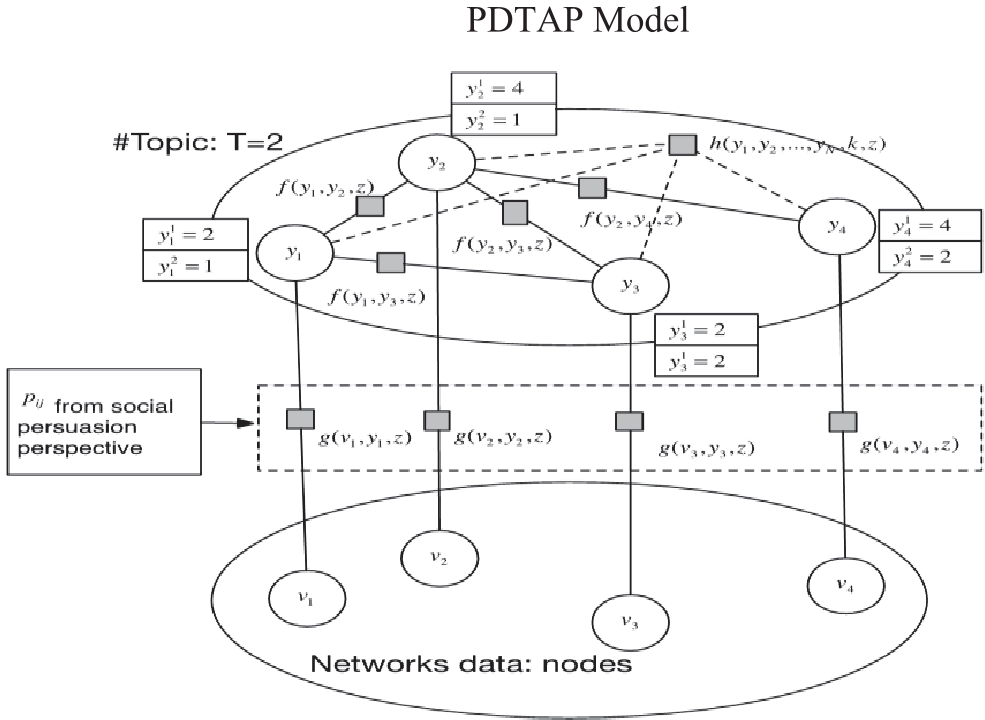 Figure 1: The graphical representation of PDTAP, showing how hidden variables (y) and topical weights (w) are influenced by node and edge features.
Experiments: Authority vs. Tie Strength
The researchers tested PDTAP on three distinct datasets: Citation (Academic), Film (Wikipedia), and News (Newsgroups).
Key Findings:
- The Authority Dominance: Using the Authority metric (especially via PageRank) led to a massive performance surge. In the Film dataset, accuracy doubled compared to the baseline TAP.
- The Failure of Tie Strength: Interestingly, using Tie Strength actually decreased performance compared to the original TAP. The authors argue that in professional networks (like academia or film), people follow experts (Authority) rather than just following people they share many friends with (Tie Strength).
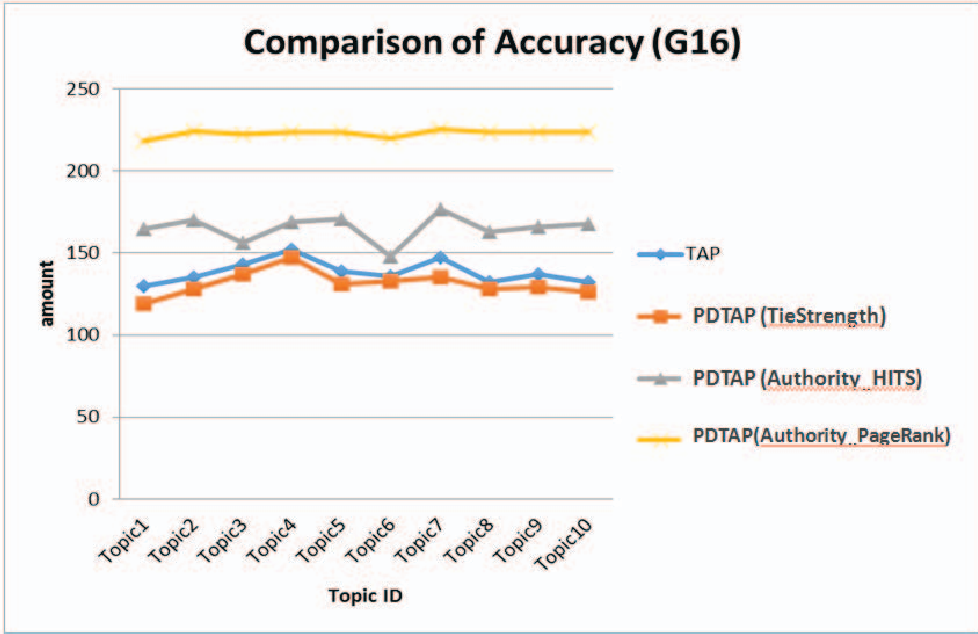 Table 1: Performance comparison showing PDTAP (Authority-PageRank) achieving the highest hit rates across all datasets.
Critical Insight: Efficiency Matters
One might assume that adding complex sociological calculations would slow down the model. However, the authors demonstrate that the computational cost of calculating persuasion probabilities is negligible. The iteration time remains comparable to TAP, making PDTAP feasible for large-scale Online Social Networks (OSNs).
Conclusion & Future Outlook
PDTAP proves that incorporating "Authority" is critical for modeling influence in professional environments. While "Tie Strength" might work for casual viral marketing (like a fashion trend among friends), "Authority" is the true driver of information diffusion in expert-led communities.
Limitations: The model currently relies on static network structures. A future iteration could look at moving from static graphs to dynamic, temporal graphs where authority and influence fluctuate over time.