
Persuasion vs. Virality: Why Being "Convincing" Isn't Enough to Go Viral
Persuasion and Social Contagion
This paper explores the intricate relationship between persuasive content and its propensity for social contagion (virality) using a large-scale Digg dataset. The authors formalize eight distinct "persuasive effects"—ranging from appreciation and buzz to controversiality—and demonstrate that while persuasiveness is a prerequisite for virality, different effects correlate with content spread in non-linear and often unexpected ways.
TL;DR
Is a highly persuasive, thought-provoking, or controversial story guaranteed to go viral? According to this research leveraging Digg's massive dataset, the answer is a resounding "No." While content virality is driven by its persuasive properties, the relationship is far from linear. In many cases, pushing a persuasive effect to its extreme (like being too controversial) can actually limit its spread.
The Missing Link in Social Contagion
For years, "Viral Marketing" focused on influencers and network topology. However, this paper argues that the internal nature of the content—its persuasive DNA—is the real engine of social contagion. The authors break down "persuasion" into a taxonomy of effects, including Appreciation, Buzz, Controversiality, and Elaboration.
The core research question is: Does more persuasion always equal more virality? Or is there a "Goldilocks zone" for social spreading?
Methodology: Formalizing Persuasion
The authors utilized a dataset of over 1.1 million Digg stories to define and measure persuasive effects. By mapping user interactions (Diggs, comments, sentiment) to specific formulas, they created distinct metrics for how content affects an audience.
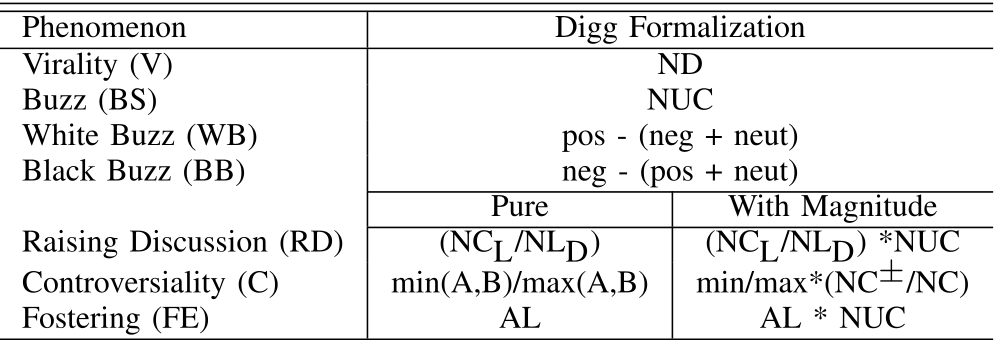
Key metrics include:
- Buzz (BS): The sheer volume of unique users commenting.
- Controversiality (C): The ratio and magnitude of Up-votes vs. Down-votes on comments.
- Fostering Elaboration (FE): The average length and depth of comments, indicating how much the content forced the audience to think.
The "Bell Curve" of Controversy
The most striking finding of the study is that not all "engagement" creates virality.
- Linear Success: "Buzz" (the number of people talking) correlates almost perfectly (ρ=0.86) with virality. If people are talking, the story is spreading.
- The Controversy Trap: Controversiality (C pure) shows a non-monotonic relationship. A mid-level of controversy can pique interest, but extreme controversy often segments the audience so sharply that the content fails to achieve mass-market virality.
- The Complexity Tax: Similarly, "Fostering Elaboration" shows that content requiring too much cognitive effort (long, deep discussions) tends to have lower overall virality compared to more "scannable" content.
 Fig: Note how Buzz (BS) scales linearly while other metrics like Raising Discussion (RD) exhibit different slopes.
Critical Insights & Takeaways
The study proves that planning for the persuasive effect of content is a necessary but not sufficient condition for virality.
- Magnitude vs. Purity: The authors found that "Pure" metrics (measuring the essence of an effect, like the ratio of a split audience) were more informative than "Magnitude" versions, which simply tended to mirror the general volume of noise (Buzz).
- Strategic Implication: For marketers and creators, this suggests that aiming for "maximum discussion" or "maximum controversy" might actually be counter-productive. The goal should be to find the optimal persuasive balance that encourages sharing without creating friction that halts the contagion process.
Conclusion
This work serves as a foundational bridge between Linguistics, Psychology, and Network Science. It shifts the focus from who is spreading the message to what the message is doing to the audience. While the dataset (Digg) is a snapshot in time, the underlying logic—that extreme persuasive effects can bottleneck virality—remains a critical lesson for the age of social algorithms.