
A Top-level Ontology: Bridging the Semantic Gap in Smart Environments
Pervasive and mobile computing
The paper proposes a top-level ontology for smart environments to harmonize multi-modal sensor data interpretation. It introduces a formal framework using set theory and description logic (OWL DL) to provide a conceptual backbone for activity recognition and context reasoning, achieving a scalable method for knowledge sharing across heterogeneous systems.
TL;DR
Smart homes are often "silos" of data where a motion sensor in the kitchen doesn't "know" it's relevant to a "cooking" activity recognized by a separate app. This paper provides a mathematical and logical backbone (a top-level ontology) that allows different smart systems to speak the same language. By defining core concepts like "finer-grained" and "conflict," it enables automated reasoning that catches sensor errors and simplifies how developers build complex activity-aware applications.
Problem & Motivation: The Heterogeneity Trap
The deployment of smart technologies in real-world settings is hindered by three types of heterogeneity:
- Data Heterogeneity: Sensors use different markups and protocols.
- Knowledge Heterogeneity: A "living room" in one system has no semantic relation to a "house" in another.
- Application Heterogeneity: Different apps define "watching TV" in ways that cannot be shared or compared.
The authors observed that while many domain-specific ontologies existed, they lacked a foundational model to link elementary sensor data to high-level human behaviors. Without this, developers are forced to manually code thousands of rules (O(n²) complexity) to handle every possible state in a smart home.
Methodology: The Core Semantic Backbone
The paper’s genius lies in its simplicity. It treats every piece of information as a point in a Product Space and uses classic Set Theory to establish four primary relations:
- Finer-grained (): Is "Bedroom" inside "House"?
- Equals (): Are these two terms referring to the same state?
- Conflicts (): Can a person be in the "Kitchen" and "Bedroom" simultaneously?
- Overlaps (): Do "Morning" and "Friday" share a time window?
The Three-Layer Architecture
The ontology is structured into a hierarchy that flows from raw data to intelligence:
- Concept Layer: Defines dimensions (Time, Location, Temperature).
- Context Predicate Layer: Uses triples (e.g., ).
- Activity Layer: Composes predicates into complex situations via logical entailment.
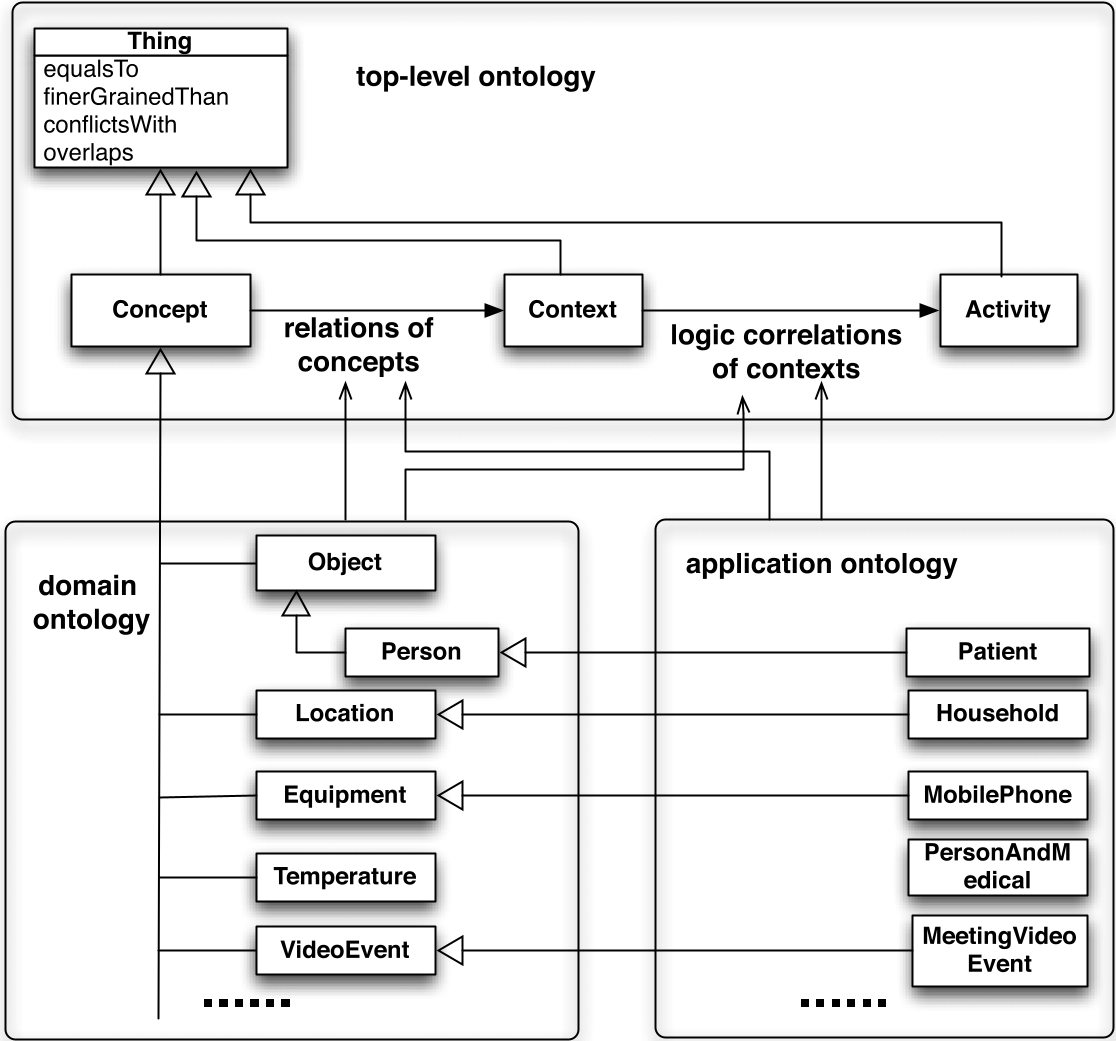 Figure 1: The proposed hierarchy linking Top-level, Domain, and Application Ontologies.
Experiments: Real-world Validation at PlaceLab
The authors tested their model using the PlaceLab data (a living laboratory from MIT/TIAX).
Reducing Engineering Effort
By defining just 10 immediate spatial containment relationships (e.g., Dining Room is in the House), the system used its Generic Rules (Lemma 3-8) to automatically infer 78 other relationships. More impressively, it derived over 32,000 conflicting relationships between 605 objects sensed via RFID. This moves the developer's workload from O(n²) to O(n).
Detecting Inconsistency
The model excels at "Sanity Checks." If one sensor says Bob is in the bedroom and another says he's in the foyer at the same timestamp, the system flags a Context Inconsistency.
- Result: Identified 178 inconsistent pairs out of 2,316 data points in a single day of PlaceLab infra-red sensor data.
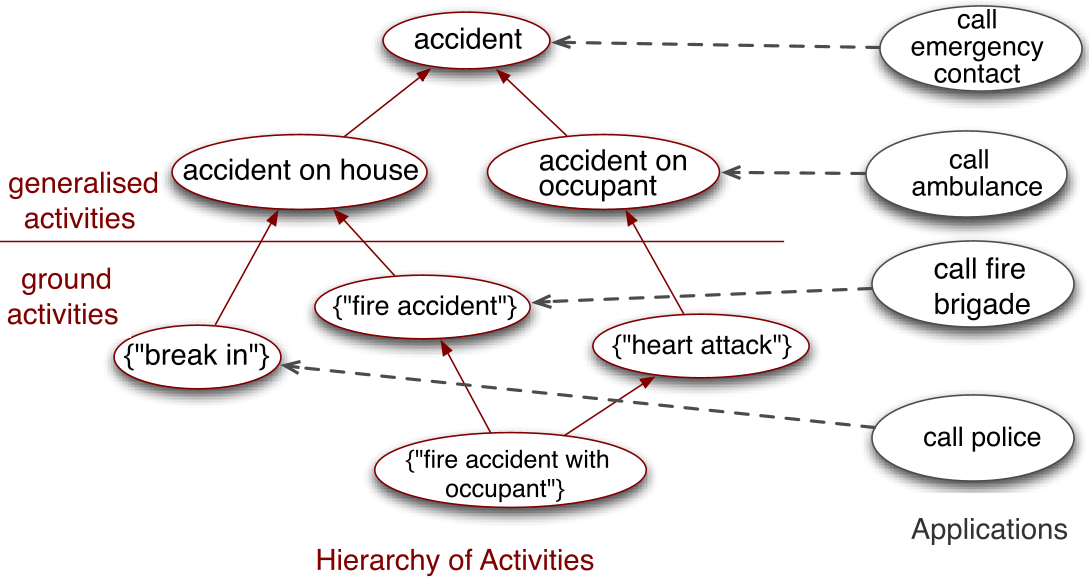 Figure 2: Example of a structured activity hierarchy for emergency response.
Critical Analysis & Conclusion
Takeaway
This work proves that we don't need "black box" AI for everything in a smart home. A traceable, logical model can handle the heavy lifting of data organization and error detection. It provides a formal "source of truth" that makes smart homes more reliable and easier to program.
Limitations & Future Work
The primary limitation is Temporal Logic. While the model handles static states and simple intervals well, it lacks the complex temporal operators (e.g., "Activity A happens before Activity B") required for complex routines. The authors aim to integrate Allen’s Interval Algebra or similar temporal semantics in future iterations. Additionally, the reliance on manual mapping of ground values to abstract concepts (e.g., what temperature range constitutes "Hot") remains a bottleneck that could be improved with machine learning.
Final Verdict: A foundational piece of research that elevates pervasive computing from "ad-hoc coding" to "formal engineering."