
Maximizing MSN Efficiency: Predictive Data Dissemination with Controlled Service Overhead
Pervasive and mobile computing
The paper proposes a social-aware data dissemination scheme for Mobile Social Networks (MSNs) that maximizes delivery ratios under a strictly controlled "service overhead." By employing a time-homogeneous semi-Markov model to predict neighbor interest transitions, the system dynamically selects the most effective relay nodes (servers) to carry uninterested messages.
TL;DR
In the chaotic environment of Mobile Social Networks (MSNs), where connectivity is intermittent and device resources are precious, the "Social-aware Data Dissemination Service" introduces a surgical approach to message spreading. By limiting the number of active "servers" (relay nodes) and using a semi-Markov model to predict which nodes will encounter the most interested users, the authors achieve a 10% improvement in delivery ratio while keeping network overhead strictly capped.
The Motivation: The Hidden Cost of "Gossip"
Most opportunistic routing protocols act like viruses: they try to infect as many nodes as possible to ensure the message reaches its destination. While this "Epidemic" approach maximizes delivery, it creates a massive Overhead Problem. Uninterested nodes become clogged with data they don't want, wasting storage and bandwidth.
The authors identify a critical gap: Prior work lacks a mechanism to estimate or control overhead as the network scales. To solve this, they move away from counting total transmissions and instead propose Service Overhead—a fixed limit on how many nodes can act as "authorized servers" for a specific message at any given time.
Methodology: Social Awareness through Markovian Logic
The core innovation lies in treating a node's social environment as a stochastic process.
1. The Semi-Markov Model
Instead of just looking at who a node meets, the system looks at what those neighbors want. Each node maintains a state machine representing the "appetite" of its current neighbors.
- States: The specific interest types most prevalent among current encounters.
- Transitions: The probability that a node currently surrounded by "Business" interested peers will move into a crowd interested in "Health."
2. Utility Functions (The Decision Engine)
When two nodes meet, they must decide: Should I hand over my server status to you?
- Utility 1 (Short-term): Evaluates a node’s ability to serve an interest within the immediate and next time slot.
- Utility 2 (Long-term): Calculates the cumulative probability of serving the interest over the message's remaining Time-To-Live (TTL).
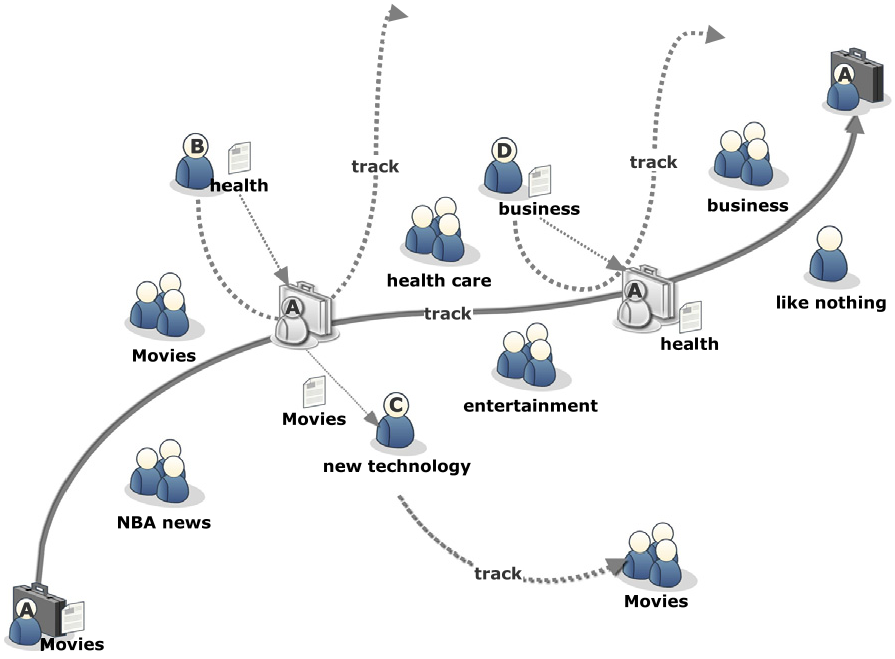 Figure 1: Example of role transitions between Servers and Clients based on predicted encounters.
Experiments: Real-World Validation
The researchers tested their model against UMassDieselNet (bus-based DTN) and SIGCOMM09 (conference Bluetooth traces).
Key Performance Metrics:
- Delivery Ratio: The Markov-utility approaches consistently beat the "Future" protocol and "HighCentrality" methods. Markov-utility2 (the long-term variant) proved most robust, especially in larger synthetic networks.
- Latency: By picking better "quality" relays rather than more "quantity" relays, the time-to-delivery was significantly reduced.
- Switching Efficiency: Crucially, the model required fewer "Server Copy Switches," meaning it reached the right carriers faster without constant hand-offs.
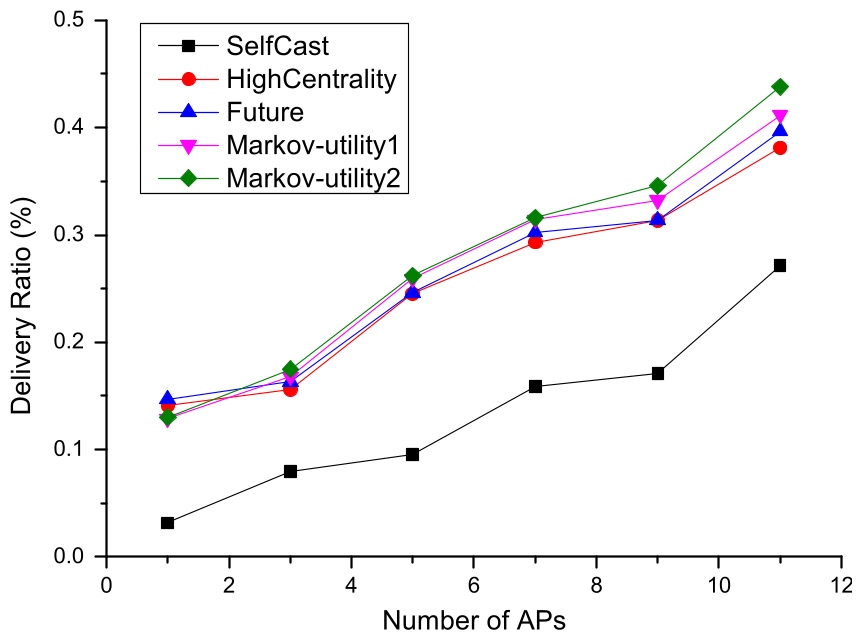 Figure 2: Performance across different datasets showing the superior delivery ratio of Markov-based methods.
Critical Insights & Takeaways
The transition from Epidemic spreading to Predictive Slot-based dissemination represents a shift toward more sustainable mobile networking.
- Context is King: Simply being a "popular" node (High Centrality) isn't enough. You must be popular among the right people at the right time.
- Resource Fairness: By capping the server copies, the network ensures that one popular message doesn't drown out everything else.
- Future Outlook: While this paper assumes nodes are cooperative, the authors acknowledge that real-world deployment would require an incentive layer (like virtual credits) to reward nodes for the energy spent acting as a Markov-predicted server.
In conclusion, this work provides a rigorous mathematical framework for social-aware networking, proving that we can do more with less—provided we have the right statistical foresight.