
RelTypeFinder: Shifting Relationship Discovery from Text to Multimedia Rules
Pervasive and mobile computing
The paper proposes a rule-based relationship discovery framework that identifies social ties (colleagues, relatives, friends) in social networks by analyzing published photos. It utilizes a crowdsourcing methodology to build photo datasets and automatically generates discovery rules using metadata and implicit visual attributes.
TL;DR
Social networks often know who you are connected to, but rarely how you are connected (e.g., is this a coworker or a cousin?). This paper presents a framework that automatically generates discovery rules by mining the rich metadata and visual context of shared photos. By leveraging crowdsourced data from Flickr and personalizing it via the Apriori algorithm, the authors achieve superior accuracy in identifying colleagues, relatives, and friends compared to traditional textual profiling.
The Missing Link: Why Text Isn't Enough
Relationship management is a cornerstone of Social Network Sites (SNS). While finding new contacts is easy, organizing them is a "complex, time-consuming, and tedious task." Most users skip labeling their contacts, and existing tools rely on textual "About Me" sections that are often outdated or sparse.
The authors argue that photos are the ultimate source of truth. Photos capture natural, everyday human interactions. However, previous photo-based attempts were hindered by:
- Attribute Sparsity: Only looking at age or gender.
- Hard-coded Logic: Using expert-defined rules that don't adapt to different cultures or personal habits.
Methodology: A Three-Tiered Intelligence
The core of the paper lies in its hybrid rule generation strategy, moving from the general to the specific.
1. Basic Rules (The Wisdom of the Crowd)
Instead of hiring experts, the authors used crowdsourcing. They queried Flickr for photos tagged with "family," "colleagues," etc., to build a massive dataset. From this, they extracted frequent patterns: if two people of different genders appear together on a weekend during working hours, they are highly likely to be relatives (Rule 6 in their findings).
2. Common Sense Rules (Human Logic)
These are universal heuristics. For example, if a stranger appears in many photos exclusively with your family members, they are likely part of the family as well (Rule 2).
3. Derived Rules (Personalized Mining)
This is where the system adapts. Using the Apriori algorithm, the system analyzes a specific user's photo collection. It identifies patterns unique to that individual—perhaps they only take photos with friends at a specific GPS location—and generates "Derived Rules" that replace or refine the generalized basic rules.
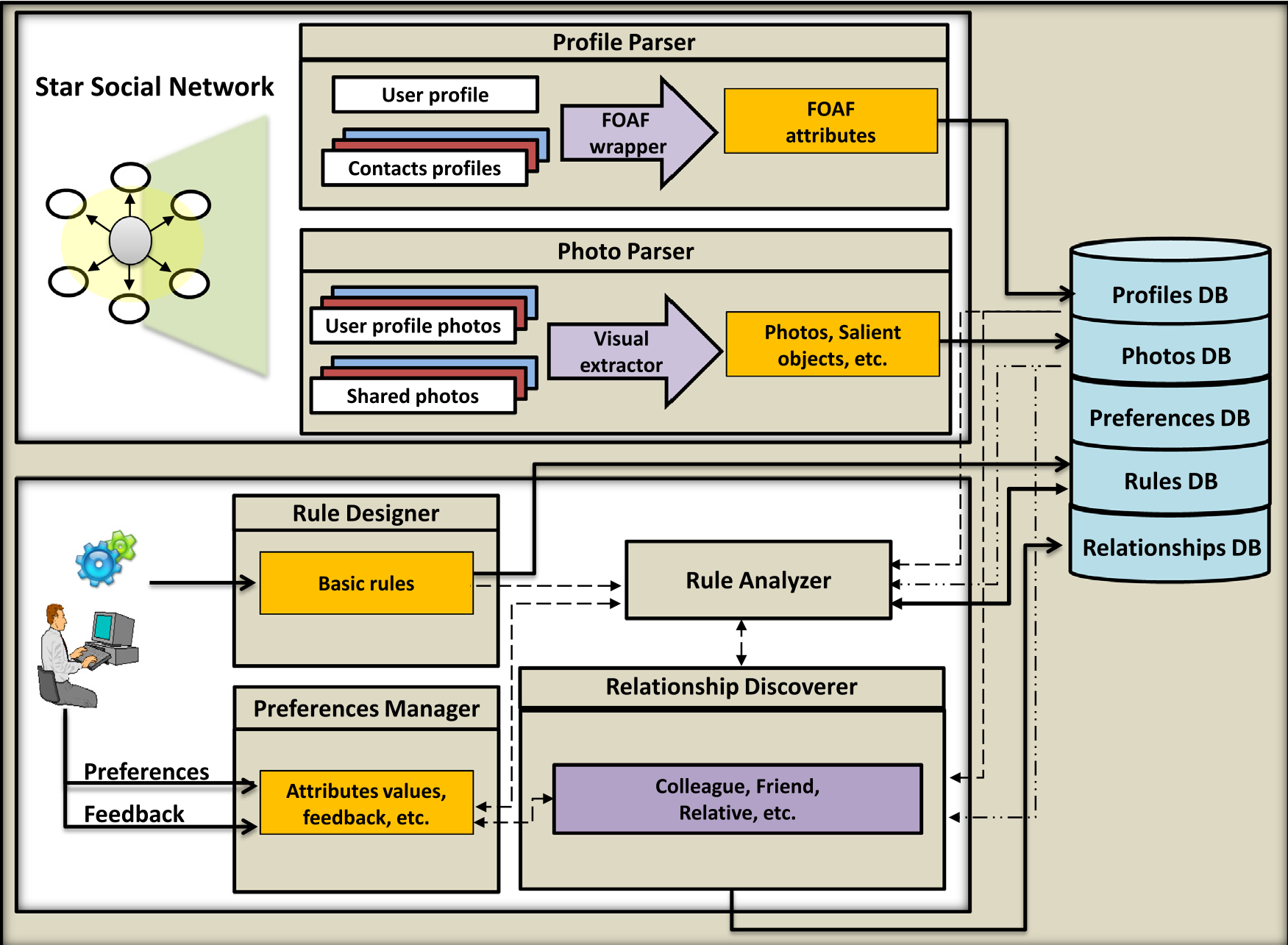 The five-module framework: Preference Manager, Parser, Rule Generator, Miner, and Finder.
Experiments and "The Common Sense Test"
The authors validated their rules through a survey of 120 graduate students and real-world Facebook data.
- Survey Accuracy: Over 80% of participants agreed that the crowdsourced "Basic Rules" accurately described real-life relationship contexts.
- Performance Boost: By adding personalized "Derived Rules" (Test C), the system saw significant gains. For "Friends" detection, precision jumped from 54% (Basic only) to 74%.
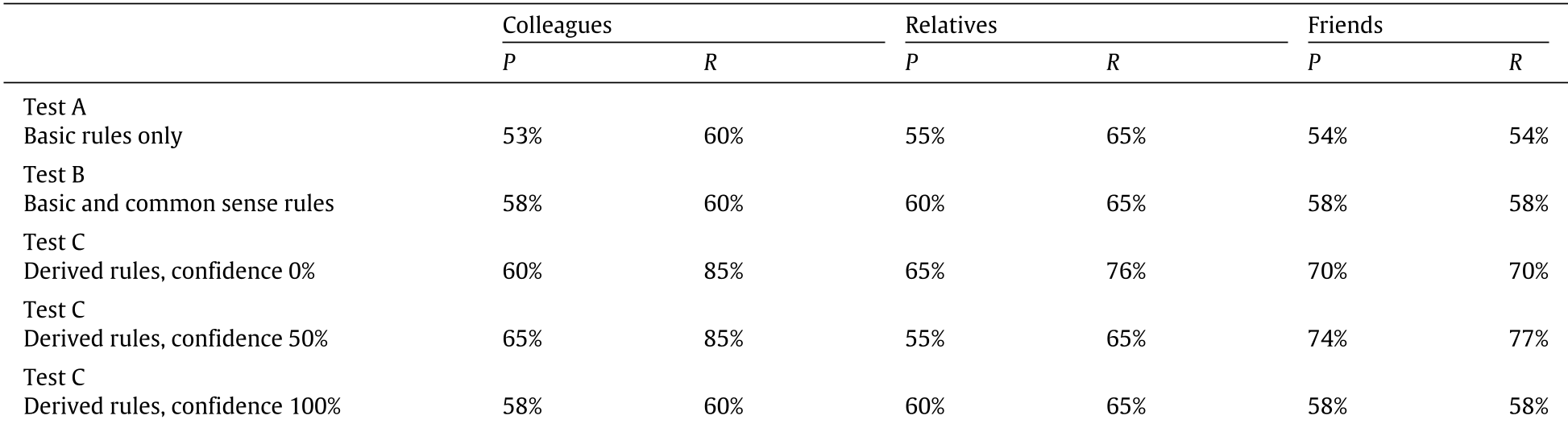 The ablation study: Note how Derived Rules (Test C) consistently outperform Basic Rules (Test A) in precision and recall.
Critical Insight: The Power of Exif and Metadata
One of the paper's standout contributions is its heavy reliance on Exif data (capture time, date, GPS). While computer vision researchers usually focus on pixel-level face recognition, this paper shows that the context of the photo—when and where it was taken—is often a stronger indicator of social relationship than the faces themselves. A face recognition model can tell you who is in the photo, but the timestamp tells you if you were with them during "working hours" (Colleagues) or "family time" (Relatives).
Limitations and The Future
While powerful, the approach has limitations:
- Multiple Roles: A colleague can also be a friend. The current dataset used for testing didn't fully explore these overlapping labels, though the algorithm supports it.
- Visual Distance: The authors note that the physical distance between people in a photo is a proxy for "intimacy," a factor they plan to integrate as a "social closeness measure" in future work.
Takeaway
This work demonstrates that the future of social network management is multimodal. By blending semantic web standards (FOAF, DC) with automated image metadata mining, we can significantly reduce the "manual labor" of social organizing.