
INTCare: Advancing Critical Care with Pervasive Ensemble Learning
Pervasive and Intelligent Decision Support in Critical Health Care Using Ensembles
The paper introduces INTCare, a pervasive Intelligent Decision Support System (IDSS) for Intensive Care Units (ICU) that employs ensemble learning to predict organ failure and patient outcomes within a 24-hour horizon. By combining real-time data acquisition with an ensemble of Support Vector Machines (SVM), Decision Trees (DT), and Naive Bayes (NB), the system achieves State-of-the-Art predictive performance in a live clinical environment.
TL;DR
In the high-stakes environment of an Intensive Care Unit (ICU), seconds count. This paper presents INTCare, a pervasive Intelligent Decision Support System (IDSS) that uses an ensemble of Data Mining (DM) techniques to predict organ failure and patient outcomes for the next 24 hours in real-time. By prioritizing Sensitivity, the system ensures healthcare providers are alerted to potential patient deterioration before it becomes irreversible.
The Challenge: Speed vs. Accuracy in the ICU
Critical care medicine is characterized by "information overload." Doctors must synthesize data from vital signs, lab results, and drug titrations to make life-saving decisions. Conventional methods typically rely on manual scoring or offline analysis, which are often too slow or lack the precision needed for proactive intervention. The core problem addressed here is twofold: how can we process massive streams of clinical data in real-time, and which machine learning models provide the most reliable alerts for clinical staff?
Methodology: The Ensemble Architecture
The researchers developed a system driven by autonomous intelligent agents. These agents handle the entire pipeline: from data acquisition across five different sources (Laboratory, Pharmacy, Nursing records, etc.) to the induction of predictive models.
The Ensemble Strategy
Instead of relying on a single "monolithic" model, the authors employed a Stacked Generalization ensemble strategy. They induced 126 different models using three core techniques:
- Decision Trees (DT)
- Support Vector Machines (SVM)
- Naive Bayes (NB)
The system evaluates these models against six targets (Renal, Hepatic, Neurologic, Respiratory, Cardiovascular, and Coagulation systems) and selects the "champion" model based on four metrics: Sensitivity, Accuracy, Total Error, and Specificity.
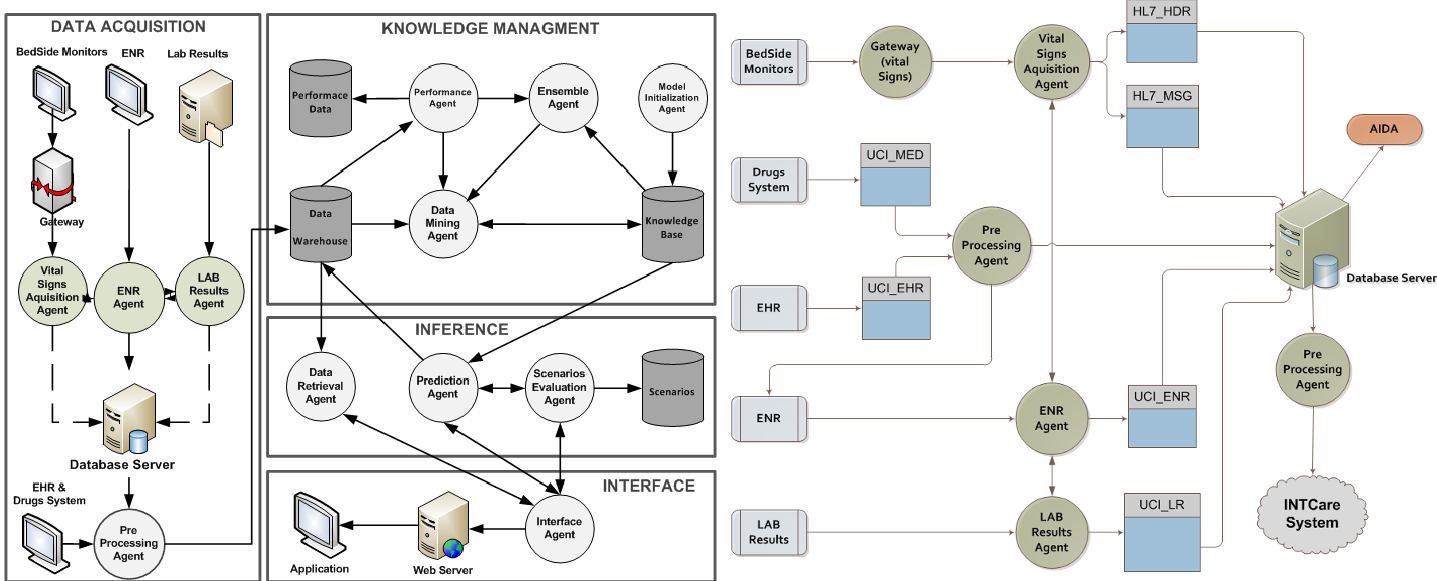 Figure 1: The INTCare modular architecture showing data acquisition, knowledge discovery, and the inference sub-system.
Clinical Insight: Why Sensitivity Matters
One of the paper's most significant contributions is its alignment with clinical pragmatism. In the ICU, a False Negative (missing a patient's decline) is far more dangerous than a False Positive (an unnecessary alarm). Therefore, the ensemble selection agent is programmed with a "Sensitivity-First" bias, requiring a minimum Sensitivity of 0.85.
Experimental Performance and SOTA Comparison
The system was tested over 98 days at the ICU of Centro Hospitalar do Porto. The ensemble strategy outperformed previous monolithic approaches significantly.
Key Results:
- Cardiovascular System: Achieved a staggering 97.52% Sensitivity, proving extremely reliable at catching heart-related issues.
- Patient Outcome: Reached 91.01% Sensitivity, allowing doctors to foresee death risks with high confidence.
- Renal System: Maintained a balanced performance with 93.43% Sensitivity and 91.00% Accuracy.
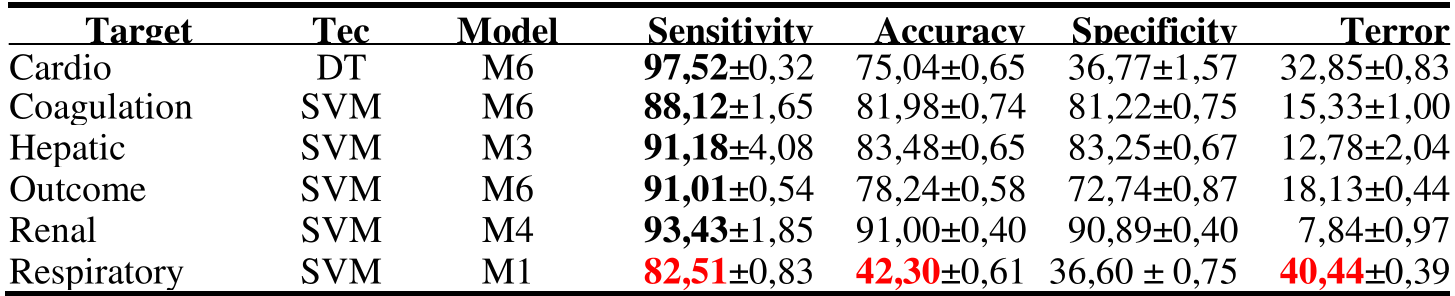 Table 1: Performance metrics of the best-performing ensemble models for each organ target.
While the Respiratory system (82.51% Sensitivity) struggled due to the complexities of mechanical ventilation data, the overall system was deemed highly effective for clinical adoption.
Critical Analysis & Conclusion
This work marks a shift from theoretical Data Mining to Pervasive AI. By embedding intelligence into the ICU's daily workflow, INTCare transforms "after-the-fact" documentation into "before-the-fact" prediction.
Limitations: The system's specificity in certain areas (like Cardiovascular) is relatively low, leading to potential "alarm fatigue." Future work should focus on refining the respiratory models and reducing false positives without compromising the critical sensitivity threshold.
The Takeaway: For AI to succeed in medicine, it must be pervasive (always on), real-time, and clinically aligned. INTCare demonstrates that ensemble learning is not just a technique for Kaggle competitions—it’s a life-saving tool in the hands of modern intensivists.