
SAPERE: When Pervasive Middleware Meets the Social Graph
Pervasive Middleware Goes Social: The SAPERE Approach
This paper introduces an extension to the SAPERE middleware, a "Self-aware Pervasive Service Ecosystem" that uses bio-chemical metaphors for service coordination. It integrates social network graphs (e.g., Facebook) with physical proximity to govern the topology of interactions between pervasive devices, users, and services.
TL;DR
The SAPERE project transforms pervasive computing into a "computational ecosystem" where services, data, and devices interact like chemical reagents. By integrating social network data (like Facebook) directly into its middleware, SAPERE ensures that digital interactions don't just happen because two devices are physically close, but because their owners actually share a social bond or common group interest. It’s a transition from "blind proximity" to "socially-aware spatiality."
The Problem: The Proximity Paradox
Current pervasive systems often suffer from a lack of context. If you walk into a crowded mall, your phone might "see" hundreds of devices and services. Without a filter, the result is noise. Prior work focused on:
- Network-driven models: Purely based on Wi-Fi/Bluetooth range.
- Map-driven models: Based on GPS or indoor coordinates.
Both fail to account for the Relational Context. Why should your phone interact with a stranger’s device just because they are two meters away? Conversely, how do we handle privacy in a way that feels natural to users?
The Insight: Social Networks as Dynamic Maps
The SAPERE (Self-aware Pervasive Service Ecosystems) team realized that social networks already contain the "logical maps" of our lives. They define who we trust (Friends) and where we belong (Groups like "Department of Engineering" or "Meeting Room X").
By using social graphs as a filter, the middleware creates a Socially-Situated Space. A connection only forms if:
- Condition A: The nodes are in physical proximity (e.g., Bluetooth range).
- Condition B: The nodes share a social link (Friendship or common Group) on a platform like Facebook.
Methodology: Bio-Chemical Coordination
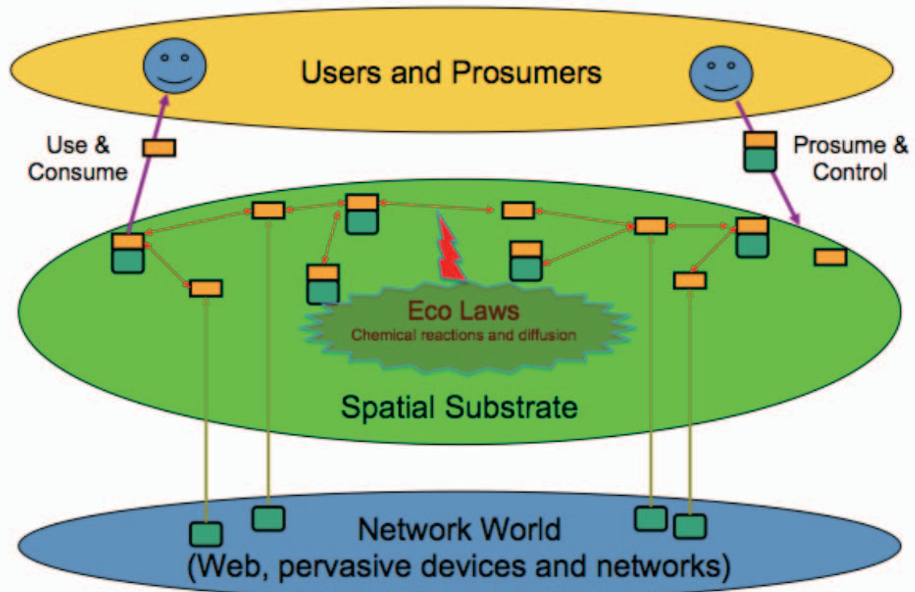
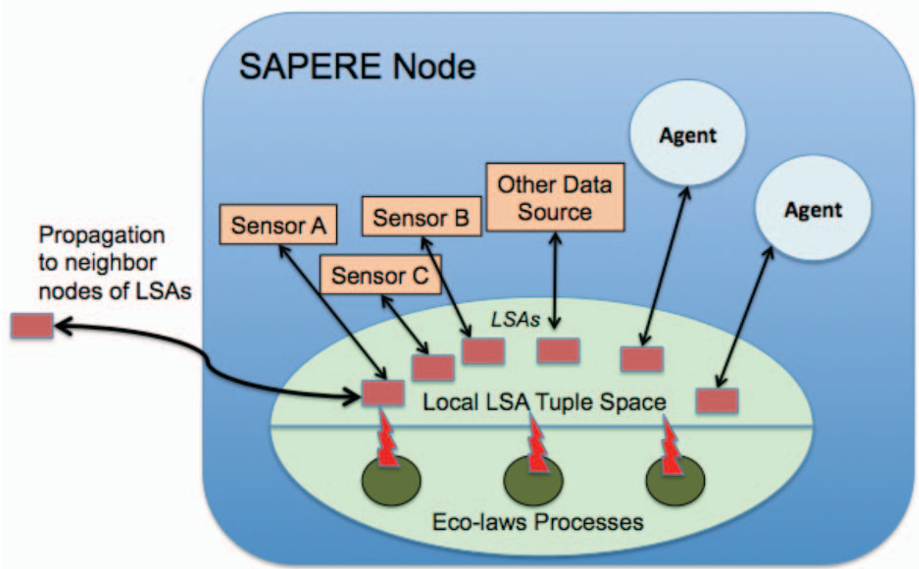
SAPERE doesn't use standard Request/Response protocols. Instead, it treats services and data as Live Semantic Annotations (LSAs)—essentially digital "molecules" floating in a distributed "tuple space."
1. The Interaction Logic
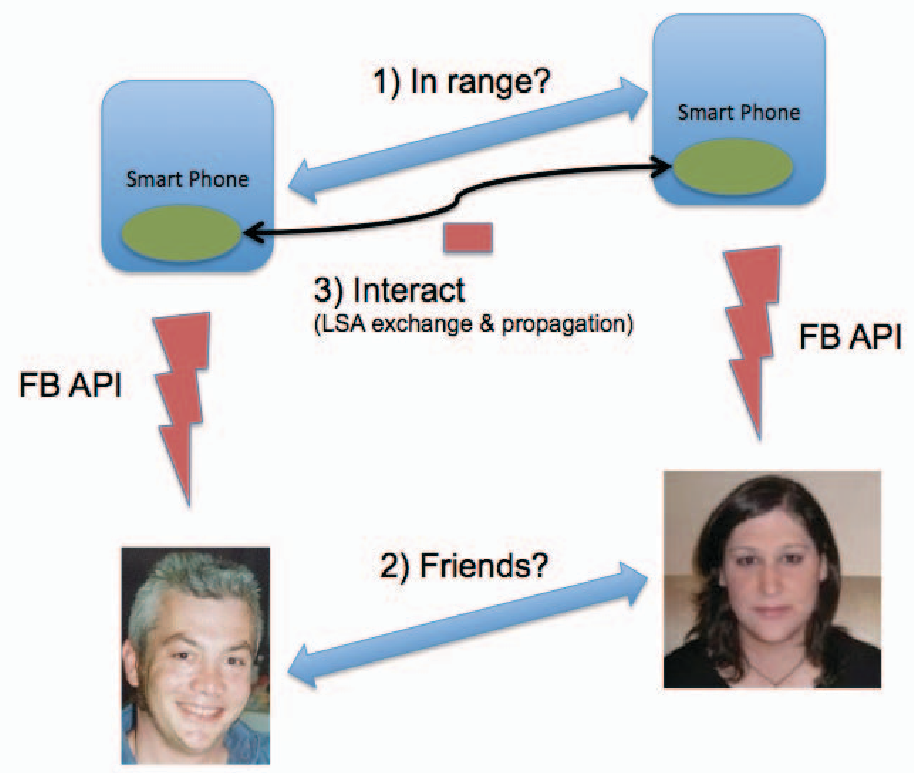
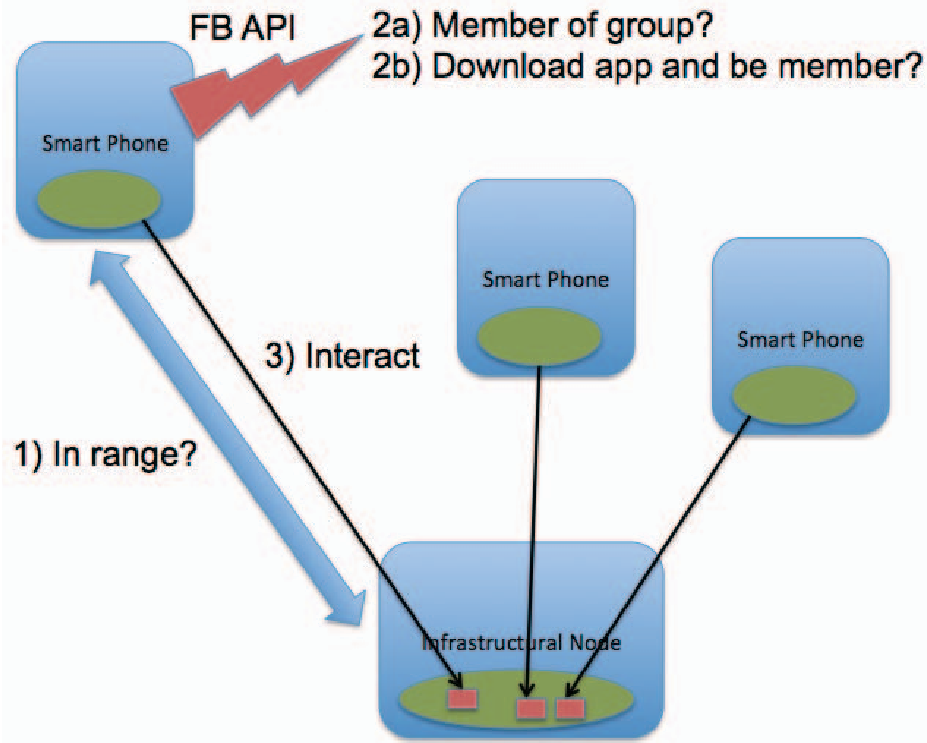
When a user's phone (a mobile node) approaches an infrastructural node (like a smart display in a room), the Network Topology Manager checks the social graph.
- For Users: "Are we friends?" If yes, LSAs propagate, triggering "Eco-laws" (virtual chemical reactions) that might share contact info or collaborative documents.
- For Infrastructure: "Is the user a member of this Room's Group?" If yes, the user can "consume" the room's services.
2. Middleware Architecture
The system is implemented as a lightweight layer on top of Android, using an enhanced version of the TUCSON tuple space engine.
Experiments & Social Dynamics
The authors demonstrate two primary interaction archetypes:
-
Friend-to-Friend (Mobile-to-Mobile): Relies on individual social profiles. It enables spontaneous, trusted sharing without manual configuration, using the social network's privacy settings as the gatekeeper.
-
User-to-Infrastructure (Mobile-to-Group): Infrastructure nodes are represented as Facebook "Groups." Walking into a classroom is equivalent to entering a digital shared space where the "Eco-laws" facilitate the distribution of lecture notes or local temperature control only to verified group members.
Critical Insights & Future Outlook
The true value of this work lies in its Inductive Bias toward social structures. By delegating privacy and membership to established social networks, the middleware avoids the "cold start" problem of new pervasive systems.
Key Takeaways:
- Privacy by Proxy: Users don't need to learn new privacy tools; they just manage their Facebook/social settings.
- Logic over Physics: High-level spatial relations (e.g., "being in the same department") are more useful for service discovery than raw GPS coordinates.
Limitations: The reliance on centralized APIs (like Facebook’s Graph API) introduces a single point of failure and potential latency. As the industry moves toward decentralized identity (DID) and Web3 social protocols, the "SAPERE approach" could be even more powerful if implemented over open, sovereign social graphs.
Conclusion
SAPERE provides a visionary blueprint for a "Socio-Technical Infrastructure." It proves that for pervasive computing to become truly helpful, it must stop looking just at the hardware and start looking at the social fabric that connects the people using that hardware.