
MPFJ: Combining Multi-Priority Queuing and Fork-Join for High-Performance SDN
Pervasive and mobile computing
The paper introduces an SDN-based Multi-Priority Fork-Join (MPFJ) scheduling scheme designed to optimize data transmission in mobile crowdsourcing. By combining priority queuing with parallel multi-path (fork-join) forwarding, it achieves minimized delay and backlog, significantly outperforming traditional single-path and single-priority models.
TL;DR
Mobile crowdsourcing (MCS) is evolving beyond simple data collection into intensive "crowdcomputing." This transition demands network architectures that can handle massive, heterogeneous traffic with strict QoS requirements. This paper proposes the Multi-Priority Fork-Join (MPFJ) scheduling scheme within an SDN context. By leveraging parallel network paths (Fork-Join) and traffic differentiation (Multi-Priority), it achieves significantly lower delay and backlog bounds than traditional methods, backed by rigorous Stochastic Network Calculus (SNC) analysis.
Problem & Motivation: The Heterogeneity Trap
Traditional networking struggles with the "all-or-nothing" nature of mobile crowdsourcing data. Real-time sensing (e.g., traffic anomaly detection) requires ultra-low latency, while bulk data offloading requires high throughput.
The authors identify two fatal flaws in prior work:
- Underutilization: Single-path routing cannot handle the "bursty" nature of MCS.
- Lack of Differentiation: Standard scheduling treats delay-sensitive and delay-tolerant packets similarly, leading to "queue jumping" by low-priority data.
The Insight: Use SDN's global view to identify flow priorities and split high-demand traffic across multiple paths simultaneously—a "divide and conquer" strategy for the data plane.
Methodology: The MPFJ Framework
The core of the MPFJ scheme lies in the synergy between the SDN controller and the data plane switches.
Architecture Decomposition
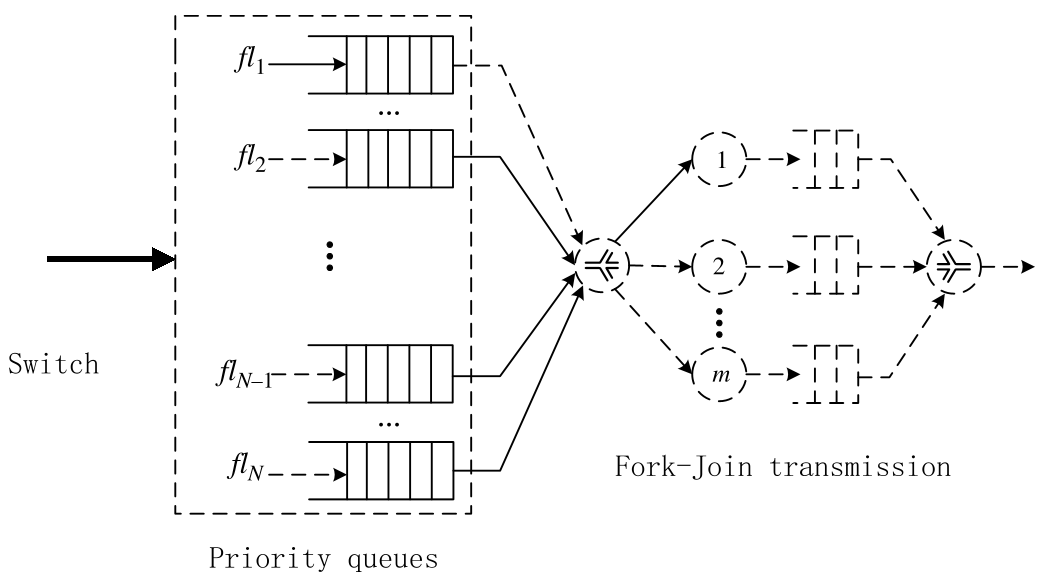
When a task arrives, the SDN controller classifies the flow. High-priority flows are placed in superior queues and then forked into parallel sub-flows, served by independent servers (representing parallel paths). This ensures that even if one path is congested, the aggregate service rate is maximized.
Theoretical Foundation: Stochastic Network Calculus
To evaluate this, the authors move beyond simple queueing theory (which often assumes Poisson arrivals) and use Stochastic Network Calculus (SNC). They define the performance using:
- (Arrival Curve): A probabilistic bound on the traffic volume.
- (Service Curve): The minimum service capacity guaranteed by the fork-join system.
By calculating the min-plus deconvolution of these curves, the authors derive the Backlog Bound and Delay Bound, providing a mathematical "safety net" for network operators.
Experiments & Results
The authors compared MPFJ against Multi-Priority Single-Path (MPSP) and Single-Priority Fork-Join (SPFJ) across various metrics.
Performance Comparisons
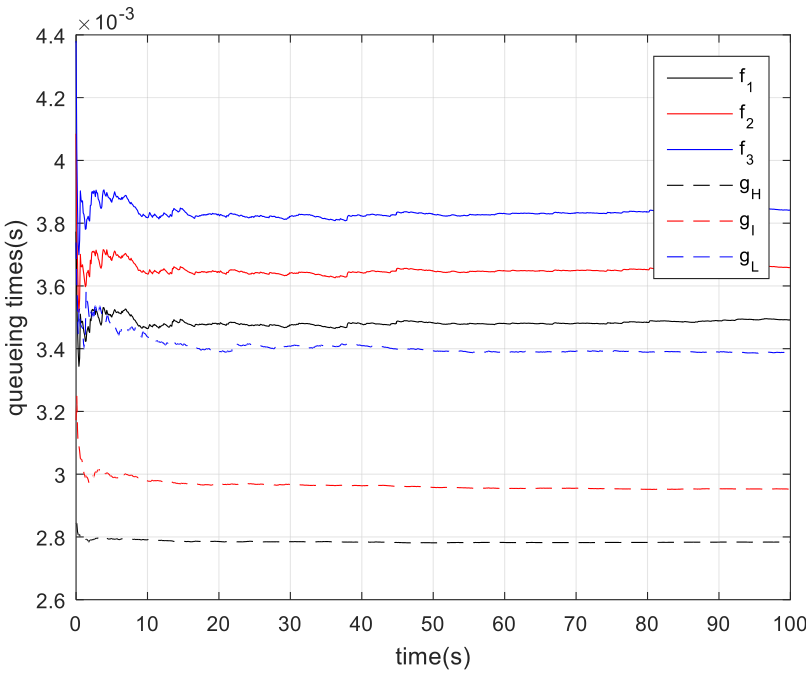
The findings (validated via MATLAB and OMNeT++) show a clear winner. Even as the arrival rate of high-priority flows increases, the MPFJ system keeps the backlog for those flows constant, effectively isolating them from the "numerical noise" of lower-priority traffic.
Key takeaways from the data:
- Throughput: MPFJ increases the system's processing capability by times (where is the number of parallel paths).
- Stability: The delay bounds for high-priority flows remain remarkably flat, regardless of how much "background" low-priority traffic is added.
Critical Analysis & Conclusion
Takeaway
The MPFJ scheme effectively solves the congestion problem in mobile crowdsourcing. It treats the network not as a single pipe, but as a flexible fabric of parallel resources.
Limitations
- Reordering Overhead: The paper assumes the "Join" operation at the destination is seamless. In practice, packet reordering after parallel transmission can introduce CPU overhead at the receiver.
- Stochastic Precision: SNC provides upper bounds, which can sometimes be "loose" (too pessimistic) in highly dynamic environments.
Future Outlook
The next step for this research involves moving from simulations to real-world SDN hardware (OpenFlow switches). As 5G network slicing becomes mainstream, MPFJ-style scheduling will likely become the standard for ensuring that sensitive "crowd" data doesn't get lost in the noise.