
Bridging Disconnected Worlds: Hybrid Dissemination in Mobile Social Networks
Pervasive and mobile computing
This paper introduces a hybrid content dissemination strategy for Mobile Social Networks (MSNs) that combines infrastructure-supported replication with opportunistic device-to-device communication. By strategically replicating user-generated content (UGC) on just 10% of consumer devices, the method bridges disconnected temporal communities to ensure timely delivery.
TL;DR
Mobile Social Networks (MSNs) are plagued by fragmentation—users move in clusters, leaving gaps that "store-carry-forward" protocols cannot bridge in time for short-lived content. This paper presents a hybrid solution: use the cloud to seed the right "replicators" in each cluster, then let local opportunistic networks do the heavy lifting. The result? 100% coverage with 60% less bandwidth.
The Fragmentation Paradox
We live in an age of User Generated Content (UGC). From promotion coupons to live traffic updates, UGC is context-heavy and time-sensitive. While we want the privacy and cost-efficiency of device-to-device (D2D) sharing, pure opportunistic networks are too slow.
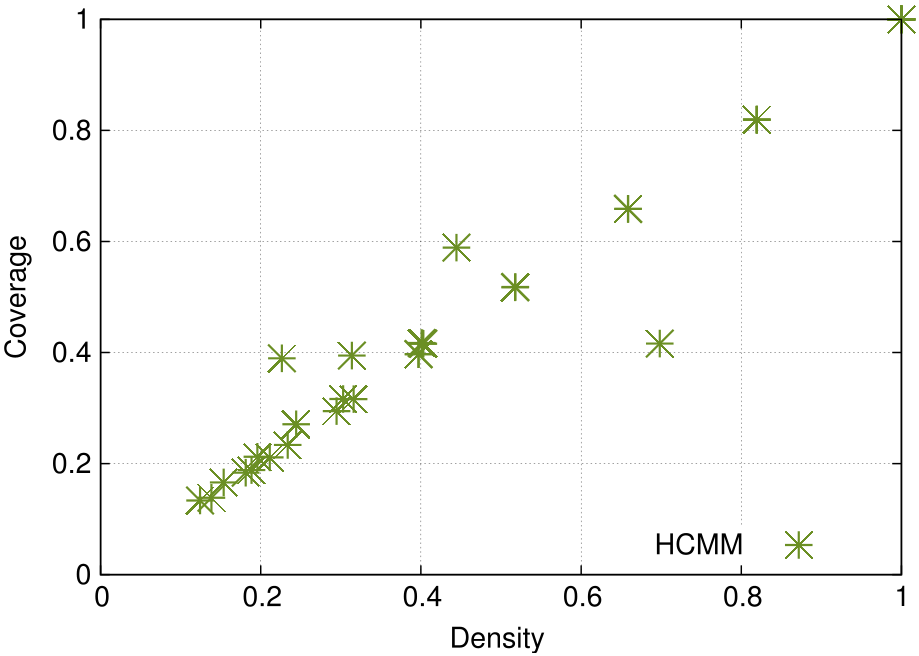
The authors' simulation of the Dartmouth campus trace revealed a grim reality: in a typical hour, a piece of content might reach less than 20% of its intended audience. Why? Because human mobility creates "disconnected components"—temporal islands of users who never physically meet the "infected" nodes carrying the data.
Methodology: The Replicator Strategy
The researchers propose a hybrid architecture that uses always-on infrastructure (Cellular/WiFi) not as a primary delivery vehicle, but as a "bridge" for these islands.
1. Replicator Selection
The core innovation lies in how the system chooses which devices should use their precious data plans to fetch content from the cloud. They compare two strategies:
- Random Replication: Simple, no network knowledge required.
- Component-based Greedy Selection: The "Smart" way. By analyzing a contact graph (), the system identifies the largest disconnected components and assigns one replicator to each.
2. Content Pre-fetching
To solve the "impatience" problem, the MobiTribe app monitors notifications and begins fetching content in the background before the user even clicks to view it. This utilizes idle contact windows, turning "dead time" into "download time."
Performance: Slaying the Bandwidth Beast
The results are striking. By identifying the social "VIPs" or component leaders, the system achieves a massive performance leap.
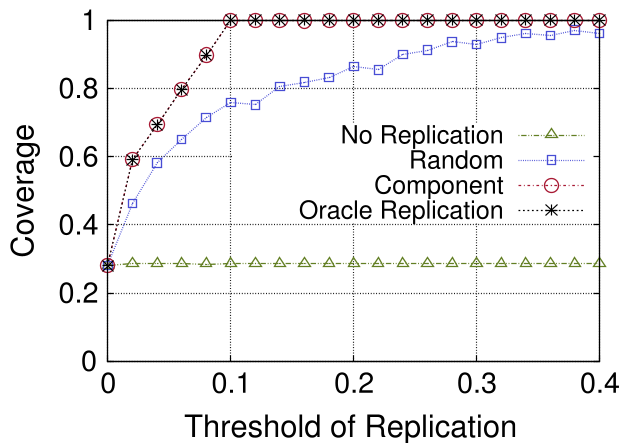
- Coverage: In the sparse Dartmouth environment, moving from "No Replication" to just 10% "Component Replication" shifted coverage from 20% to nearly 100%.
- Efficiency: Because local D2D communication handles the "last mile" within each cluster, the reliance on expensive cellular infrastructure drops by 60%.
- Robustness: Remarkably, even if only 20% of users are willing to help, the system's performance remains stable. This is due to the "Small-World" nature of human social networks—once the "hubs" are seeded, the rest follows.
Critical Insight: Why This Works
The physical world is not a well-mixed gas; it is a collection of evolving subgraphs. Previous opportunistic protocols tried to optimize the path between nodes. This paper realizes that in MSN environments, the initial placement of content is more important than the routing protocol. By using the infrastructure to overcome the topological gaps (the "cuts" in the graph), they transform a failing opportunistic network into a highly efficient delivery engine.
Conclusion and Future Outlook
This work proves that we don't need to choose between the high cost of the Cloud and the high latency of the Crowd. A hybrid approach provides the best of both worlds.
Future Work: As we move toward 5G sidelink and WiFi 7, the "local" transfer rates will only increase, making this hybrid model even more attractive. The next hurdle? Managing energy consumption and creating foolproof incentive systems (perhaps via micro-payments or blockchain) to ensure users remain happy to act as the "bridges" of the network.
Takeaway: If you want to spread content in a fragmented world, don't just shout louder; find the leader of every room and give them a copy.