
SPISM: Balancing Privacy and Utility through Machine Learning in Social Networks
Pervasive and mobile computing
SPISM (Smart Privacy-aware Information Sharing Mechanism) is a machine-learning-based system designed for mobile social networks to automate selective information sharing. It utilizes cost-sensitive multi-class classifiers (SVM, Naive Bayes, Logistic Regression) to decide whether to share location, activity, or co-presence data and at what granularity, achieving a 72% median accuracy for sharing decisions.
TL;DR
Researchers have developed SPISM, a smart mechanism that uses machine learning to decide for you when and how much personal information (like your location or current activity) to share with friends. By analyzing your past behavior and current context, it achieves over 70% accuracy while significantly reducing the "manual burden" of setting complex privacy rules.
Contextual Privacy: Why Static Rules Fail
We live in an age of "push" and "pull" social data. Whether it's Facebook, WhatsApp, or specialized sensors, our mobile devices are constant broadcasters of our digital selves. However, our willingness to share is rarely binary. You might share your street-level location with your spouse, but only your city-level location with a work colleague—and perhaps nothing at all if you are at a doctor's office.
The paper identifies two critical failures in current systems:
- Articulation Gap: Users are terrible at writing down their own sharing rules.
- Context Blindness: Static "White Lists" don't account for the time of day, who you are with, or the sensitivity of your current location.
Methodology: The Intelligence Behind SPISM
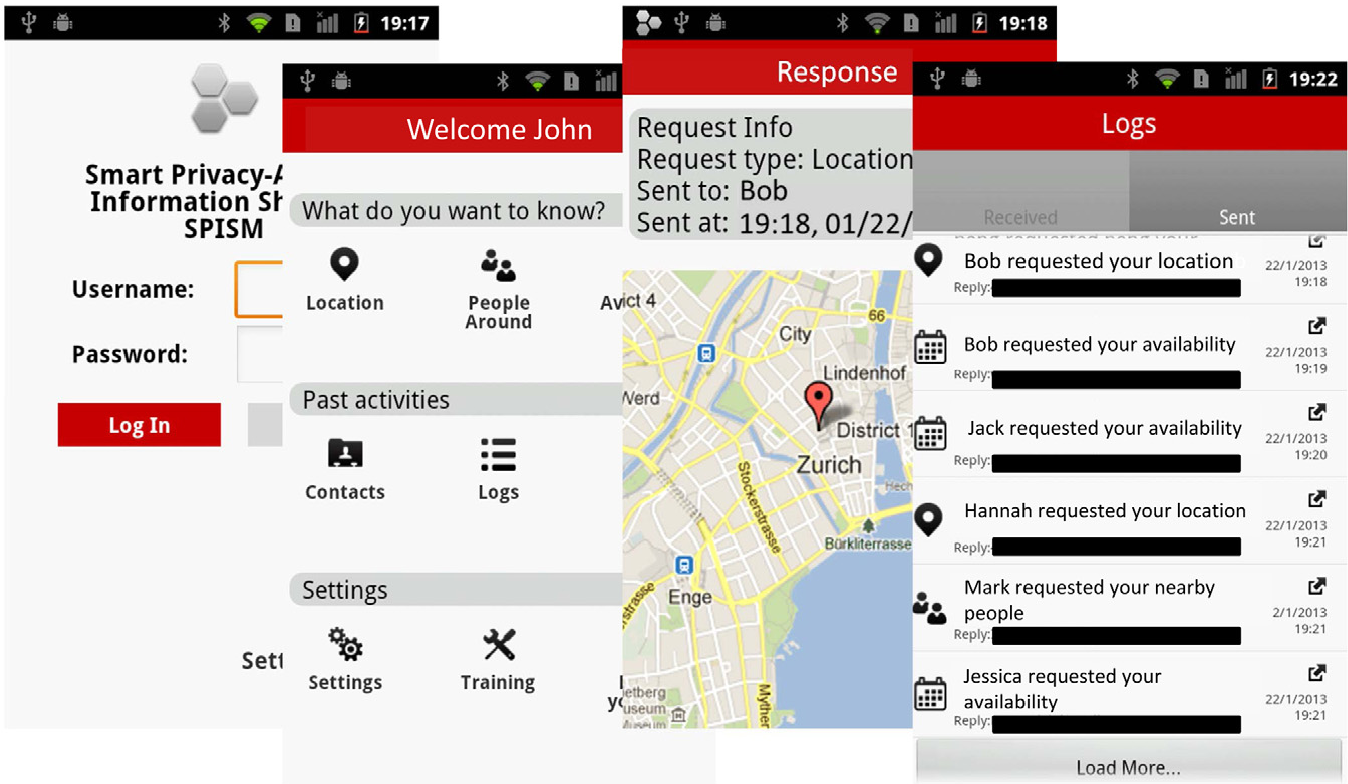
SPISM operates as an intermediary on the mobile device. When a request for information arrives, it extracts a feature vector composed of 18 distinct variables.
The Core Framework
The system doesn't just say "Yes" or "No." It evaluates:
- Who is asking? (Social ties, familiarity)
- What is being asked? (Location, activity, co-presence)
- What is the context? (Time, weekday, current neighbors)
Advanced Learning Mechanics
The brilliance of SPISM lies in its two-pronged approach to optimization:
- Active Learning: Instead of guessing blindly, the system calculates the entropy of its decision. If it's uncertain, it asks the user. This "teachable" moment improves the model for future requests.
- Cost-Sensitive SVM: Recognizing that sharing a private location by mistake (Over-sharing) is much worse than forgetting to share a public one (Under-sharing), the authors introduced an error-penalty matrix. This allows the model to be "conservative" by default.
Experimental Insights
The study involved a rigorous data collection phase with 70 validated participants from both university and MTurk backgrounds.
Key Findings
- Social Group is King: The social tie (Family vs. Acquaintance) is the #1 predictor of sharing behavior, followed by information type.
- Granularity Matters: Users utilize "Medium" or "Low" detail settings frequently when dealing with distant social ties, proving that binary privacy switches are insufficient.
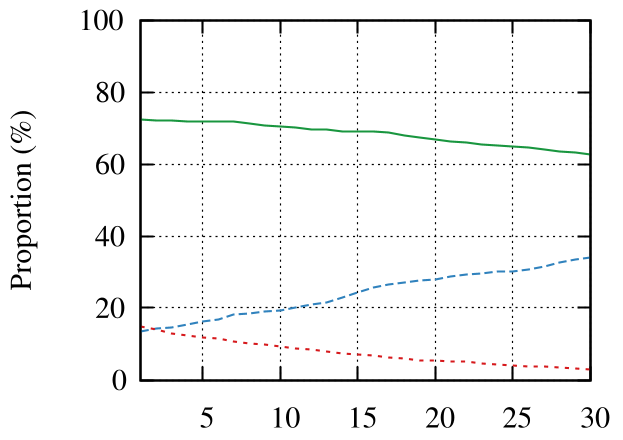 The chart above shows how accuracy climbs rapidly with just a few dozen manual decisions, eventually hitting a plateau that far exceeds manual rule-setting.
Critical Analysis & Conclusion
SPISM represents a transition from "Privacy by Manual Configuration" to "Privacy by Prediction."
Pros:
- High accuracy (72% median) with low user overhead.
- Effective use of cost-sensitivity to protect user privacy.
- Handles multi-class granularity (Low/Med/High detail).
Limitations:
- The study relied on "what-if" survey scenarios rather than real-world field data.
- Data sparsity: With only 75 scenarios per user, the model might struggle with rare but highly sensitive contexts (the "long tail" of privacy).
Final Takeaway
This work highlights that the future of mobile privacy isn't more settings menus—it's smarter algorithms. By treating privacy as a contextual classification problem, we can build systems that protect us without requiring a PhD in policy management.