
AMSNP: Orchestrating Adaptive Social Networks via Context-Aware P2P Mediation
Pervasive and mobile computing
The paper introduces AMSNP, an adaptive mediation framework for Mobile Social Network in Proximity that utilizes a service-oriented architecture (SOA) based on Enterprise Service Bus (ESB) and WS-BPEL. The framework achieves efficiency through a context-aware user preference prediction scheme for proactive service discovery and a resource-aware workflow mechanism to optimize mobile peer-to-peer (MP2P) interactions.
TL;DR
The Adaptive Mediation Framework for Mobile Social Network in Proximity (AMSNP) is a sophisticated service-oriented solution designed to solve the twin challenges of discovery latency and resource exhaustion in mobile peer-to-peer (MP2P) social environments. By combining Bayesian prediction for user preferences with a WS-BPEL workflow engine that dynamically calculates a Cost-Performance Index (CPI), it allows mobile devices to switch between local execution and Cloud offloading in real-time.
Problem & Motivation: The Chaos of Proximity
Mobile Social Networks in Proximity (MSNP) allow users to interact with people nearby—sharing content, meeting new friends, or mashing up services—without a central server. However, the reality of public Wi-Fi and Bluetooth P2P is chaotic:
- High Latency: Semantic service discovery (finding "who provides what") is computationally expensive and slow.
- Resource Bottlenecks: Offloading tasks to the Cloud isn't always better due to network latency and data costs, yet local execution drains batteries rapidly.
- Dynamic Topology: Peers appear and disappear constantly, making static service binding impossible.
The authors' insight was to stop viewing service discovery as a static "search" and start viewing it as a dynamic "workflow" that adapts its execution path based on the current context.
Methodology: The Core of AMSNP
The framework is built around an ESB (Enterprise Service Bus) architecture miniaturized for mobile hosts.
1. Context-Aware Prediction
Instead of waiting for a user query, the Predictor uses a probabilistic model based on Bayes' Theorem to calculate the likelihood of a user wanting a specific service type given the current environment and history . This allows the device to prefetch Service Description Metadata (SDM) before the user even asks for it.
2. The CPI Adaptation Model
The most innovative part of the system is the Cost-Performance Index (CPI). This model doesn't just look at speed; it evaluates:
- Performance (): Execution timespan across different approaches (Local vs. Cloud).
- Cost Element (): Weightings for CPU usage, Battery, and Bandwidth.
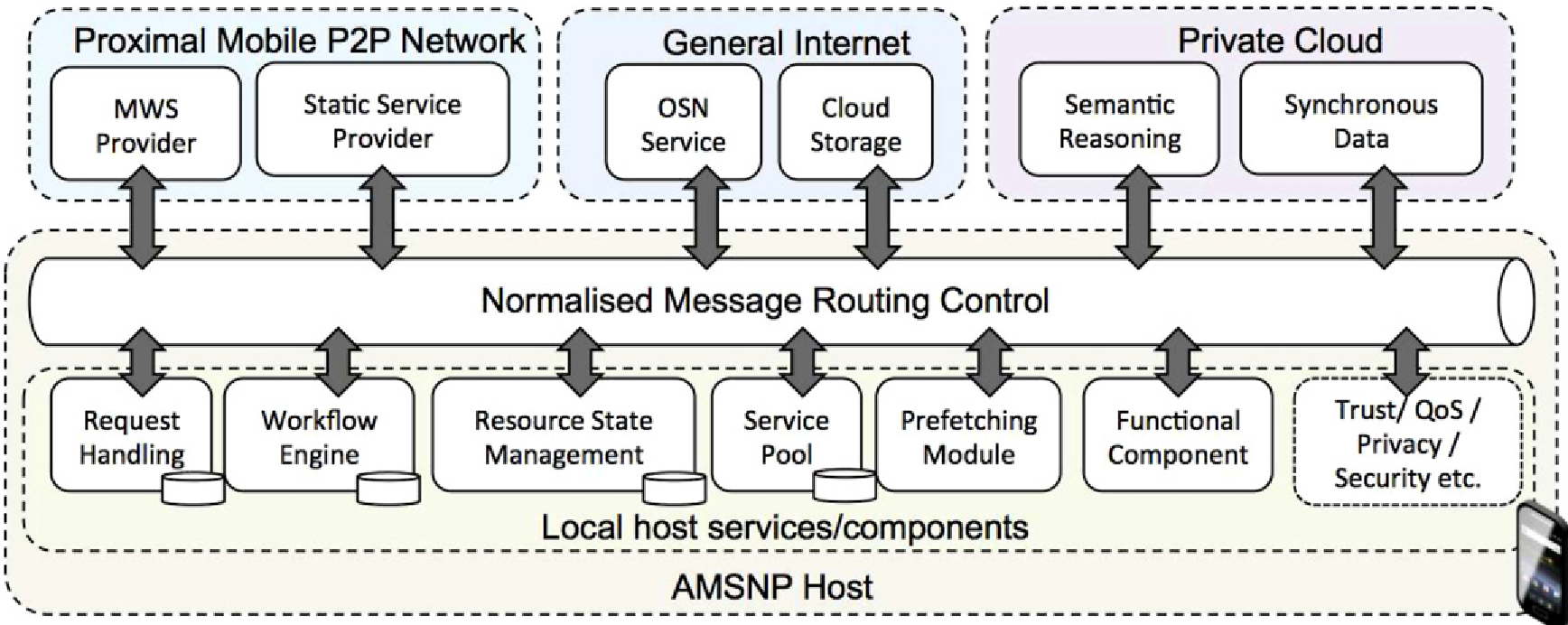
The workflow engine (WS-BPEL) triggers Task Agents that calculate the best path. For instance, if the battery is below 20%, the system increases the "weight" of CPU usage in the CPI formula, forcing the task to offload to a Cloud utility service like Amazon EC2 or Google App Engine.
Experiments & Results
The authors tested AMSNP in two primary scenarios: Service Discovery and Content Advertising.
Key Breakthroughs:
- PrefPush Performance: In the discovery scenario, the authors introduced "Preference-assisted Push" (PrefPush). By informing peers of what you likely want, the discovery timespan decreased as peer density increased, whereas traditional "Pull" methods became slower.
- Dynamic Offloading: In the Content Advertising test, the framework monitored CPU usage (hitting 100% during local matchmaking). When peer counts reached a critical threshold, the framework successfully transitioned the matchmaking task to the Cloud, maintaining a consistent user experience while shielding the device from thermal throttling.
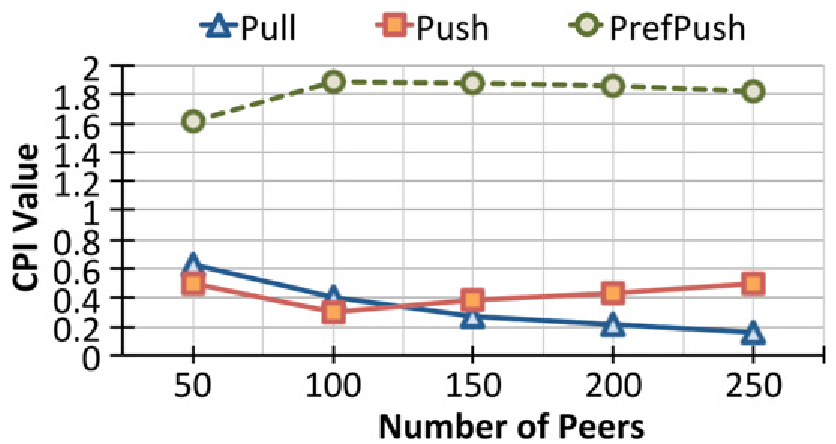 Figure: The CPI values demonstrate how different discovery approaches (Pull, Push, PrefPush) trade off efficiency as the peer network grows.
Critical Analysis & Conclusion
Takeaway
AMSNP proves that SOA/ESB principles—traditionally reserved for heavy enterprise backends—are surprisingly effective for mobile P2P. By abstracting discovery and advertising into "tasks" managed by a resource-aware mediator, we can build social networks that are both proactive and energy-efficient.
Limitations
- Privacy Concerns: Predictors sharing "context" and "preferences" with nearby peers raises significant privacy risks, which the paper acknowledges but does not solve.
- Cloud Dependency: The system relies on backend CloudUtil services. In a true "disaster recovery" or "no-signal" MSNP scenario, the framework's efficiency would regress to standard MP2P performance.
Future Work
The next frontier for this research involves integrating Social Trust Mechanisms and extending the framework to handle complex Web API mashups (e.g., combining data from a nearby friend's device with a live Twitter feed) autonomously.