
SCI: Distinguishing Friends from Strangers via Spatiotemporal "Fingerprints"
Pervasive and mobile computing
The paper introduces SCI (Social Connection Inference), a framework designed to infer social ties in Location-Based Social Networks (LBSNs). By simulating "co-location" events from check-in data, the method employs a Random Forest classifier fueled by four key spatiotemporal features—Diversity, Popularity, Duration, and Stability—to achieve SOTA performance.
TL;DR
Building social graphs from location data is a classic challenge. This paper presents SCI (Social Connection Inference), a framework that proves that where and when you meet someone is a powerful indicator of friendship. By analyzing meeting stability and long-term duration, SCI outperforms previous state-of-the-art models by up to 23.9% in AUC.
Context: The Bridge Between Virtual and Physical
Why do we care about check-ins? In LBSNs like Foursquare or Gowalla, a check-in is more than a GPS coordinate; it is a bridge between the virtual social network and physical behavior. However, the data is "noisy." If you and a stranger both check into the same airport at 9:00 AM, are you friends? Probably not. SCI aims to solve this "coincidental meeting" problem.
The Problem: The Noise of Coincidence
Existing methods like EBM (Entropy-Based Model) and PGT (Personal, Global, Temporal) struggle because:
- Lack of Temporal Depth: They often only look at the gap between the most recent meetings.
- Weekday Bias: Most models treat Monday commutes the same as Saturday night outings, even though the latter are much more likely to involve social ties.
- Computational Scalability: Generating co-location pairs from millions of check-ins is traditionally an nightmare.
Methodology: The Four Pillars of SCI
The authors propose a multi-stage pipeline: first, a KD-tree structure is used to find spatial neighbors efficiently, reducing computation to . Then, they extract four features that reflect sociological "multiplexity":
1. Popularity (The "Airport" Filter)
If a meeting happens at a high-entropy location (like a mall), its weight in predicting friendship is lowered.
2. Diversity (The "Stalker" vs "Friend" Filter)
Do you only meet at one Starbucks, or do you share check-ins at parks, cinemas, and homes? High diversity across different locations strongly signals a real bond.
3. Stability (The "Routine" Signal)
SCI measures the standard deviation of time intervals between meetings. Real friends meet with some degree of regularity or "rhythm."
4. Duration (The "Old Friends" Signal)
Relationship span matters. SCI captures the time delta between the very first and the last recorded meeting.
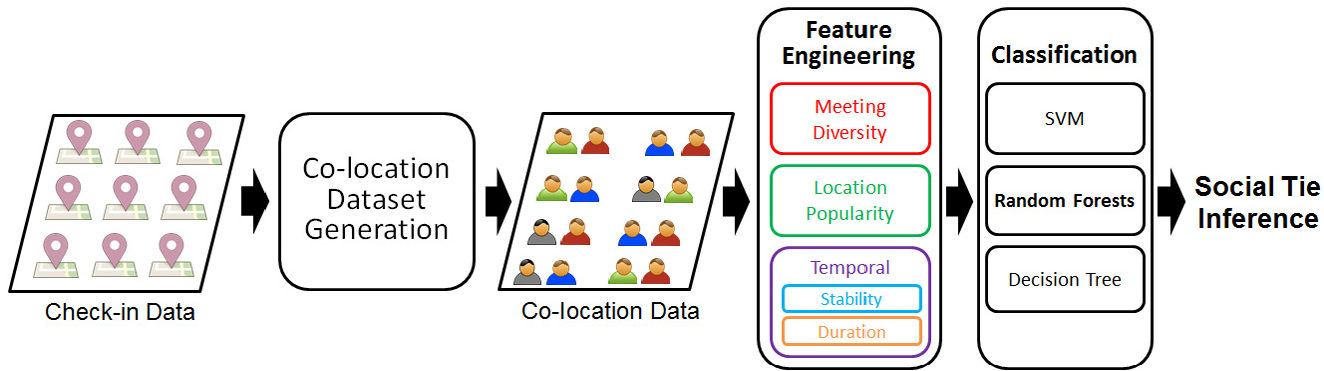 Figure 1: The SCI Framework workflow, from check-in data to Random Forest classification.
Experiments and Insights
The team tested SCI on three major LBSN datasets. The results were clear: Temporal features are the "secret sauce."
- The Weekend Effect: The study found that while weekend data is smaller in volume, it contains a much higher density of "social check-ins." AUC scores were consistently higher when the model focused on weekend behavior.
- Feature Importance: While "Popularity" is a strong individual predictor, the combination of "Duration" and "Stability" provides the nuance needed to separate coincidental strangers from long-term friends.
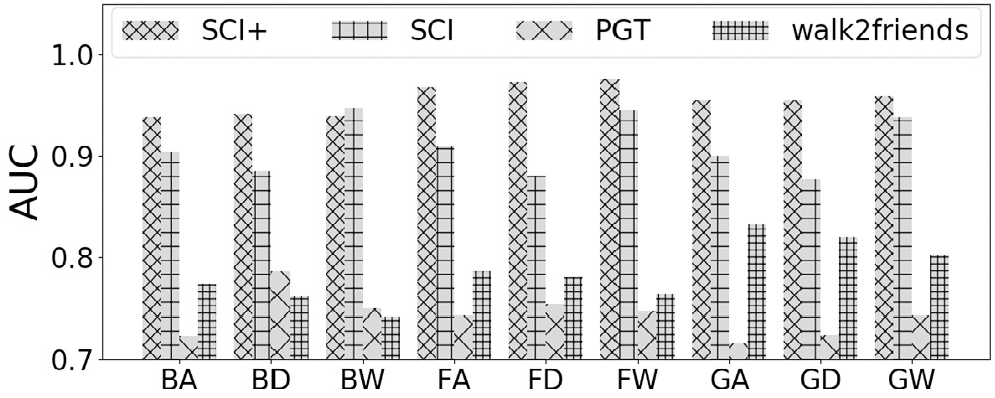 Figure 2: AUC performance of SCI vs. Prior SOTA (PGT and walk2friends). SCI shows a dominant lead across all datasets.
Critical Analysis & Conclusion
Takeaway
The SCI framework demonstrates that social ties are etched into our spatiotemporal patterns. The introduction of "Stability" and "Duration" turns raw location pings into a story of human relationship evolution.
Limitations
- Check-in Bias: People often check in to "brag" or get rewards, meaning the data doesn't represent 100% of their life—only the "public" parts.
- Privacy: As social inference becomes more accurate, the "anti-social" or privacy-preserving side of this technology must be developed to protect users from unwanted link discovery.
Future Work
The authors suggest that future models could integrate Location Categories (e.g., "Home" vs "Work") and Sequential Patterns (the order of visits) to further refine the "Friend vs Stranger" boundary.