
p-PLIERS: Revolutionizing Content Discovery in Infrastructure-less Social Networks
Pervasive and mobile computing
This paper introduces p-PLIERS, a decentralized, tag-based recommender system designed for Pervasive Social Networks (PSNs). It leverages the PLIERS algorithm to provide highly personalized content discovery in opportunistic environments, achieving SOTA accuracy by exploiting the full tripartite relationship of users, items, and tags.
Executive Summary
TL;DR: The exponential growth of mobile data has created a "needle in a haystack" problem for users in crowded areas where cellular networks often fail. This paper presents p-PLIERS, a fully decentralized framework that turns your mobile device into an intelligent content filter. By swapping "knowledge graphs" during brief physical encounters, p-PLIERS provides recommendations as accurate as a centralized server without ever needing an internet connection.
Academic Positioning: This work bridges the gap between Tag-based Recommender Systems and Opportunistic Computing. It moves beyond simple "keyword matching" to a sophisticated graph-diffusion model that understands the physical and semantic context of pervasive social interactions.
The Problem: The "Standard Recommendation" Paradox
Current mobile recommendation systems face a double-edged sword:
- Centralization Dependence: They require consistent cloud access, which fails in high-density events (stadiums, conferences) or "off-grid" urban zones.
- The Popularity Bias: Existing algorithms like ProbS only recommend "trending" items (too generic), while others like HeatS focus on niche items (too specific).
In a Pervasive Social Network (PSN), your "context" is defined by who you pass on the street and what they share. Mapping these fleeting connections into a semantic recommendation model is the core challenge.
Methodology: Tripartite Diffusion & Local Knowledge
The "secret sauce" of p-PLIERS lies in its ability to solve the popularity dilemma using a Tripartite Graph (Users-Items-Tags).
Instead of just looking at what your friends liked, p-PLIERS calculates two distinct metrics:
- Affinity Index: How close is this item to your personal history?
- Similarity Index: How semantically related are the tags of this item to your interests?
The Decentralized "Handshake"
When two nodes meet, they don't just swap files; they swap their Local Knowledge Graphs (LKG).
- Encounter: Node A and B detect proximity.
- Merge: Each node integrates the other's LKG into its own.
- Reason: The PLIERS algorithm runs locally to score new items.
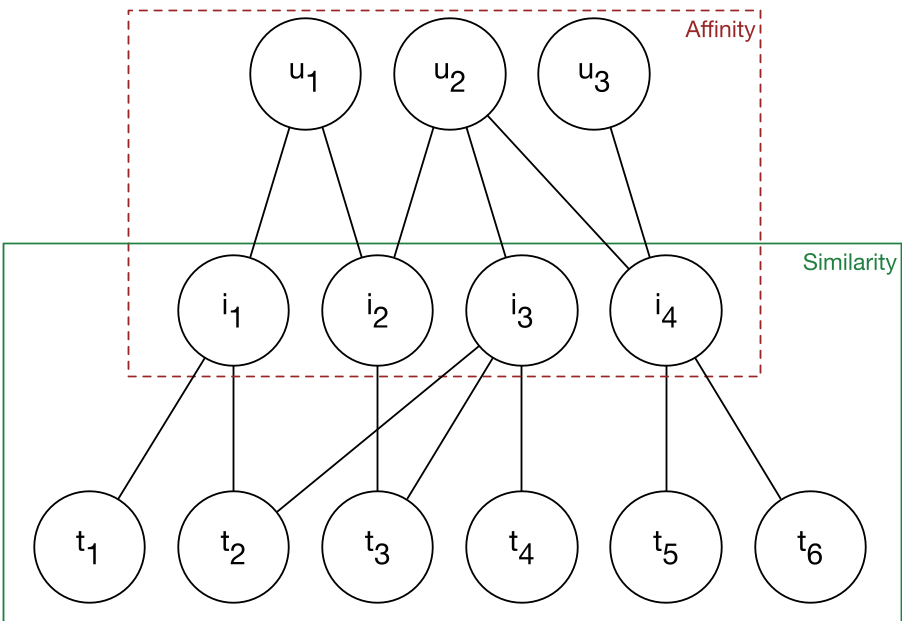 Figure: The p-PLIERS framework for local content evaluation.
Experiments: Real-World Stress Tests
The authors didn't just test this in a lab; they used real-world data from Twitter and mobility traces from:
- Expo 2015: A massive crowd scenario in Milan.
- ACM KDD Conference: A professional environment where interests are highly specific.
- Helsinki City Center: A 24-hour urban mobility simulation.
Accuracy vs. Efficiency
In terms of pure recommendation quality, PLIERS significantly outperforms classic Collaborative Filtering (CF) and Tag Expansion (TE).
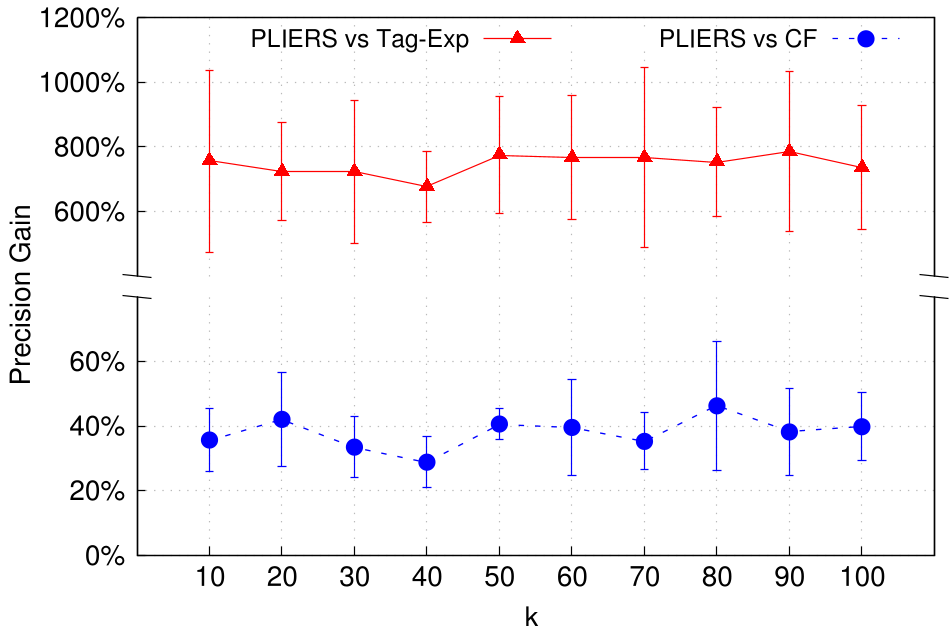 Figure: Precision/Recall gains of PLIERS over state-of-the-art baselines.
The most striking result is the Knowledge Convergence. In the Expo scenario, even with only a fraction of the total "global" knowledge, nodes achieved over 80% recommendation similarity to an omniscient global system after just 2-3 hours of movement.
Critical Analysis & Conclusion
Takeaway: p-PLIERS proves that "Local is Good Enough." You don't need to know everything in the world to find the one tweet or video that matters to you in your current physical space.
Limitations:
- Storage/Privacy: Exchanging LKGs could potentially leak user interest history, though the authors focus on the technical feasibility rather than the privacy layer.
- Device Heterogeneity: The resource-saving claims are strong, but the actual battery impact of frequent graph merging on older hardware remains an area for future exploration.
Future Outlook: As we move toward 6G and Edge Intelligence, the p-PLIERS framework offers a blueprint for how "Smart Cities" can operate autonomously during infrastructure failures or in hyper-local social scenarios.
For the full mathematical derivation of the PLIERS resource vector , refer to Section 3 of the original Arnaboldi et al. (2016) paper.