
Beyond Connectivity: An Information-Theoretic Framework for Opportunistic Social Networks
Pervasive and mobile computing
This paper introduces a novel information-theoretic mathematical framework for similarity-based opportunistic social networks. It proposes Generalized Probability Mass Function (PMF) profiles and introduces the "Vectorized Cosine" (VCOS) metric to quantify user similarity, ultimately establishing fundamental limits for knowledge sharing through concepts like Knowledge Gain (KG) and Knowledge Limit (KL).
TL;DR
This research pioneers a mathematical bridge between information theory and social networking. By treating user behavioral profiles as probability distributions and knowledge as entropy, the authors define the "Knowledge Limit"—the maximum information a user can harvest from social encounters. They demonstrate that while simple social encounters are fleeting, a "Forward Mine Plus Others" strategy can theoretically capture the entire collective wisdom of a network, even when users are rarely in direct contact.
The "Knowledge" Bottleneck in Mobile Societies
Mobile Opportunistic Networks (MONs) have long relied on the "Store-Carry-Forward" paradigm, but they lacked a rigorous way to measure the quality of an encounter. Why should two people exchange data? Previous SOTA mostly looked at geographic proximity ("Are they in the same room?"). This paper argues that Similarity is the true engine of opportunistic services.
The problem is that declaring two users "similar" is harder than it looks. Non-temporal snapshots (what you like right now) are often misleadingly optimistic. If you and I both use a travel app, we look similar. But if I use it at 8 AM for commuting and you use it at 10 PM for vacation planning, our "temporal dynamics" reveal we share little in common.
Methodology: Entropy as a Yardstick for Success
The authors propose a radical shift: modeling user interests (Digital Footprints) as Probability Mass Functions (PMFs).
1. Vectorized Cosine (VCOS)
To solve the computational heaviness of SVD-based similarity, the authors propose VCOS. By flattening a temporal profile matrix (Days Categories) into a single high-dimensional vector, they capture temporal patterns with linear complexity.
2. The Information-Theoretic Engine
If a user's interests follow a distribution , their "Knowledge" is defined by the Entropy . When two similar users and meet:
- Knowledge Gain: , the unique info has that doesn't.
- Overhead: , the redundant info both already know.
 Fig 1: The vision of Opportunistic Recommendation Systems (ORS).
Reaching the Fundamental Limits
The most profound contribution is the definition of the Knowledge Limit (KL). For a user in a group of similar users:
Through mathematical proof, the authors demonstrate a critical trade-off:
- SMO (Send Mine Only): Simple but inefficient. In multi-hop networks, your knowledge is capped by your immediate neighbors.
- FMPO (Forward Mine Plus Others): By acting as a "knowledge relay," a user can achieve their full KL almost surely, even with sparse connectivity, provided they have enough time (delay tolerance).
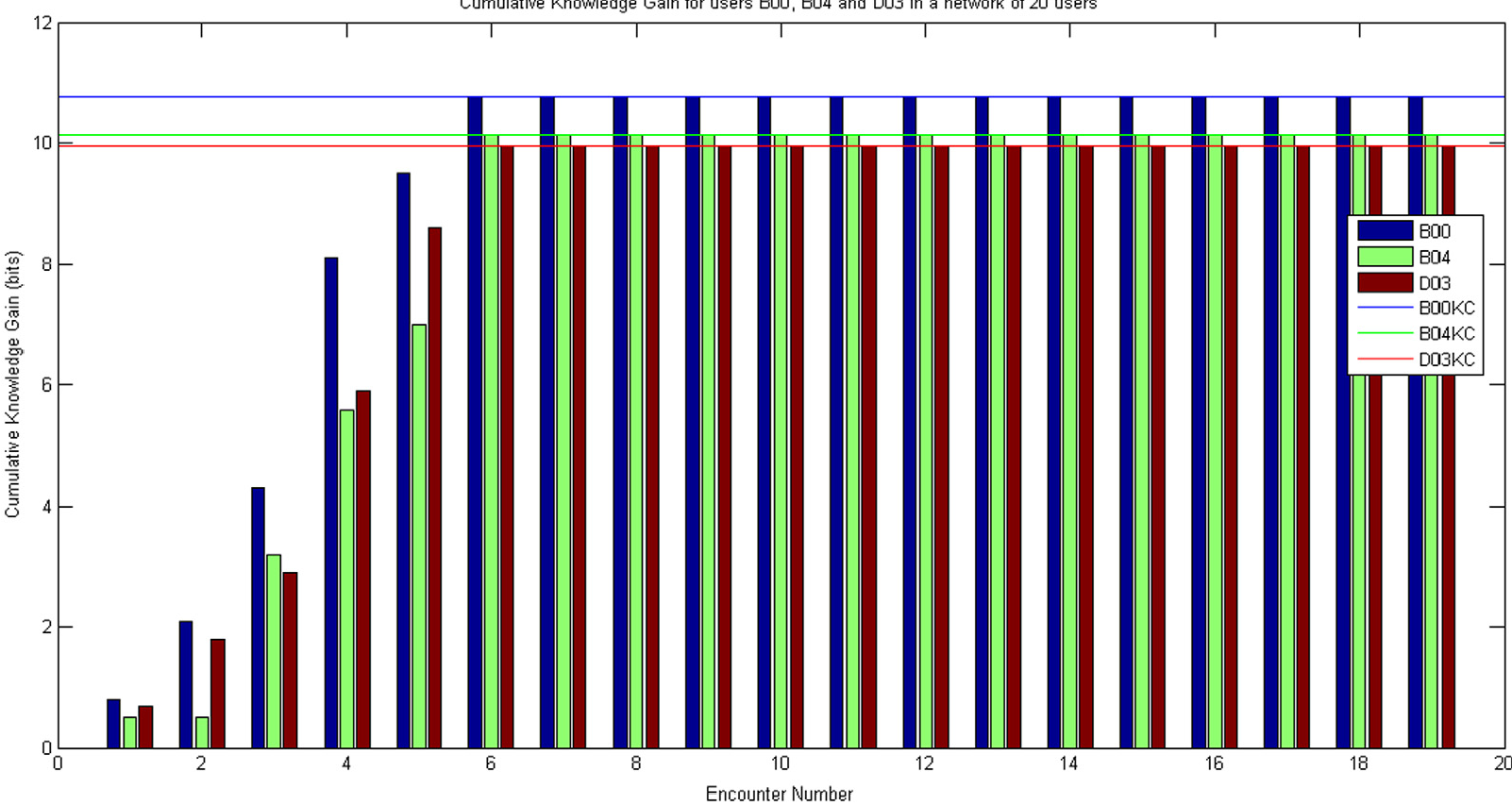 Fig 2: Cumulative Knowledge Gain over time. FMPO (Forwarding) allows users to hit the theoretical Knowledge Limit (KL) plateau rapidly.
Key Insights & Experimental Validation
Using the LiveLab (iPhone usage) and Infocom 2005 (iMote proximity) datasets, the study reveals:
- Temporal conservatism: Temporal metrics like SVD and VCOS are "tougher graders." They reduce the number of users declared similar by up to 80% compared to basic Cosine similarity, preventing useless data exchanges.
- Mobility as a Catalyst: In mobile scenarios, even if you never meet a "knowledge hotspot" (a person with tons of info) directly, you can still reach your KL via intermediate encounters. Mobility effectively "mixes" the entropy of the network.
Critical Analysis & Future Outlook
While the information-theoretic approach is elegant, it assumes that "tips" follow the same distribution as the "user profile." In real-world scenarios, a user might have deep knowledge in a category they rarely browse (e.g., a professional accountant browsing sports).
Takeaway: This paper moves the needle from "can we connect?" to "is it worth connecting?" For future D2D and IoT systems, the Knowledge Limit provides a North Star for designing routing protocols that optimize for information value rather than just byte delivery.
Limitations
- Trust & Privacy: The framework assumes trust is established. In reality, exchanging PMF profiles could lead to de-anonymization.
- Assumed Distribution: The alignment between interest PMFs and actual "tip" databases needs more empirical validation.
Editor's Note: This work effectively quantifies the "social potential" of mobile devices, transforming abstract social links into a calculable information-theoretic resource.