
CAMEO: Bridging the Gap Between Physical and Virtual Social Networks
Pervasive and mobile computing
This paper introduces CAMEO, a light-weight context-aware middleware designed for Opportunistic Mobile Social Networks (MSNs) on Android. It leverages a multidimensional "well-being context" to optimize real-time social interactions and content dissemination in environments with intermittent connectivity.
TL;DR
CAMEO is a novel context-aware middleware for Android that powers Opportunistic Mobile Social Networks (MSNs). Unlike traditional social networks that rely on persistent internet connections, CAMEO uses local device-to-device communication, multidimensional context reasoning, and "traveler nodes" to share content across physical communities. It significantly outperforms previous SOTA frameworks like Haggle and Yarta in speed and resource efficiency.
The Evolution of Context: From Location to "Well-being"
The primary motivation behind CAMEO is the convergence of the Cyber-Physical World (CPW). Traditional context-awareness focused on simple parameters like GPS coordinates. However, for a mobile social network to feel "organic," it needs to understand Social-Awareness.
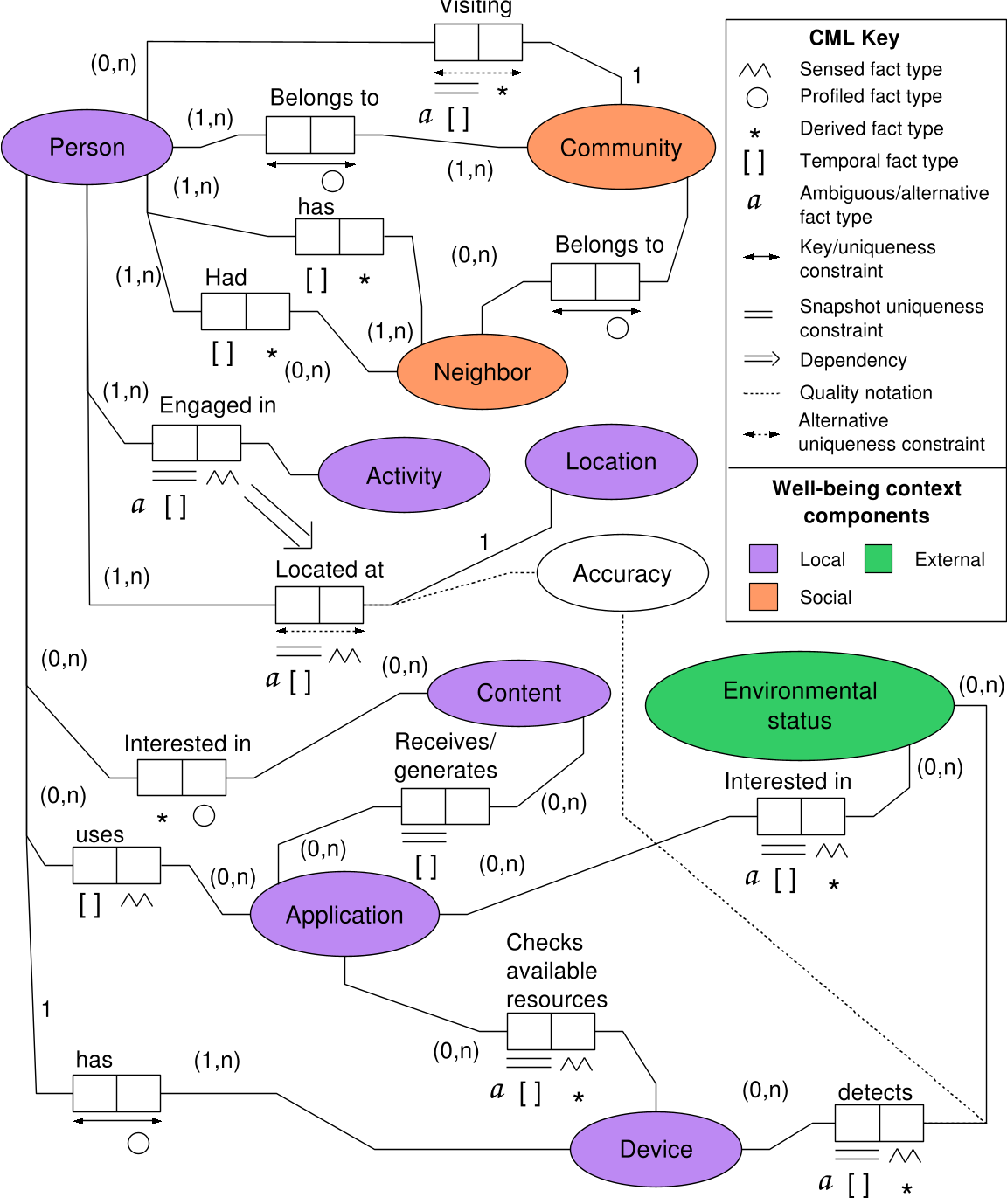
The authors argue that existing solutions are either too centralized (relying on cloud servers) or too narrow (only looking at virtual social ties). CAMEO introduces the "Well-being Context", a three-pillared model:
- Local Context: User profile, hardware resources, and application-specific needs.
- External Context: Data from environmental sensors or remote monitoring services.
- Social Context: Real-time identification of physical community membership and historical contact patterns.
Methodology: The Core of CAMEO
The technical brilliance of CAMEO lies in how it handles the Intermittent Connectivity problem. In an opportunistic network, you might only see another node for a few seconds as you pass them on the street.
1. Light-weight Context Modeling (CML)
Instead of heavy Ontological models (which are computationally expensive to reason with on mobile), CAMEO uses Context Modeling Language (CML). This object-role-based model allows for efficient SQL-like queries while supporting "uncertain" logic—essential when dealing with stale or incomplete sensor data.
2. Physical Community Detection
CAMEO detects when a user moves from one community (e.g., "Home") to another (e.g., "Tourist Attraction") using a majority-voting algorithm based on Bluetooth/WiFi beacons from neighbors.
3. Utility-Based Content Ferrying
The most impactful feature is the Utility Function. When a "Traveler Node" moves between communities, CAMEO calculates the utility of available local content () against the interests of nodes it met previously. If the utility is high, the node preemptively downloads the content to "carry" it to the other community.
Performance: Crushing the Baselines
The researchers validated CAMEO using a testbed of Google Nexus One devices. The results were categorized into three critical metrics:
- Context Retrieval: CAMEO retrieved 1000 node contexts in under 6 seconds, while Yarta took over 90 seconds for just 100 nodes.
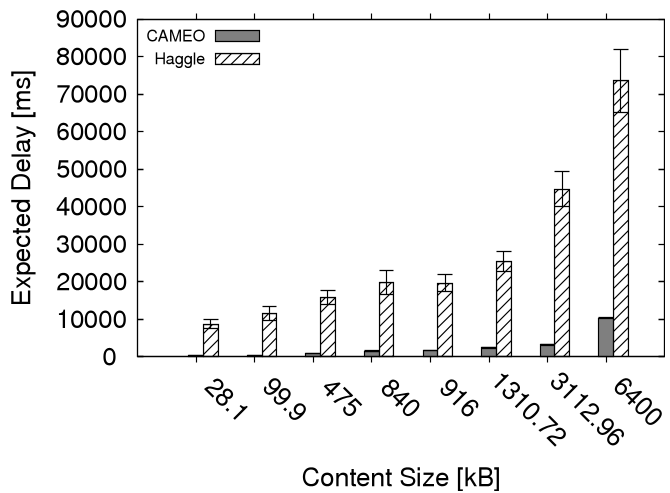
- File Transfer Latency: Compared to the Haggle project—the previous gold standard for opportunistic networking—CAMEO was 7 times faster for large files (6.4 MB).
- Process Efficiency: The core service uses only ~6MB of RAM, making it feasible for the background-execution constraints of Android.
Case Study: Tourist-MSN
To prove practical value, the authors built Tourist-MSN, an application where tourists share "Posts" (tips about long lines at the Colosseum) and participate in "Opportunistic Chats" with local strangers. The middleware handles all the complex networking and interest-matching in the background.

Final Insights
CAMEO succeeds because it acknowledges a physical reality: our social interactions are local and context-dependent. By treating mobile devices as proxies for their owners' social behavior, CAMEO enables a "collective awareness" that doesn't need to check in with a central server.
Limitations: The current implementation requires "root" access for WiFi ad-hoc mode on older Android versions, though the authors are moving toward WiFi Direct to solve this. Future work also needs to integrate probabilistic learning to better predict where a "traveler" might go next.
Takeaway: This is a blueprint for the next generation of "off-grid" social apps and opportunistic computing services.