
Signals of Persuasion: How Mobile Sensors Uncover the Invisible Spread of Political Opinions
Pervasive Sensing to Model Political Opinions in Face-to-Face Networks
2011-01-01
Summary
Problem
Method
Results
Takeaways
Abstract
This paper introduces a pervasive sensing framework using mobile phone sensors (Bluetooth, WLAN, Call/SMS) to model the diffusion of political opinions in a real-world social network of 67 undergraduates during the 2008 US election. By quantifying face-to-face proximity and communication, the authors successfully predict individual political opinions on election day and uncover hidden behavioral routines associated with opinion shifts.
## TL;DR
Researchers from MIT and IDIAP utilized smartphone sensors to track the face-to-face interactions of college students during the 2008 US Election. They discovered that **physical proximity is a better predictor of your political vote than who you claim your friends are.** By analyzing "Dynamic Homophily" and using LDA topic models, the team successfully identified behavioral "routines" that precede a change in political heart.
## The Crisis of Memory in Social Science
For decades, understanding how ideas spread relied on a shaky foundation: human memory. Studies show that people are **30-50% inaccurate** when recalling who they talked to and for how long. This "informant inaccuracy" makes it nearly impossible to model the tiny, daily social nudges that lead someone to change their political party or interest level.
The authors of this paper argue that we don't need better surveys; we need better sensors. By turning the mobile phone into a "sociometer," they captured 132,000 hours of social interaction data, moving social science from retrospective snapshots to continuous, real-time observation.
## Methodology: The Social Microscope
The study focused on 67 residents of an undergraduate hall. The technical stack involved:
* **Bluetooth Proximity**: Scanning every 6 minutes to detect people within a 10-foot radius.
* **WLAN Access Points**: Mapping movement patterns and indoor location.
* **Communication Logs**: Call and SMS metadata (hashed for privacy).
* **Opinion Surveys**: Monthly ground-truth labels on political leanings.
### Defining "Exposure"
The core of their analysis is the **Exposure Formula**, which weights an individual's contact with others by those others' self-reported opinions.

This allowed the researchers to create a "daily dose" of political influence for every participant, visualizing how much "Democratic" vs. "Republican" influence a person absorbed through their skin each day.
## Key Insight 1: Dynamic Homophily
The paper measures **Dynamic Homophily ($H(t)$)**—the tendency to huddle with like-minded people. Interestingly, this isn't a static trait. The researchers found that during major external shocks—like the Presidential Debates or Election Day—the community's "interaction gap" narrowed. People actively sought out those who agreed with them, a phenomenon the sensors captured as significant "dips" in the homophily index.
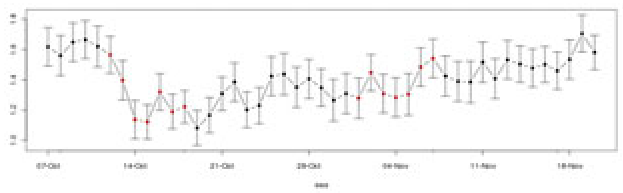
*Significant homophily effects were observed particularly among freshmen, who were still in the volatile stage of network formation.*
## Key Insight 2: Predicting the "Pivot" with Topic Models
Why do some people change their minds while others stay firm? The authors used **Latent Dirichlet Allocation (LDA)**—usually used for finding topics in text—to find "topics" in behavior.
They discovered distinct daily routines for those who shifted their views:
1. **The Change Agents**: People who changed their party preference showed heavy face-to-face interaction with "political discussants" who were *not* necessarily their close friends. They also had significantly higher SMS and phone activity.
2. **The Apathy Loop**: People who lost interest in politics were routinely "exposed" to peers who also had zero interest. This provides empirical evidence for **social dampening**.
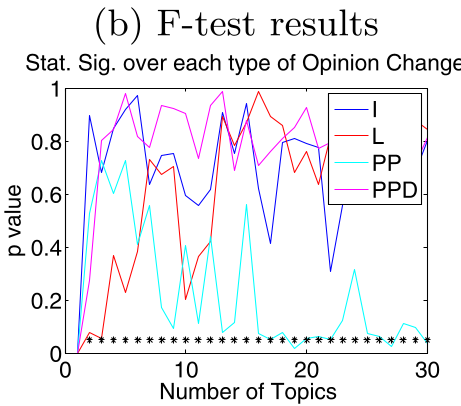
*Entropy analysis of topic distributions showing statistically significant differences between those who changed opinions and those who did not.*
## Critical Analysis & Professional Perspective
This work is a landmark in **Reality Mining**. Its primary contribution is proving that "Passive Sensing" is superior to "Active Reporting." While the R² of 0.8 is impressive, the study has limitations:
* **Media Gap**: It does not account for the "Echo Chamber" effect of television or the internet.
* **Contextual Ambiguity**: Bluetooth proximity doesn't guarantee a conversation occurred (e.g., two people sleeping in adjacent rooms).
However, the implication for the future of "Pervasive Sensing" is clear: our devices know our social trajectory better than we do. As we move toward 2026, the integration of GPS and more sophisticated AI (like the LDA approach used here) will likely allow researchers to predict large-scale shifts in public sentiment weeks before they appear in traditional polls.
## Takeaway
Your daily physical environment—the "face-to-face network"—is the silent architect of your opinions. If you want to know what someone will believe tomorrow, look at who they are standing next to today.