
PET: Decoding the Synergy of Networks and Text in Popular Event Tracking
PET: A Statistical Model for Popular Events Tracking in Social Communities
The paper introduces PET (Popular Events Tracking), a novel statistical model designed to track the popularity and content evolution of events in social communities. By coupling a Gibbs Random Field for modeling network influence with a mixture topic model for textual analysis, PET achieves SOTA performance in tracking event trajectories across platforms like Twitter and DBLP.
TL;DR
Popular Event Tracking (PET) is a unified statistical framework that solves a long-standing problem in social media analytics: how to track the evolution of an event by simultaneously looking at what people are saying and who they are talking to. By combining Gibbs Random Fields with Topic Modeling, it captures the "interest" of users as a dynamic variable influenced by their history and their social circle.
Background & Positioning
In the era of Web 2.0, events like a movie release or a political scandal don't just happen; they diffuse, evolve, and die within complex social networks. Most prior work (SOTA at the time) treated this as either a pure text mining problem (burst detection) or a pure graph problem (contagion models). PET positions itself as a bridge, arguing that the social network provides the "context" and "influence" that dictates how textual topics fluctuate.
The Core Intuition: The "Interest" Molecule
The researchers identified three key observations that drive event dynamics:
- Homophily & Influence: Your interest is shaped by your friends, and similar interests lead to new connections.
- Temporal Consistency: Your interest today is highly correlated with your interest yesterday.
- Content Manifestation: The more interested you are, the more "event-related" keywords you produce.
Methodology: Coupling Graphs and Words
PET manages two streams: a Network Stream (who follows whom) and a Document Stream (the actual posts).
1. The Interest Model (Gibbs Random Field)
The model calculates a hidden "interest level" for every user. This is defined by an energy function that penalizes deviations from two things:
- The user's previous interest (Consistency).
- The "consensus" interest level of their neighbors (Social Influence).
2. The Topic Model (Mixture Model)
Once the interest level is determined, it informs the generation of text. Every word a user writes is modeled as a choice between a Global Background Model (common words) and the Dynamic Event Topic (keywords related to the event).
 Note: The model iterates between estimating topic distributions and interest levels via an EM algorithm.
Experimental Battleground: Twitter and DBLP
The authors tested PET against several heavyweight baselines, using real-world "Gold Standards" like Movie Box Office (BOM) data and Google Insights.
Performance Highlights
- The "Avatar" Case Study: PET successfully tracked the spike in interest during the movie's North American release, showing a much higher correlation with actual box office numbers than text-only models.
- Smoothing Local Noise: Unlike models that only count keywords (which can be spiked by a single "loud" user), PET uses the network to "smooth" the signal. If a user tweets about an event but has zero followers and no history of interest, PET correctly discounts this as local noise.
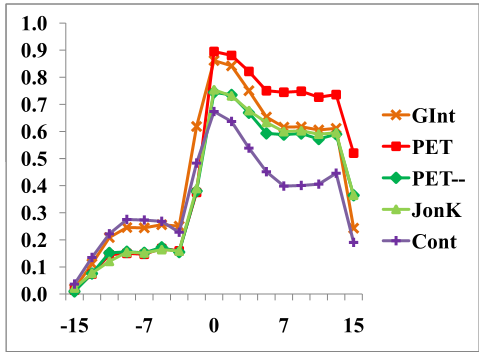 The figure shows PET (red/solid) tracking significantly closer to the gold standard trends in various news and movie events.
Deep Insight: Why it Works
The "secret sauce" is Equation 15 and 17 in the paper—the cubic function for parameter estimation. By casting the problem as an optimization that balances text likelihood against network energy, the model allows the "social graph" to act as a prior for the "textual evidence."
In scenarios where text is sparse (e.g., a day where a user doesn't tweet), the interest level doesn't just vanish; it is "sustained" by the user's neighborhood. This makes PET far more resilient than standard Topic Models like PLSA or LDA in high-sparsity environments.
Limitations & Future Outlook
While PET is powerful, it currently requires a "primitive topic" (keywords) to start the tracking. Future iterations could integrate unsupervised event discovery to find the event first and then track it. Additionally, the current model assumes a single event; extending this to "competitive events" (e.g., two movies released on the same day) would be a groundbreaking next step.
Summary Takeaway
PET reminds us that in digital communities, no user is an island. Tracking "what is popular" is a multi-dimensional task where the structure of the community is just as important as the words being spoken.